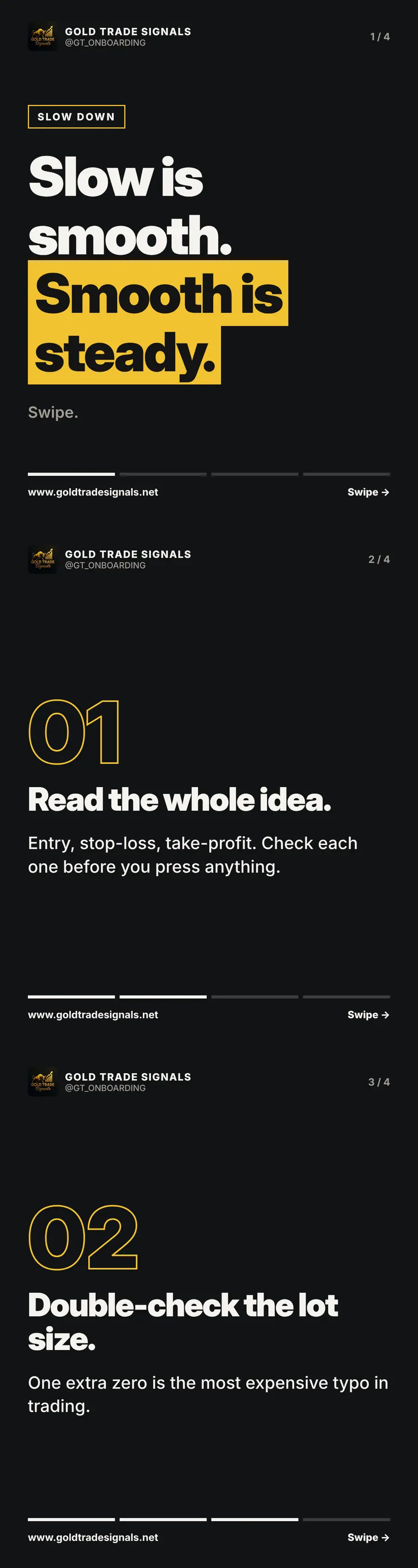
Slow is smooth, and smooth is steady. The saying comes from people whose mistakes have serious consequences, and it applies neatly to trading. Most costly errors are not bad analysis. They are a wrong lot size, a missed stop-loss or a buy pressed instead of a sell, all in a hurry.
Read the whole idea
A complete trade idea has three parts: an entry, a stop-loss and a take-profit. Before you press anything, check each one. Is the entry near the current price or is it a pending level? Is the stop-loss on the correct side of the entry? Is the take-profit realistic for the time of day? Ten seconds of reading saves a lot of regret.
The urge to rush usually comes from fear of missing the move. In reality, if an idea only works when entered in the next five seconds, it was not a robust idea. Every trade idea we share lays out all three levels so there is nothing to guess, and a trade that has already run past its entry is one to let go.
Double-check the lot size
An extra zero is the most expensive typo in trading. Typing 1.0 instead of 0.10 makes the position ten times bigger than planned, and on gold that means a normal move becomes a serious loss within minutes. Platforms will happily accept the order if your margin allows it, with no warning that you probably meant something smaller.
Make lot size the last thing you look at before confirming, every single time, even when you have done it a thousand times. Many of our members set a fixed lot size and never change it, which removes the problem entirely. Trading carefully is not slow in the long run. It is what keeps you trading.
Key takeaways
- Check entry, stop-loss and take-profit before pressing anything.
- A move you have to rush into is a move to let go.
- Confirm the lot size last, every single time.
Common questions
What are the most common beginner trading mistakes?
Entering the wrong lot size, forgetting the stop-loss, and rushing into a trade after the entry level has already passed.
How do I avoid lot size mistakes in MT5?
Use a fixed lot size for every trade and make it the last field you check before confirming the order.
Trade ideas with the levels already worked out
Join the free community and receive XAU/USD trade ideas with entry, stop-loss and take-profit, live training on Tuesdays and Thursdays, and support whenever you are stuck.
Join free on TelegramOpen the calculatorsRisk warning: This article is educational content, not personal investment advice. Gold is a leveraged, volatile instrument and you can lose some or all of your capital. Gold Trade Signals is not FCA regulated. Read the full risk warning.
More from Trading Around Your Life
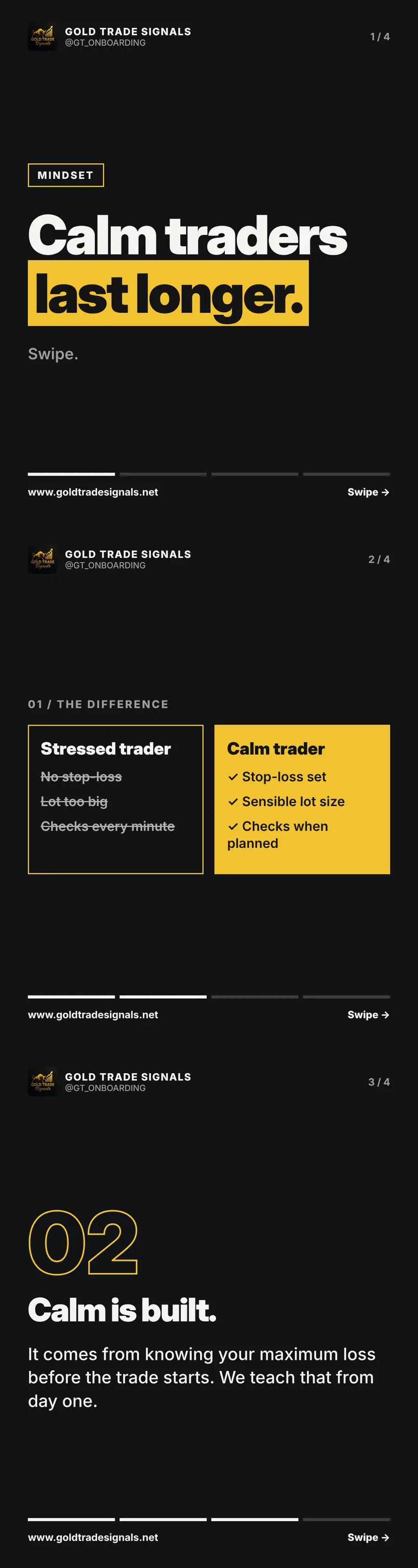
Why calm traders last longer in the gold market
Calm traders tend to survive longest, and the calm is not luck. Learn the habits that separate a stressed trader from a steady one before the trade starts.

Trade less, live more: why fewer trades often work better
More trades rarely means better trading. Why one clear, planned trade beats five rushed ones, and how a set stop-loss and take-profit give you your time back.
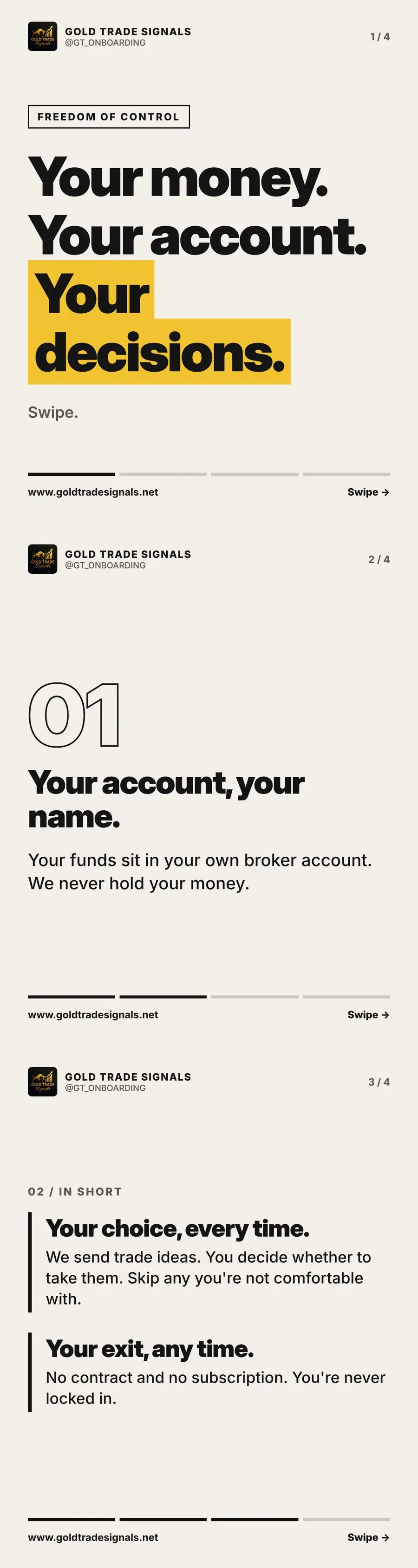
Your money, your account, your decisions
Your funds stay in a broker account in your own name, you choose which trade ideas to take, and you can leave at any time. How control stays with you.