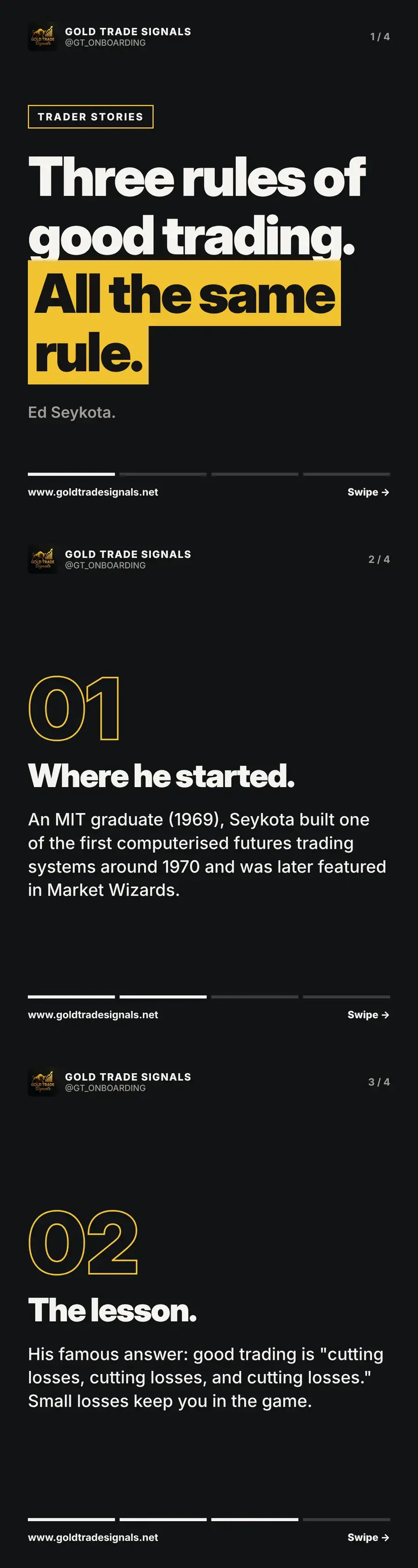
Ask Ed Seykota for the three rules of good trading and you get the same rule three times. The joke carries a serious point, and for gold traders it is the most important one there is. This article covers who Seykota is and why cutting losses sits above everything else.
Where he started
Seykota graduated from MIT in 1969 and, around 1970, built one of the first computerised futures trading systems, at a time when most trading decisions were still made by hand. He was later featured in Market Wizards, the collection of interviews with leading traders. His background is technical, but his best known lesson is about behaviour, not technology.
The lesson
His famous answer to the question of what makes good trading: "cutting losses, cutting losses, and cutting losses." Small losses keep you in the game. A trader who exits losing positions quickly can be wrong many times and still carry on. A trader who lets losses run can be right most of the time and still be finished by one trade.
What it means for a gold trader
Gold can move a long way in a short time, which makes a loss that is not cut a serious threat to an account. The practical tool is the stop-loss, set when the trade is opened and not moved further away. Every idea we send includes one. Learning to cut losses properly, and to accept them as normal, is the first skill we work on with new members.
Key takeaways
- Seykota built an early computerised trading system around 1970.
- Good trading: cutting losses, cutting losses, and cutting losses.
- Small losses keep you in the game.
Common questions
What are Ed Seykota's rules of trading?
His famous answer is that the three rules of good trading are cutting losses, cutting losses, and cutting losses.
Why is cutting losses so important in trading?
Because small losses keep you in the game. One large uncut loss can undo many good trades.
Trade ideas with the levels already worked out
Join the free community and receive XAU/USD trade ideas with entry, stop-loss and take-profit, live training on Tuesdays and Thursdays, and support whenever you are stuck.
Join free on TelegramOpen the calculatorsThe traders featured are not affiliated with, and do not endorse, Gold Trade Signals. Their results are exceptional, not typical.
Risk warning: This article is educational content, not personal investment advice. Gold is a leveraged, volatile instrument and you can lose some or all of your capital. Gold Trade Signals is not FCA regulated. Read the full risk warning.
More from Trader Stories and Habits
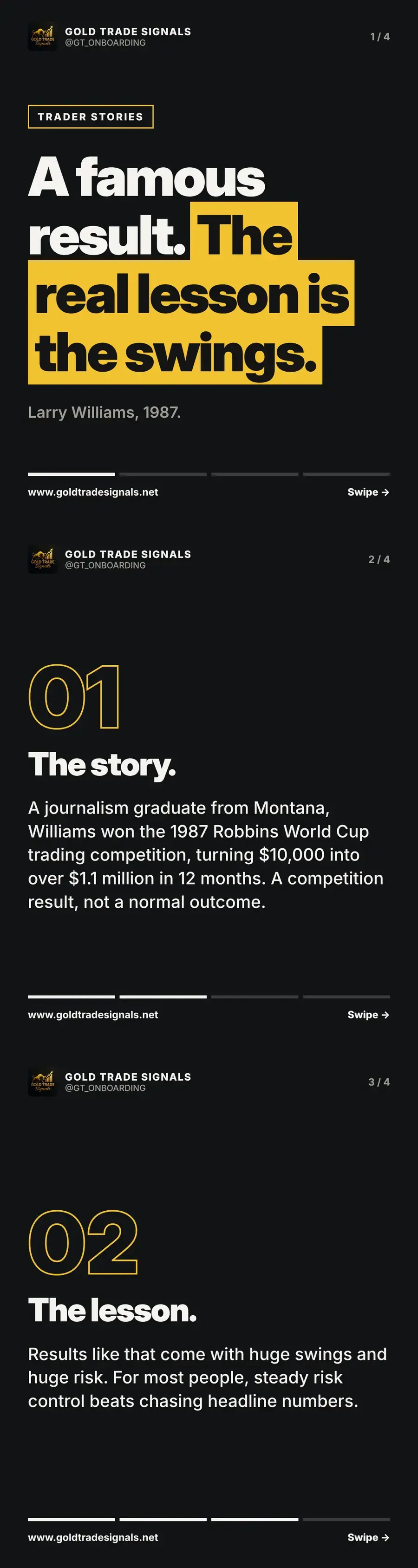
Larry Williams in 1987: the real lesson is the swings
Larry Williams won the 1987 Robbins World Cup, turning $10,000 into over $1.1 million. A competition result, not a normal outcome. The lesson is risk.
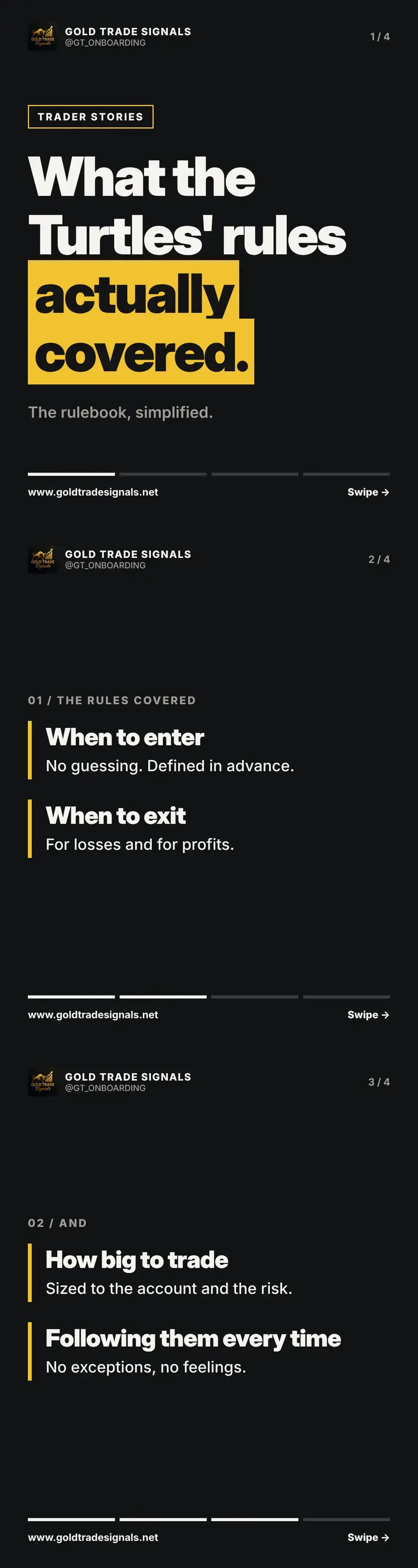
What the Turtle Traders' rules actually covered
The Turtle Traders rulebook covered four things: when to enter, when to exit, how big to trade, and following the rules. What that means for gold.
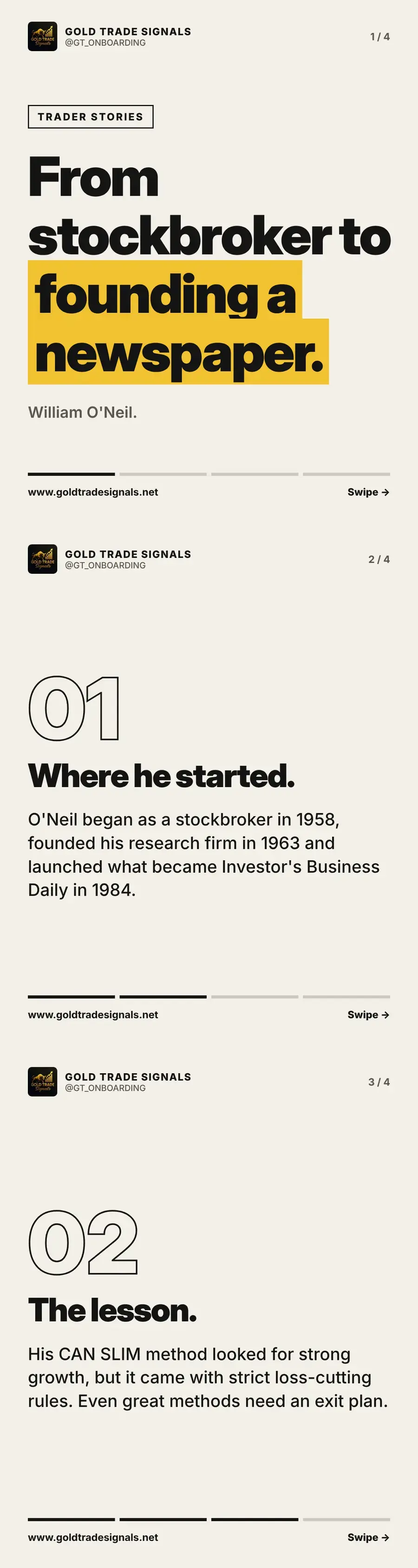
William O'Neil: from stockbroker to Investor's Business Daily
William O'Neil went from stockbroker to founding Investor's Business Daily. His CAN SLIM method had strict loss-cutting rules: a lesson for gold traders.