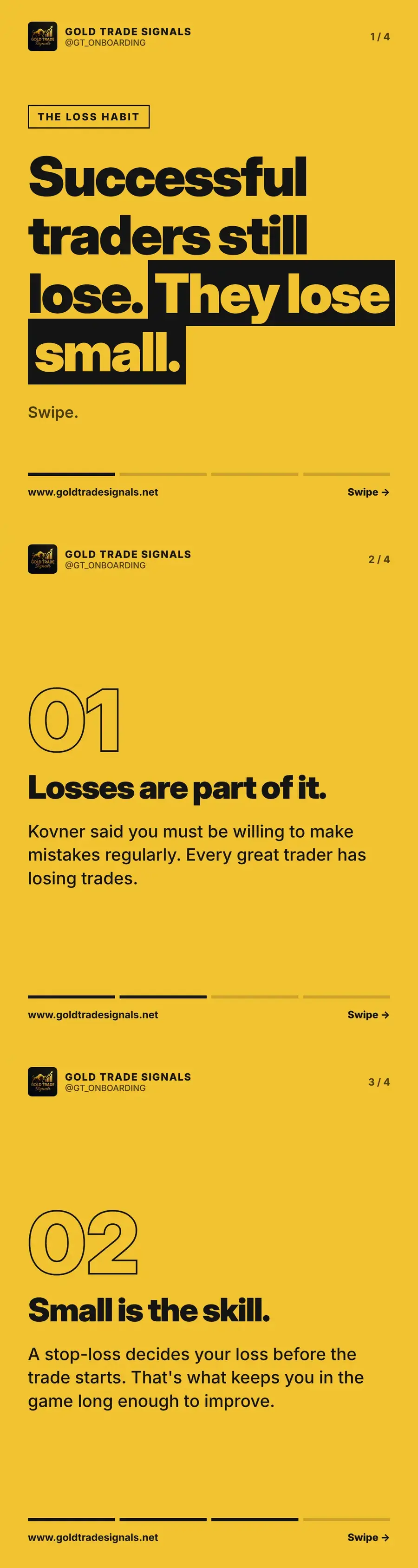
Successful traders still lose. They just lose small. That distinction is the whole game for a beginner, because losing trades are normal and big losing trades are optional. In this article we explain why even the best traders expect losses and how a stop-loss turns an unknown risk into a small, planned one.
Losses are part of it
Bruce Kovner said you must be willing to make mistakes regularly. That is not a confession of weakness from a great trader; it is a description of the job. Every great trader has losing trades, often many of them, because nobody can know in advance which setups will work. What separates them is what happens next.
For a beginner this is liberating. A losing trade on gold does not mean you did something wrong or that the idea was bad. It means the market went the other way this time, which it will do regularly. The question is never whether you will lose, but how much.
Small is the skill
A stop-loss decides your loss before the trade starts. You choose the level, you accept the amount and if price gets there the trade closes without any decision required in the moment. That is the entire difference between a small loss and a disaster: the small loss was planned.
Keeping losses small is what keeps you in the game long enough to improve. A trader who loses small can survive a bad week, learn from it and be there for the good one. Every idea we send includes a stop-loss for exactly that reason, and we spend live training teaching members to respect it. Learn to keep losses small, and everything else becomes possible.
Key takeaways
- Kovner: be willing to make mistakes regularly. Every great trader loses.
- A stop-loss decides your loss before the trade starts.
- Small losses keep you in the game long enough to improve.
Common questions
Do professional traders have losing trades?
Yes, regularly. Kovner said you must be willing to make mistakes regularly. The difference is that professionals keep each loss small and planned.
How do you keep trading losses small?
Set a stop-loss on every trade before it opens and keep your lot size consistent. The loss is then decided in advance rather than in the heat of the moment.
Trade ideas with the levels already worked out
Join the free community and receive XAU/USD trade ideas with entry, stop-loss and take-profit, live training on Tuesdays and Thursdays, and support whenever you are stuck.
Join free on TelegramOpen the calculatorsThe traders featured are not affiliated with, and do not endorse, Gold Trade Signals. Their results are exceptional, not typical.
Risk warning: This article is educational content, not personal investment advice. Gold is a leveraged, volatile instrument and you can lose some or all of your capital. Gold Trade Signals is not FCA regulated. Read the full risk warning.
More from Trader Stories and Habits
Successful traders never stop learning: study and review
Even the greats kept studying, adapting and reviewing. The two learning habits, study and review, and how a gold trader builds both into a weekly routine.
Why almost every great trader had a mentor
Marcus learned from Seykota. Kovner traded under Marcus. Why mentors change everything in trading, and how to avoid learning gold alone.
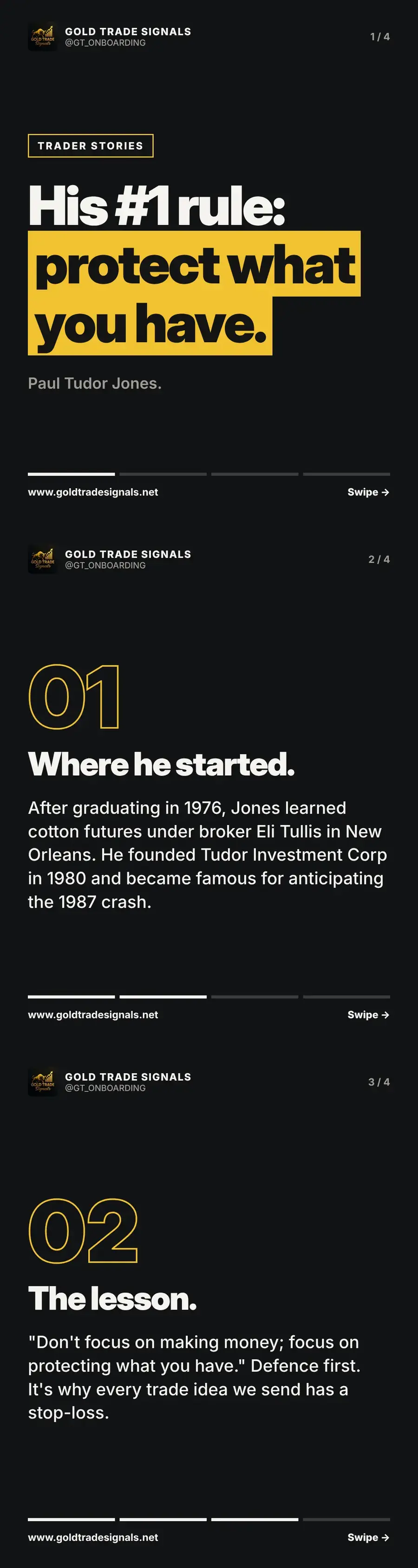
Paul Tudor Jones and his number one rule: protect what you have
Paul Tudor Jones built his reputation on defence first. Where he started, the rule he is known for, and why every trade idea we send has a stop-loss.