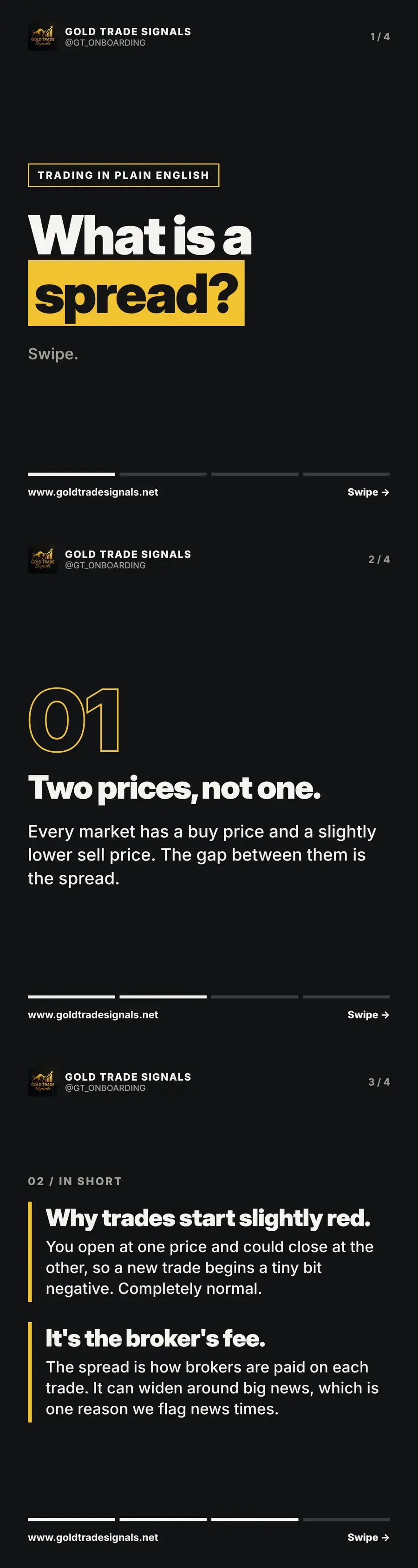
Ever noticed a new trade opens slightly in the red before the market has even moved? That is the spread at work. This guide explains what a spread is, why every trade begins a little negative, how it pays your broker and why it can widen around big news.
Two prices, not one
Every market quotes two prices rather than one. There is a buy price, called the ask, and a slightly lower sell price, called the bid. The gap between them is the spread. On a liquid market like gold it is usually small, but it is always there, and understanding it clears up one of the most common beginner confusions on day one.
Why trades start slightly red
You open a trade at one of the two prices and could close it at the other. Because the sell price sits below the buy price, a brand new trade shows a tiny negative figure the moment it opens. This is completely normal and not a sign that anything has gone wrong. The market needs to move by the width of the spread before the trade reaches break-even.
It is the broker's fee
The spread is how brokers are paid on each trade, so in most cases there is no separate commission to look for. It can widen around big news releases, when prices move quickly and liquidity thins. That is one reason we flag news times to members: a wider spread means a worse starting point and a stop-loss that can be hit more easily. If you have questions about spreads, ask us.
Key takeaways
- Every market has a buy price and a lower sell price
- The gap is the spread, so new trades start slightly negative
- Spreads widen around big news, which is why we flag news times
Common questions
Why does a trade start in negative as soon as it opens?
Because you buy at the higher price and could only sell at the lower one. The difference is the spread, and the market must move that far before the trade breaks even.
Is the spread the only cost of trading gold?
The spread is the main cost on most accounts and is how brokers are usually paid. Some brokers also charge commission or overnight fees, so check your account type.
Trade ideas with the levels already worked out
Join the free community and receive XAU/USD trade ideas with entry, stop-loss and take-profit, live training on Tuesdays and Thursdays, and support whenever you are stuck.
Join free on TelegramOpen the calculatorsRisk warning: This article is educational content, not personal investment advice. Gold is a leveraged, volatile instrument and you can lose some or all of your capital. Gold Trade Signals is not FCA regulated. Read the full risk warning.
More from Trading Basics
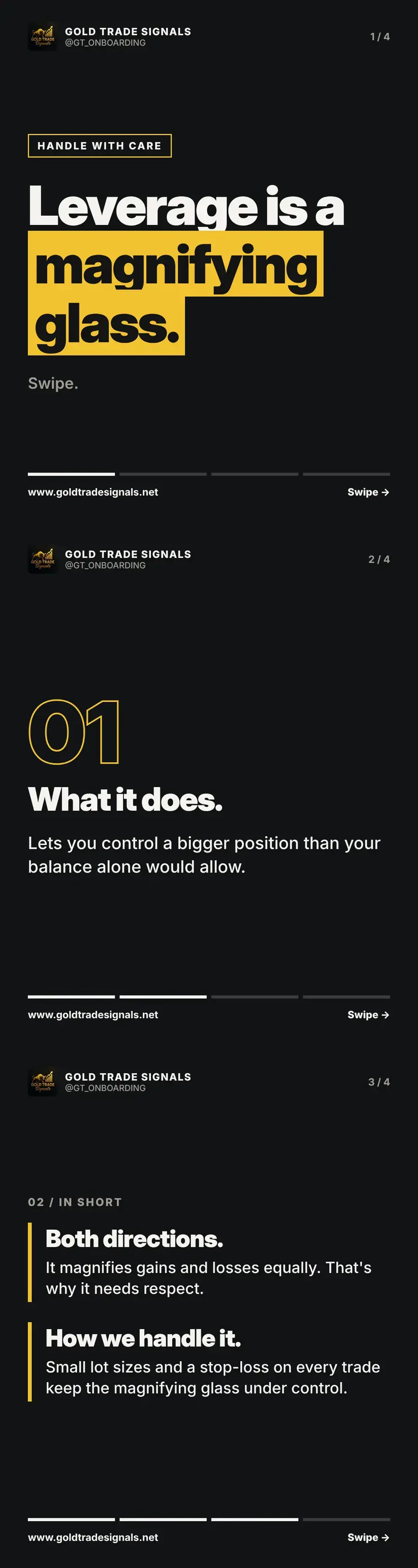
Leverage explained: why it works like a magnifying glass
Leverage lets you control a bigger position than your balance allows, and it magnifies gains and losses equally. Learn how we keep it under control.
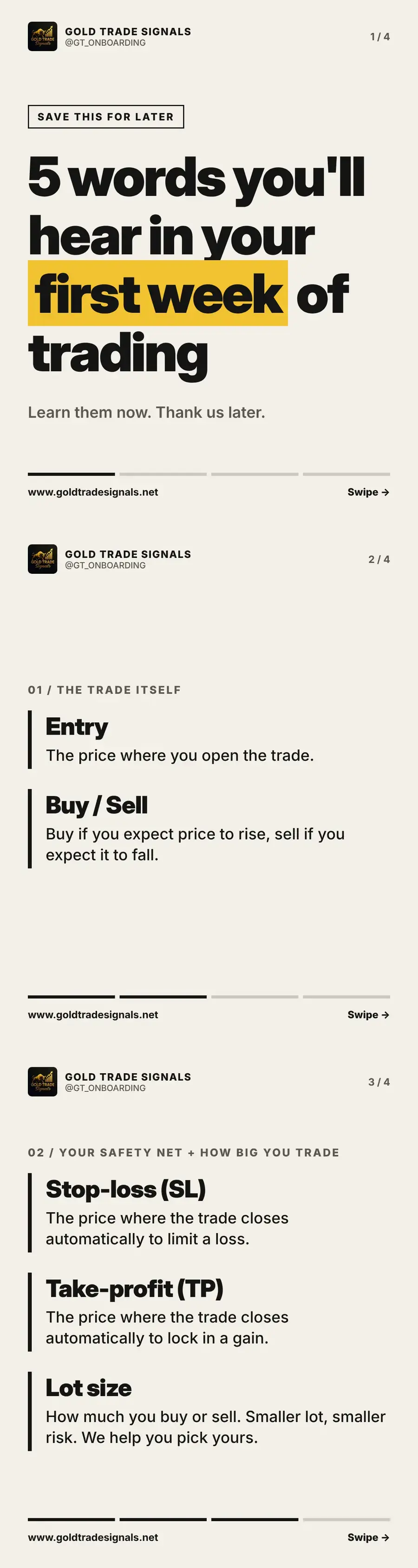
Five trading words you will hear in your first week
Entry, buy and sell, stop-loss, take-profit and lot size: the five words every new gold trader hears in week one, explained in plain English.
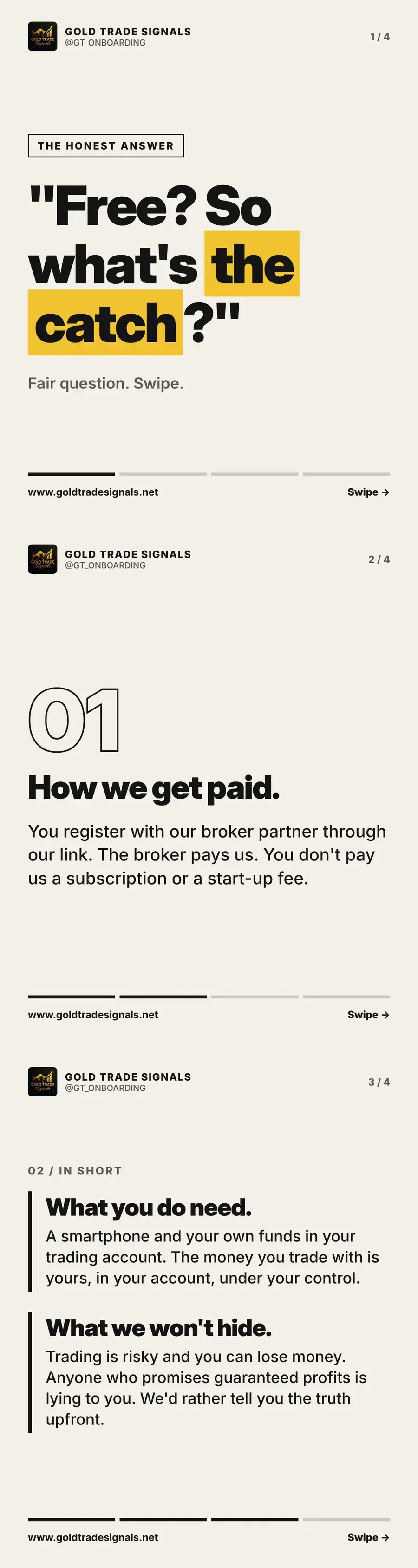
Free gold trade ideas: so what is the catch?
Our gold trade ideas are free because our broker partner pays us when you register through our link. Here is what you need, and the risks we will not hide.