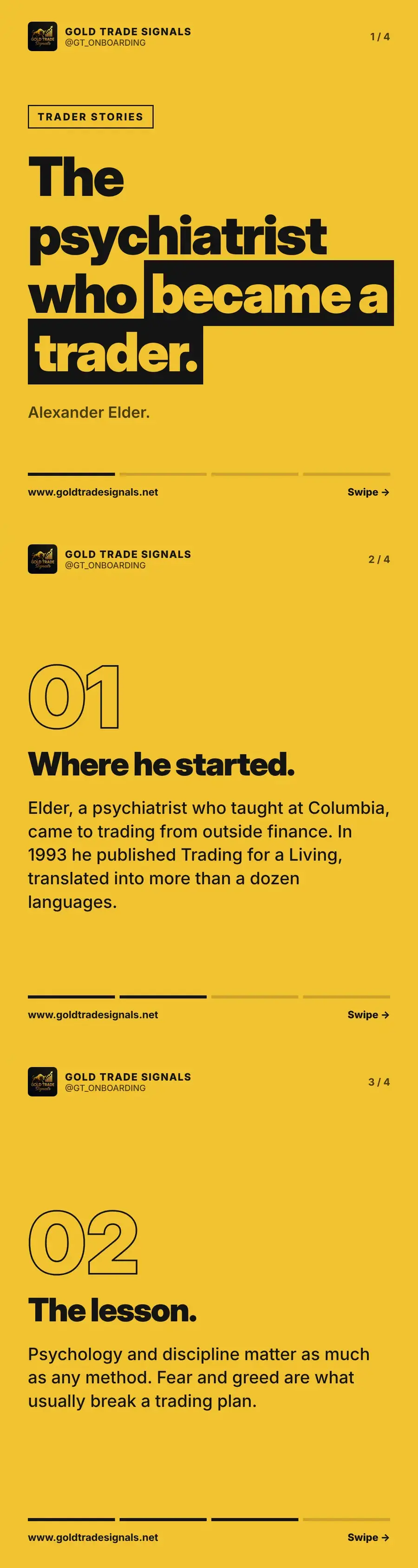
Alexander Elder came to trading from outside finance, as a psychiatrist, and that background shaped one of the best-known trading books ever written. This article covers where he started, the lesson he is remembered for, and why fear and greed are the real reason most trading plans break.
Where he started
Elder was a psychiatrist who taught at Columbia and came to trading with no background in finance. In 1993 he published Trading for a Living, which has since been translated into more than a dozen languages. What made the book different was its starting point: instead of a new indicator or system, it began with the trader's own mind, the thing a psychiatrist was uniquely placed to examine.
The lesson
Psychology and discipline matter as much as any method. Fear and greed are what usually break a trading plan: fear makes you close a good trade early or move a stop-loss, greed makes you oversize or hold past the take-profit. The method can be perfectly sound and still fail if the person running it cannot follow it under pressure. Elder is not affiliated with Gold Trade Signals, but we cover his lesson in every session.
What it means for a gold trader
Gold moves quickly, which makes it a good teacher of psychology. The fix is structure: a stop-loss and take-profit set before the trade so fear has nothing to decide, and a fixed lot size so greed has nothing to inflate. Notice what you feel when a trade goes against you, and let the rules act instead of the feeling. We cover psychology in every live training session.
Key takeaways
- Elder came to trading from psychiatry and taught at Columbia
- Trading for a Living, published in 1993, focused on the trader's mind
- Fear and greed break plans; rules remove their influence
Common questions
Who is Alexander Elder?
A psychiatrist who taught at Columbia and became a trader. In 1993 he published Trading for a Living, one of the best-known trading books.
Why does psychology matter in trading?
Because fear and greed are what usually break a trading plan. A sound method fails if the trader cannot follow it under pressure.
Trade ideas with the levels already worked out
Join the free community and receive XAU/USD trade ideas with entry, stop-loss and take-profit, live training on Tuesdays and Thursdays, and support whenever you are stuck.
Join free on TelegramOpen the calculatorsThe traders featured are not affiliated with, and do not endorse, Gold Trade Signals. Their results are exceptional, not typical.
Risk warning: This article is educational content, not personal investment advice. Gold is a leveraged, volatile instrument and you can lose some or all of your capital. Gold Trade Signals is not FCA regulated. Read the full risk warning.
More from Trader Stories and Habits
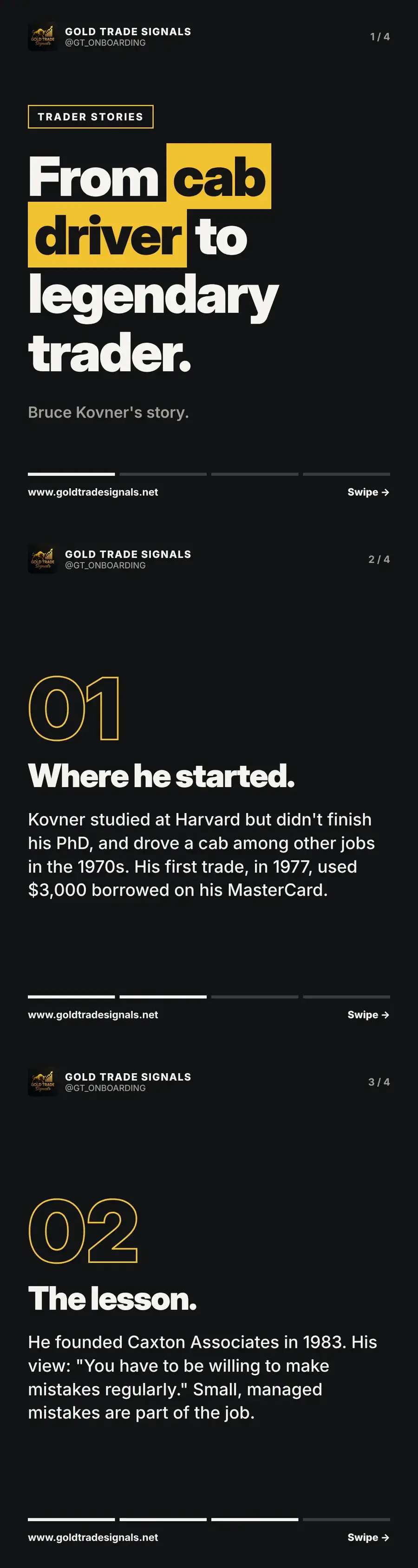
Bruce Kovner: from cab driver to legendary trader
Bruce Kovner drove a cab, made his first trade in 1977 with $3,000 borrowed on a credit card, and founded Caxton Associates. His lesson for gold traders.
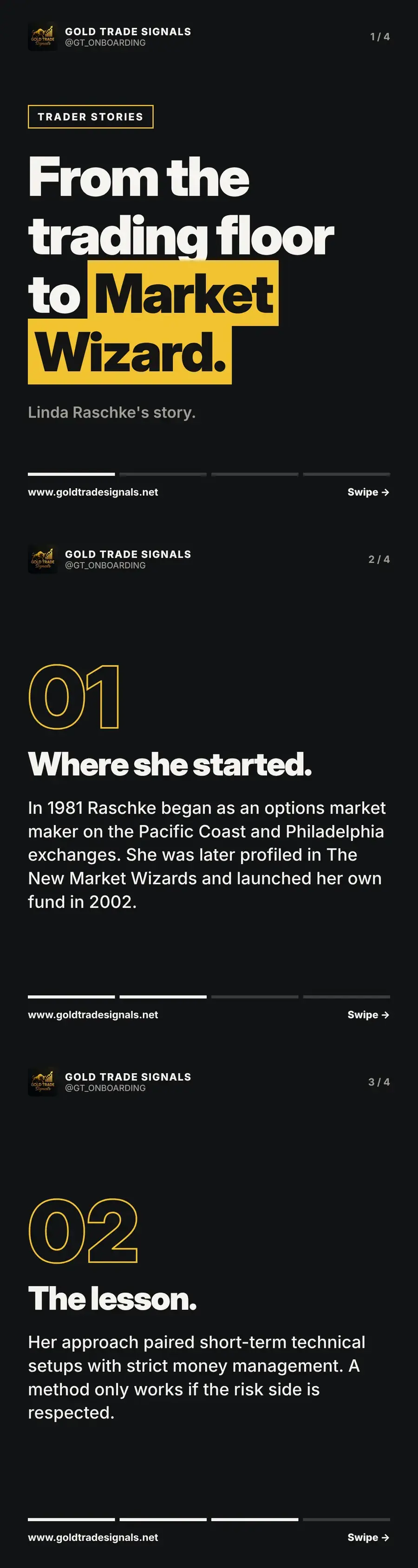
Linda Raschke: from the trading floor to Market Wizard
Linda Raschke began as an options market maker in 1981 and was profiled in The New Market Wizards. Her lesson: a method only works if risk is respected.
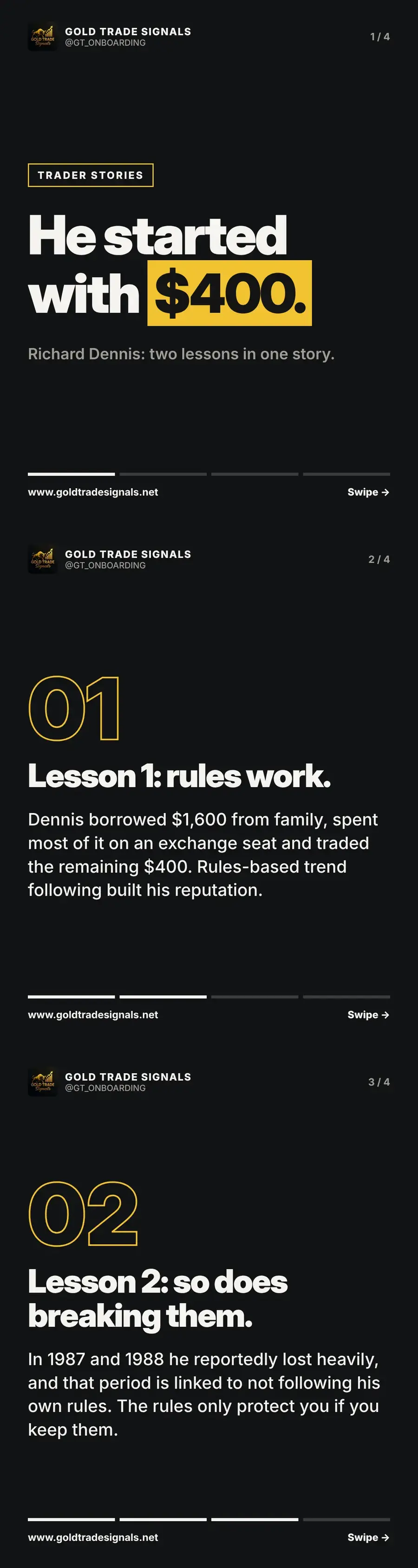
Richard Dennis: rules work, and so does breaking them
Richard Dennis traded $400 into a reputation with rules-based trend following, then reportedly lost heavily in 1987 and 1988. Two lessons for gold traders.