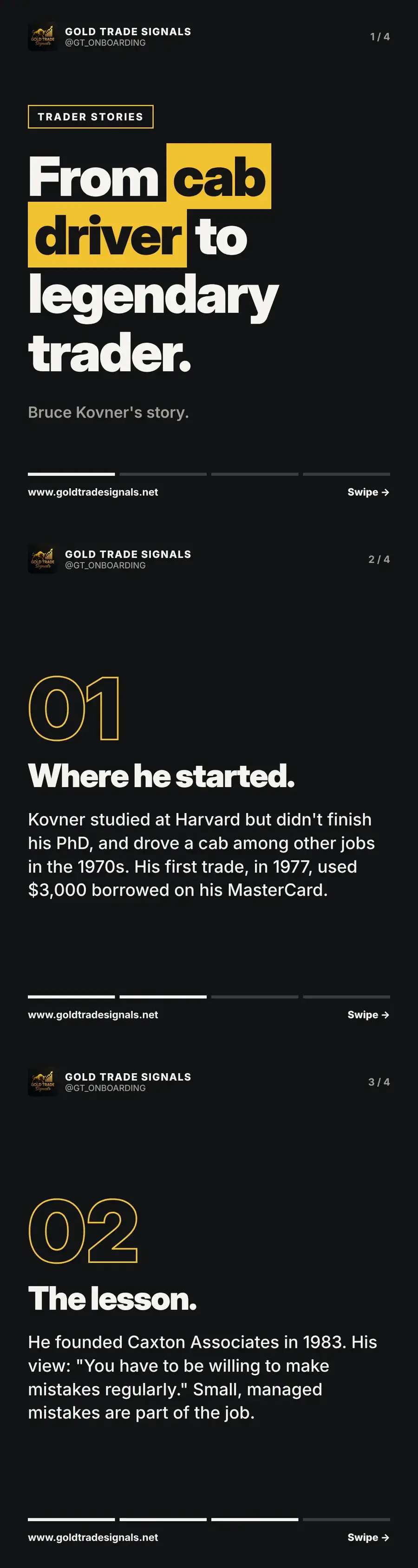
From cab driver to one of the most respected traders of his era. Bruce Kovner's path into trading was not a straight line, and the lesson he drew from it is one every gold trader can use from day one: mistakes are part of the job, as long as they stay small and managed.
Where he started
Kovner studied at Harvard but did not finish his PhD. In the 1970s he drove a cab, among other jobs, while he worked out what he wanted to do. His first trade, in 1977, was funded with $3,000 borrowed on his MasterCard. It is not an approach we would recommend to anyone, but it shows how unglamorous the start of a famous trading career can be.
The lesson
He went on to found Caxton Associates in 1983. His view on trading is simple: "You have to be willing to make mistakes regularly." That is not a licence to be careless. It means accepting that losses are a normal, repeated part of trading, and building your method so that each one is small and managed rather than rare and catastrophic.
What it means for a gold trader
For a gold trader, the practical version of Kovner's lesson is the stop-loss. Every idea we send includes one, so a mistake is a defined, limited cost rather than an open-ended one. You will have losing trades. The question is only whether they are small enough to survive and learn from. Start your own learning curve with us, with stops in place from the first trade.
Key takeaways
- Kovner drove a cab before his first trade in 1977.
- He founded Caxton Associates in 1983.
- Be willing to make small, managed mistakes regularly.
Common questions
How did Bruce Kovner start trading?
He made his first trade in 1977 with $3,000 borrowed on his MasterCard, after driving a cab among other jobs in the 1970s.
What is Bruce Kovner's trading lesson?
That you have to be willing to make mistakes regularly: losses are part of trading, so keep each one small and managed.
Trade ideas with the levels already worked out
Join the free community and receive XAU/USD trade ideas with entry, stop-loss and take-profit, live training on Tuesdays and Thursdays, and support whenever you are stuck.
Join free on TelegramOpen the calculatorsThe traders featured are not affiliated with, and do not endorse, Gold Trade Signals. Their results are exceptional, not typical.
Risk warning: This article is educational content, not personal investment advice. Gold is a leveraged, volatile instrument and you can lose some or all of your capital. Gold Trade Signals is not FCA regulated. Read the full risk warning.
More from Trader Stories and Habits
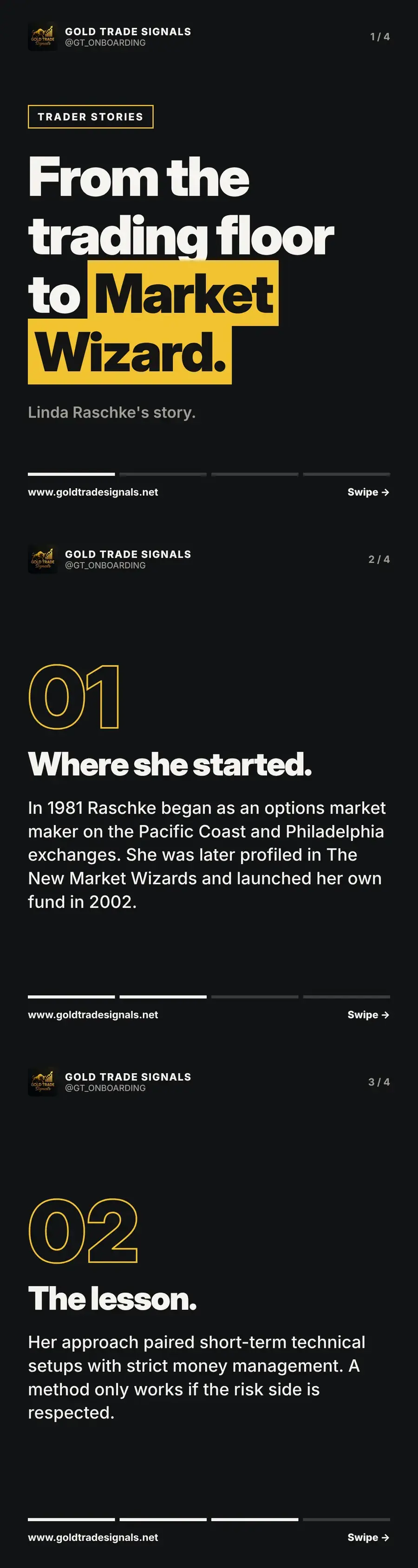
Linda Raschke: from the trading floor to Market Wizard
Linda Raschke began as an options market maker in 1981 and was profiled in The New Market Wizards. Her lesson: a method only works if risk is respected.
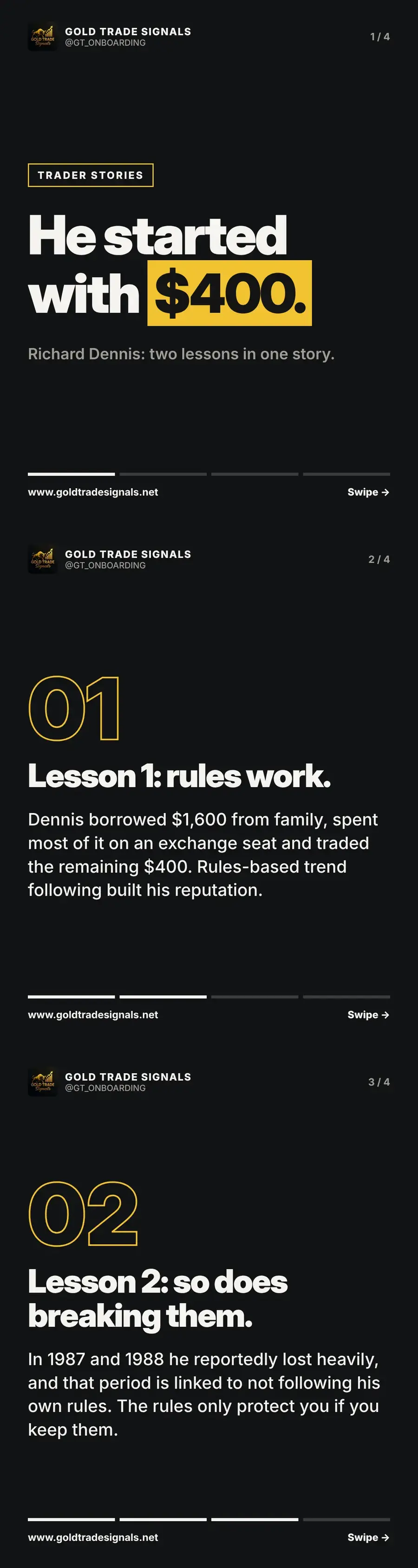
Richard Dennis: rules work, and so does breaking them
Richard Dennis traded $400 into a reputation with rules-based trend following, then reportedly lost heavily in 1987 and 1988. Two lessons for gold traders.
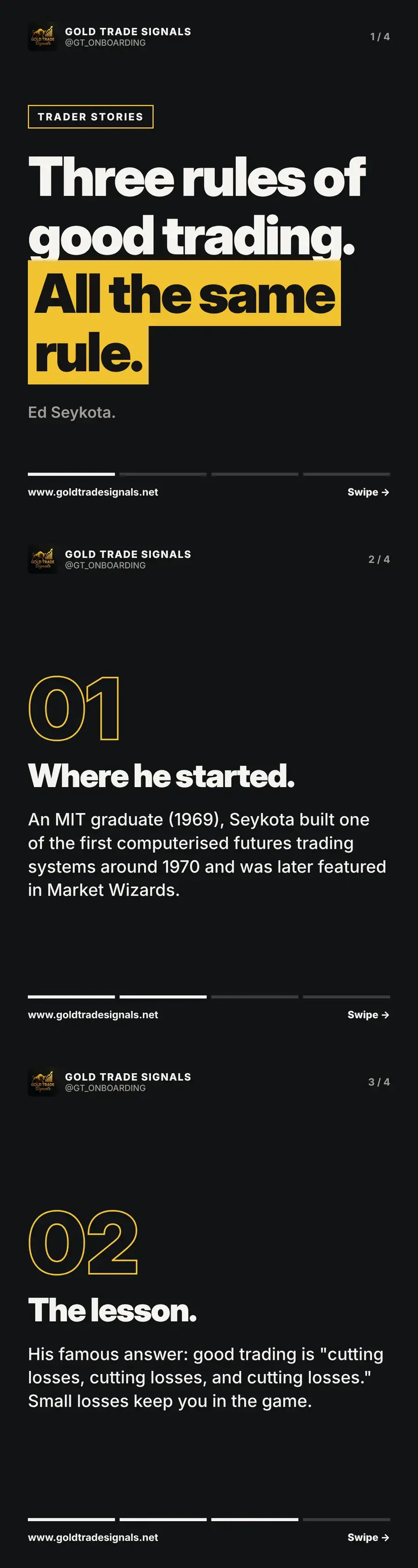
Ed Seykota's three rules of good trading, all the same
Ed Seykota, MIT graduate and early systems trader, summed up good trading as cutting losses, cutting losses, and cutting losses. Why it matters for gold.