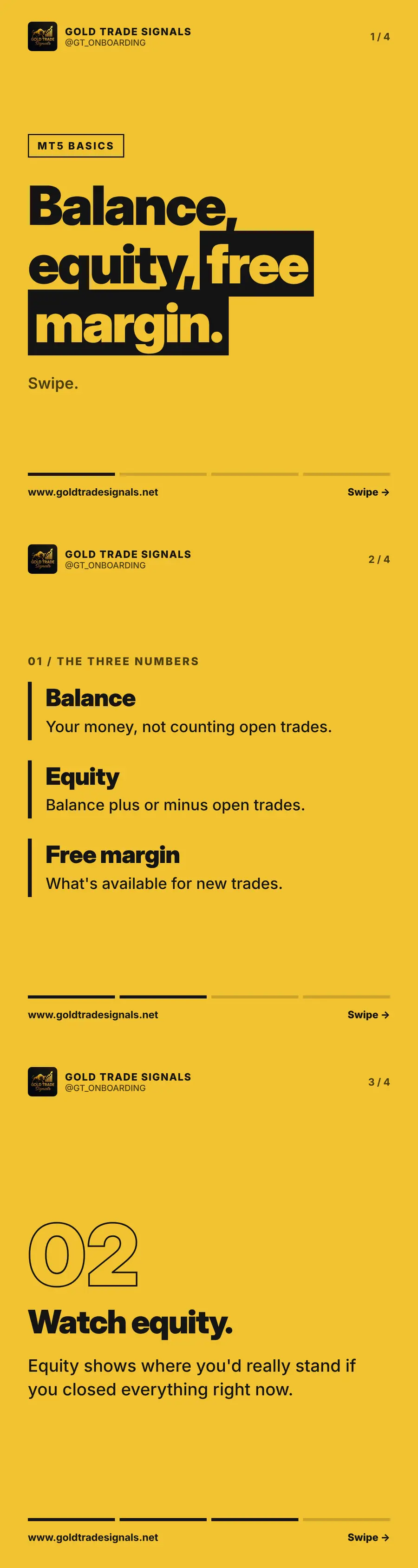
Open MetaTrader 5 and look at the bottom of the screen. You will see balance, equity and free margin, and the figures do not always match. Each one tells you something different about your account. Once you know what they mean, the platform stops feeling like a puzzle.
The three numbers
Balance is your money not counting any open trades. It only changes when a trade is closed, or when you deposit or withdraw. If you have nothing open, balance is simply how much is in the account. Many beginners watch this number and feel safe, but it can hide what is really going on.
Equity is balance plus or minus the running result of your open trades. If your open positions are up by 50 in total, equity is balance plus 50. If they are down by 80, equity is balance minus 80. Free margin is what is left over for new trades once the margin already holding your open positions has been set aside. If free margin runs low, you cannot open anything new.
Watch equity, not balance
Equity shows where you would really stand if you closed everything right now. That makes it the honest number. A balance can look healthy while a large open loss quietly eats the equity underneath it, and the first time many people notice is when the broker closes positions automatically because equity has dropped too far.
A simple routine is to glance at equity whenever you check the platform and compare it with balance. A small gap is normal. A gap that keeps widening is the sign that a trade is too big or a stop-loss is missing. When new members join us we walk through the MT5 screen with them, so these numbers make sense from the first day.
Key takeaways
- Balance ignores open trades; equity includes them.
- Free margin is what you can still use for new positions.
- Equity is the honest number, so watch it while trades run.
Common questions
Why is my equity lower than my balance in MT5?
Because you have open trades that are currently losing. Equity is balance plus or minus the running result of open positions.
What happens when free margin reaches zero?
You cannot open new trades, and if equity keeps falling the broker may start closing positions automatically to protect the account.
Trade ideas with the levels already worked out
Join the free community and receive XAU/USD trade ideas with entry, stop-loss and take-profit, live training on Tuesdays and Thursdays, and support whenever you are stuck.
Join free on TelegramOpen the calculatorsRisk warning: This article is educational content, not personal investment advice. Gold is a leveraged, volatile instrument and you can lose some or all of your capital. Gold Trade Signals is not FCA regulated. Read the full risk warning.
More from Trading Basics

Why your MT5 trade history is a free trading teacher
Your MetaTrader 5 history records every trade you have made. Learn what to look for in a weekly review and how patterns in your own trading jump out.
What is a margin call and how do you avoid one?
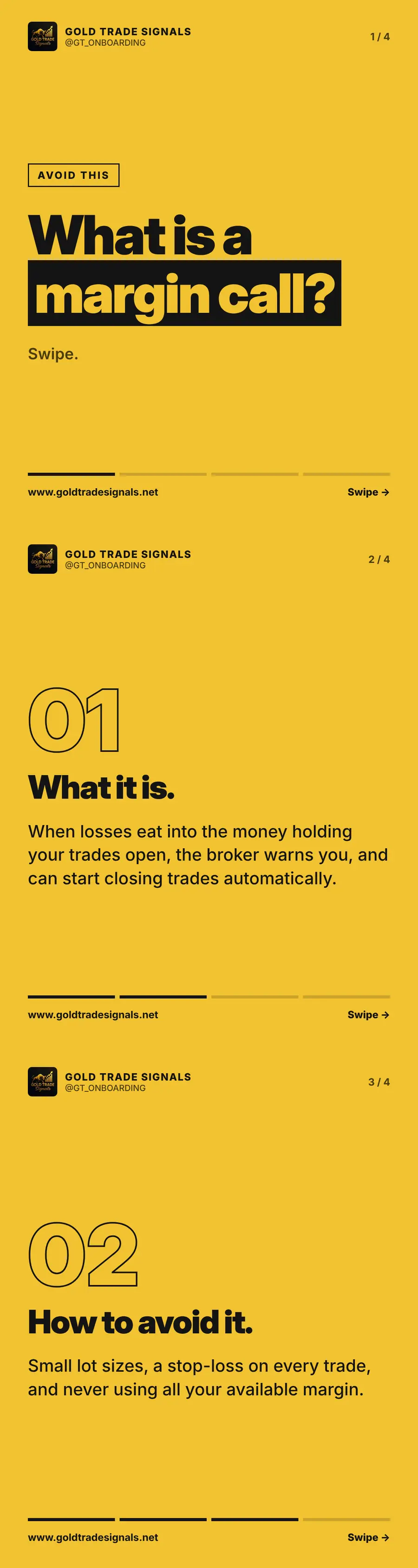
A margin call is the warning no trader wants. Learn what it is, how losses trigger it, how brokers respond, and the habits that keep your account safe.
How to choose your lot size by working backwards from risk
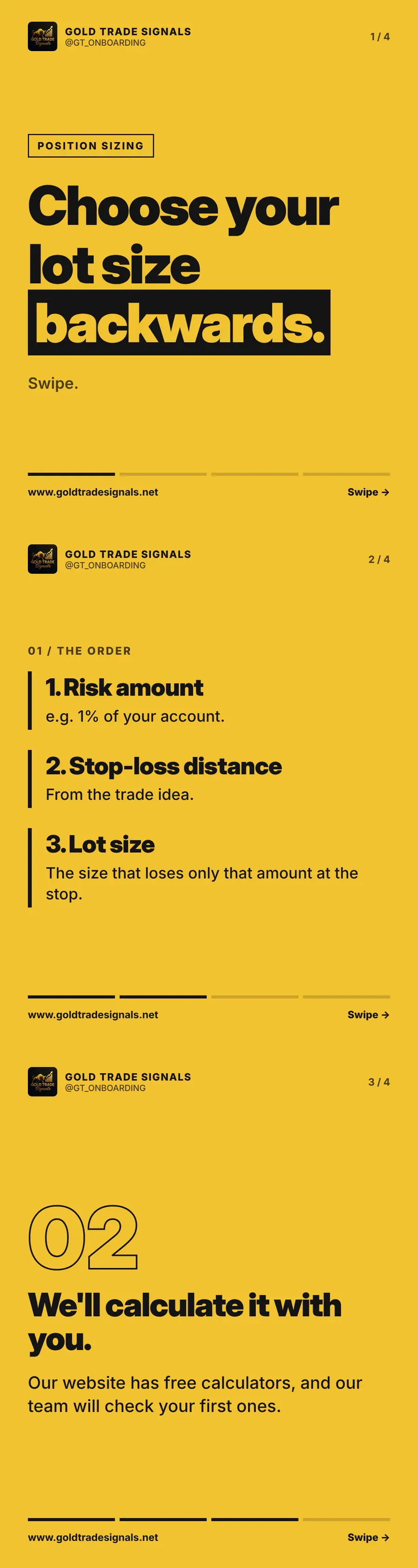
Lot size should be the last thing you decide, not the first. Learn the three-step order: risk amount, stop-loss distance, then the lot size that fits both.