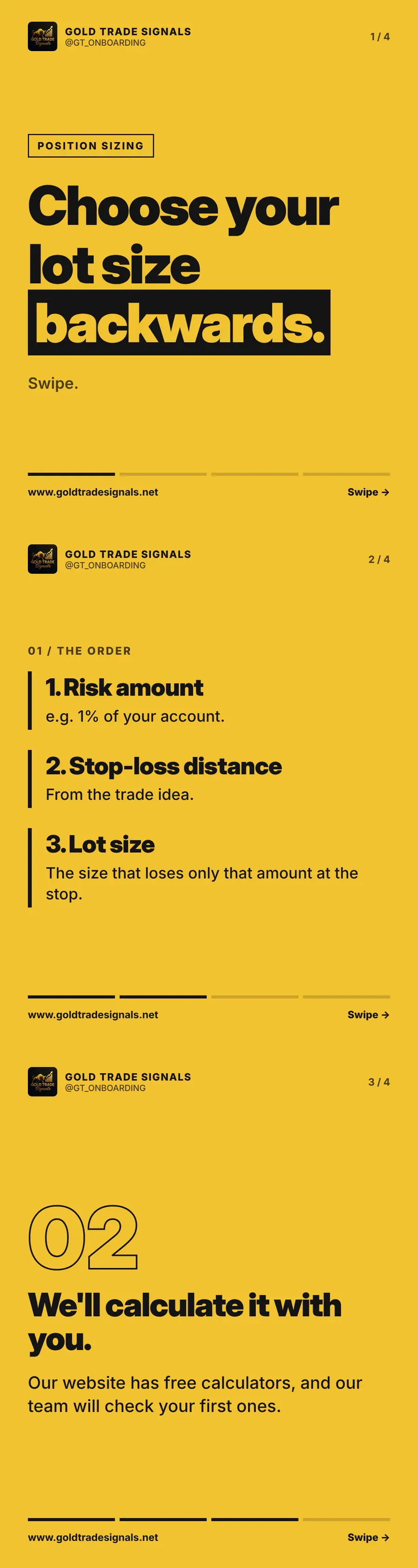
One of the most common beginner questions we get is 'what lot size should I use?' The short answer is that it depends on two other numbers, and both need to be decided first. Position sizing works backwards: decide the loss you accept, then find the size that matches it.
The order: risk, stop, then size
Step one is your risk amount. Decide what you are willing to lose on this one trade if it hits the stop-loss. Many traders use a small fixed percentage of the account, for example 1%. On a $1,000 account that is $10. The number is yours to choose, but it comes first.
Step two is the stop-loss distance. Every trade idea we post includes an entry and a stop-loss, so the distance in dollars (or pips) is already known. Step three is the lot size: the size at which losing that full distance costs only your chosen risk amount. Size is the output, never the input.
Why backwards beats guessing
Traders who pick a lot size first, perhaps because it feels right, end up risking wildly different amounts on each trade. A tight stop risks a little, a wide stop risks a lot, and one bad trade can undo a week. Working backwards keeps the loss on every trade roughly the same, which makes results far easier to understand.
You do not need to do the arithmetic by hand. Our website has free calculators that take your account size, risk percentage and stop distance and return the lot size. Our team will also check your first few trades with you, so ask in the group before you place them.
Key takeaways
- Decide your risk amount per trade first, for example 1% of the account.
- Take the stop-loss distance from the trade idea.
- Lot size is the output of those two numbers, not a guess.
Common questions
How do you calculate lot size for gold trading?
Decide the amount you are willing to lose, take the stop-loss distance from the trade idea, then choose the lot size at which that distance equals that amount. A position size calculator does the maths.
What percentage should you risk per trade?
Many traders use a small fixed percentage of the account, often around 1%. The exact figure is a personal choice, but it should be small enough that a run of losses does not do lasting damage.
Trade ideas with the levels already worked out
Join the free community and receive XAU/USD trade ideas with entry, stop-loss and take-profit, live training on Tuesdays and Thursdays, and support whenever you are stuck.
Join free on TelegramOpen the calculatorsRisk warning: This article is educational content, not personal investment advice. Gold is a leveraged, volatile instrument and you can lose some or all of your capital. Gold Trade Signals is not FCA regulated. Read the full risk warning.
More from Trading Basics
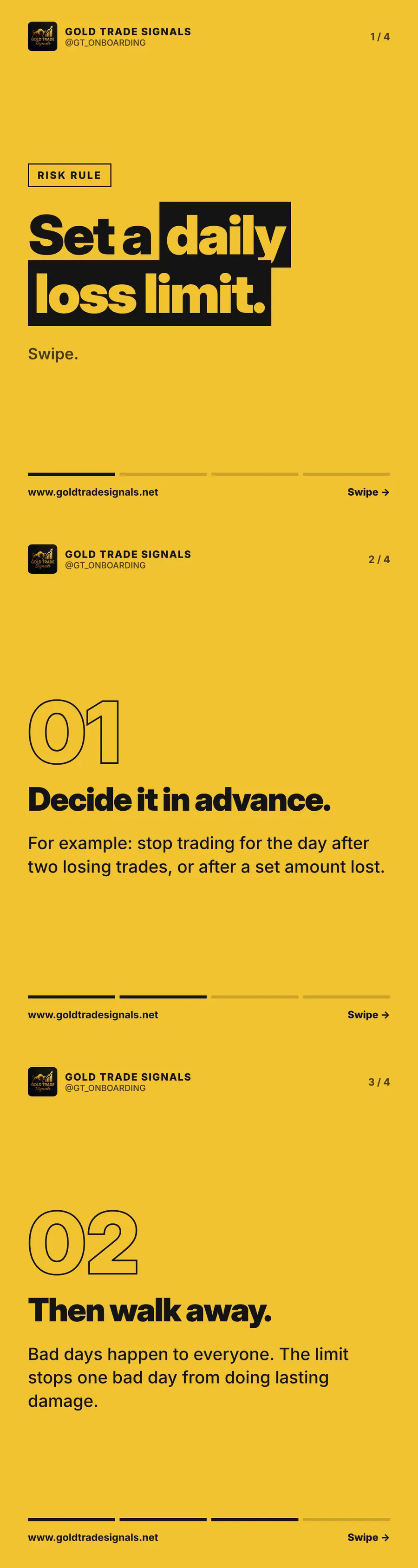
How to set a daily loss limit and why you should stop at it
A daily loss limit is one rule that stops a bad day becoming a disaster. Learn how to set one, what it might look like, and why walking away is the hard part.
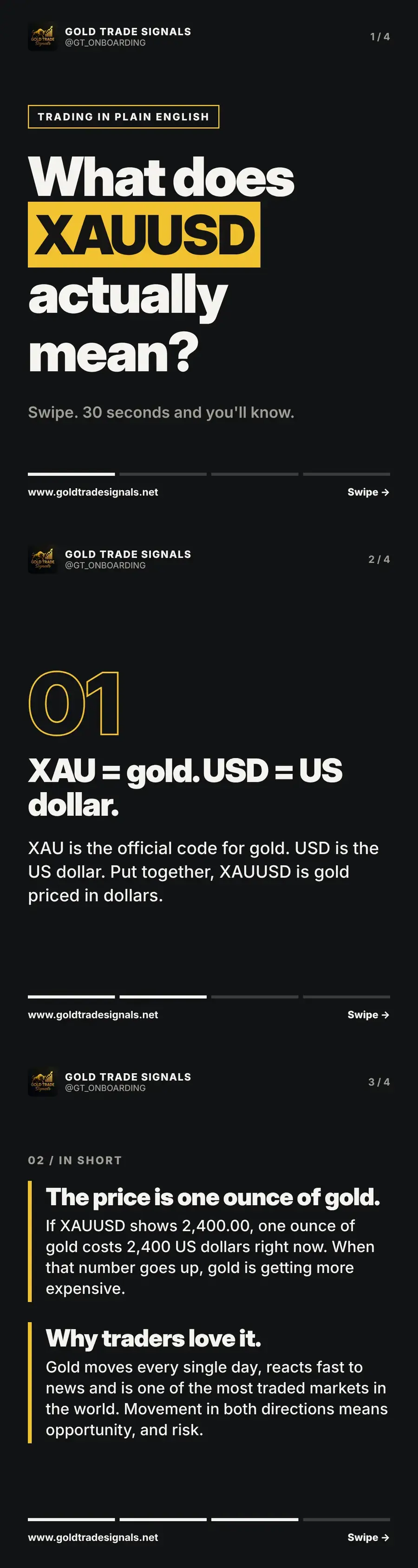
What does XAUUSD mean? Gold priced in US dollars explained
XAU is the code for gold and USD is the US dollar. Learn what XAUUSD means, how to read the price on your screen and why so many traders focus on gold.
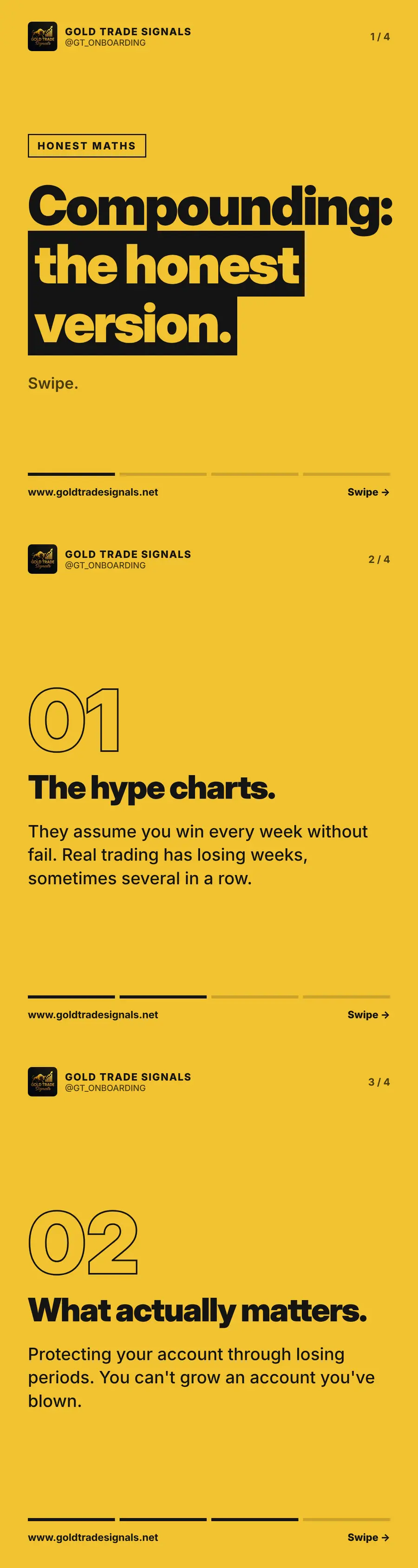
Compounding in trading: the honest version
Those charts turning $100 into $1 million assume you never lose. Learn what they leave out, why losing weeks are normal, and what really grows an account.