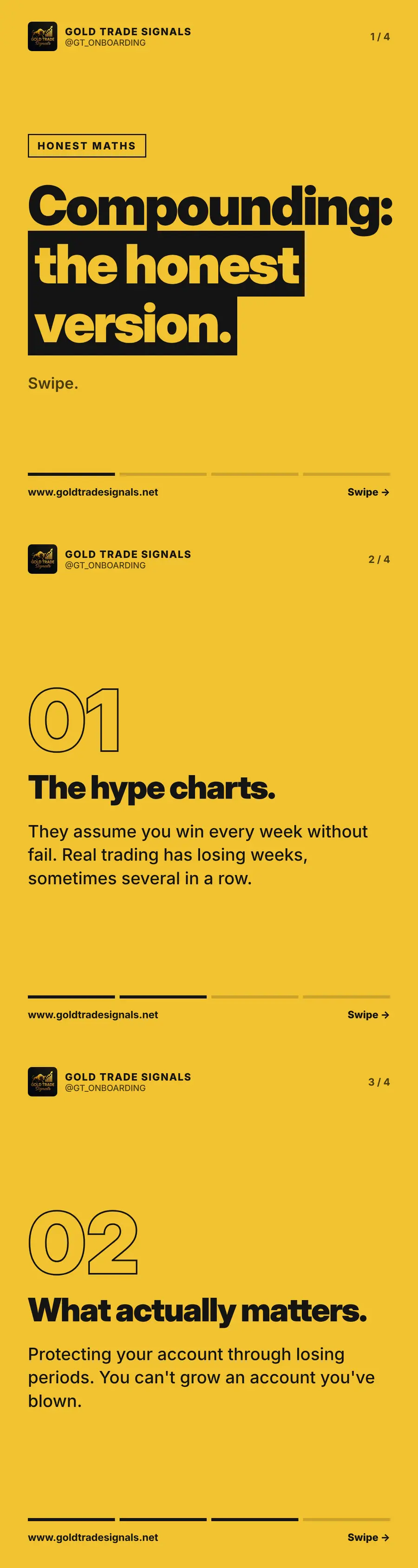
You have seen the chart. Start with $100, grow it by a fixed percentage every week, and a few years later you are a millionaire. The maths in the spreadsheet is correct. The assumption underneath it is not, and the gap between the two is where a lot of beginners lose their money.
What the hype charts assume
Every one of those compounding tables assumes you win every single week without fail, at the same rate, forever. Real trading does not look like that. It has losing days, losing weeks and sometimes several losing weeks in a row, even for people who have been doing this for years.
The charts also ignore the fact that a loss hurts more than a gain of the same size helps. Lose 20% of an account and you need a 25% gain just to get back to where you started. Lose 50% and you need to double your money. The bigger the drawdown, the steeper the climb back out.
What actually matters
Growth takes care of itself only if the account survives. The real job is protecting your capital through the losing periods, so that when the good stretches come you are still there to benefit from them. You cannot grow an account you have already blown.
That means small, consistent risk per trade, a stop-loss on every position and the discipline to keep the lot size the same after a bad run rather than doubling up to catch up. None of it fits in a viral chart, and all of it is what long-term traders actually do.
Compounding with the losses included
Compounding is real, but it works on a surviving account over years, not on a spreadsheet over weeks. Treat any promise of smooth weekly growth as a warning sign. We teach the honest version, risk first and growth second, in our live training on Tuesday and Thursday.
Key takeaways
- Hype charts assume you never have a losing week.
- Losses hurt more than equal gains help: a 50% loss needs 100% back.
- You cannot grow an account you have blown. Protect it first.
Common questions
Does compounding work in trading?
Compounding can work over the long term on an account that survives, but it does not look like the smooth weekly growth charts online, because real trading includes losing periods.
Why are compounding calculators misleading for traders?
They assume a fixed gain every period with no losses. In reality drawdowns happen, and a loss requires a larger percentage gain to recover, which the calculators ignore.
Trade ideas with the levels already worked out
Join the free community and receive XAU/USD trade ideas with entry, stop-loss and take-profit, live training on Tuesdays and Thursdays, and support whenever you are stuck.
Join free on TelegramOpen the calculatorsRisk warning: This article is educational content, not personal investment advice. Gold is a leveraged, volatile instrument and you can lose some or all of your capital. Gold Trade Signals is not FCA regulated. Read the full risk warning.
More from Trading Basics

What is slippage? Why your trade filled at a different price
Slippage is the gap between the price you clicked and the price you got. Learn why it happens, when it is worst, and how gold traders plan around it.

Free gold trade ideas: so what is the catch?
Our gold trade ideas are free because our broker partner pays us when you register through our link. Here is what you need, and the risks we will not hide.
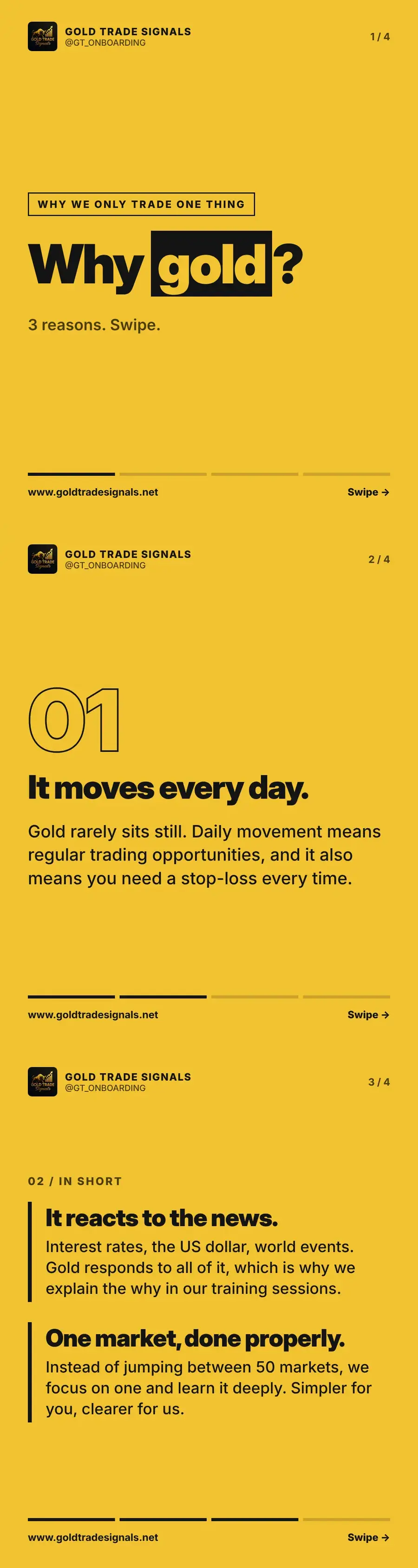
Why we only trade gold: three reasons we focus on one market
Why focus on gold out of everything you could trade? We explain three reasons: daily movement, reaction to news, and learning one market deeply.