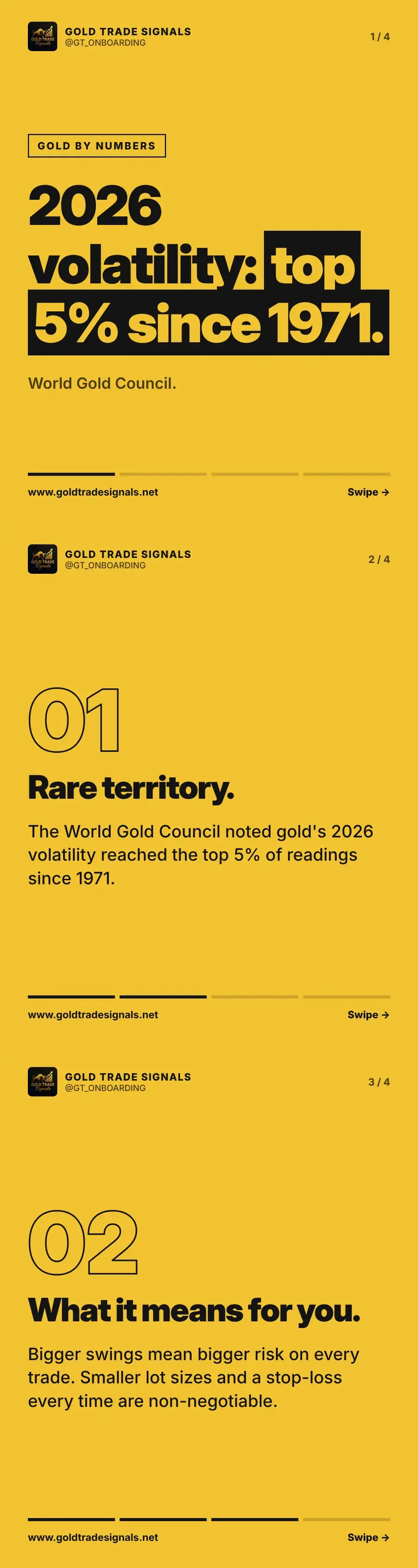
Gold's volatility in 2026 reached levels rarely seen since 1971, according to the World Gold Council. That is interesting as a headline, but it has very practical consequences if you are trading XAUUSD. In this article we explain what the figure means and what it changes about lot sizes and stop-losses.
Rare territory
The World Gold Council noted that gold's volatility in 2026 reached the top 5% of readings since 1971. In plain terms, gold has been moving further and faster, day to day, than it has in all but a small fraction of the past five decades. The swings that used to take a week can now happen in a session.
Volatility is neither good nor bad on its own. Bigger moves mean a take-profit can be reached more quickly, but a stop-loss can be reached more quickly too. What volatility changes is the size of the risk attached to every single trade, and that has to be managed deliberately.
What it means for you
Bigger swings mean bigger risk on every trade. A lot size that felt comfortable in a quieter market can produce a much larger loss when gold moves twice as far in the same time. The first adjustment is smaller lot sizes, so that a normal-sized move against you costs a normal amount, not a frightening one.
The second is non-negotiable: a stop-loss every time. In a fast market, a trade without a stop-loss can move from a small dip to a serious loss while you are away from your phone. Every idea we send includes one, and in volatile conditions we talk about sizing in nearly every training session. Manage risk properly, and volatility becomes something you work with rather than fear.
Key takeaways
- Gold's 2026 volatility reached the top 5% of readings since 1971 (World Gold Council).
- Bigger swings mean bigger risk on every trade, in both directions.
- Use smaller lot sizes and a stop-loss every time, no exceptions.
Common questions
Why is gold so volatile in 2026?
The World Gold Council noted that 2026 volatility reached the top 5% of readings since 1971. Gold reacts to interest rate expectations, the US dollar and world events, and all three have been moving.
How should you trade gold when volatility is high?
Reduce your lot size so a normal move costs a normal amount, and set a stop-loss on every trade without exception.
Trade ideas with the levels already worked out
Join the free community and receive XAU/USD trade ideas with entry, stop-loss and take-profit, live training on Tuesdays and Thursdays, and support whenever you are stuck.
Join free on TelegramOpen the calculatorsRisk warning: This article is educational content, not personal investment advice. Gold is a leveraged, volatile instrument and you can lose some or all of your capital. Gold Trade Signals is not FCA regulated. Read the full risk warning.
More from Gold by Numbers
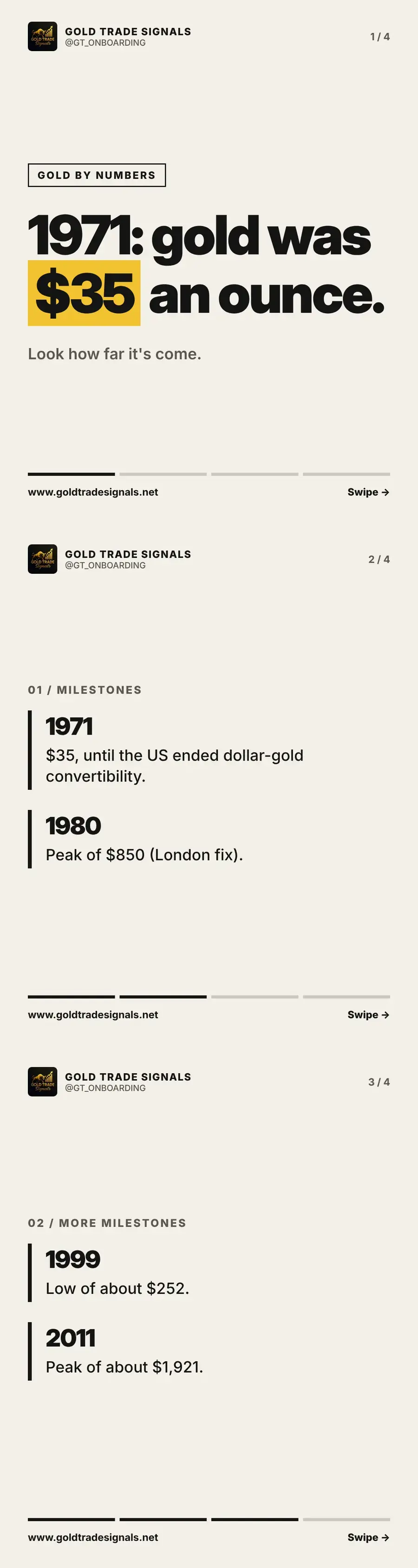
Gold price history: from $35 an ounce in 1971 to today
In 1971 gold was officially $35 an ounce. Follow the milestones since: the 1980 peak of $850, the 1999 low near $252 and the 2011 peak of about $1,921.
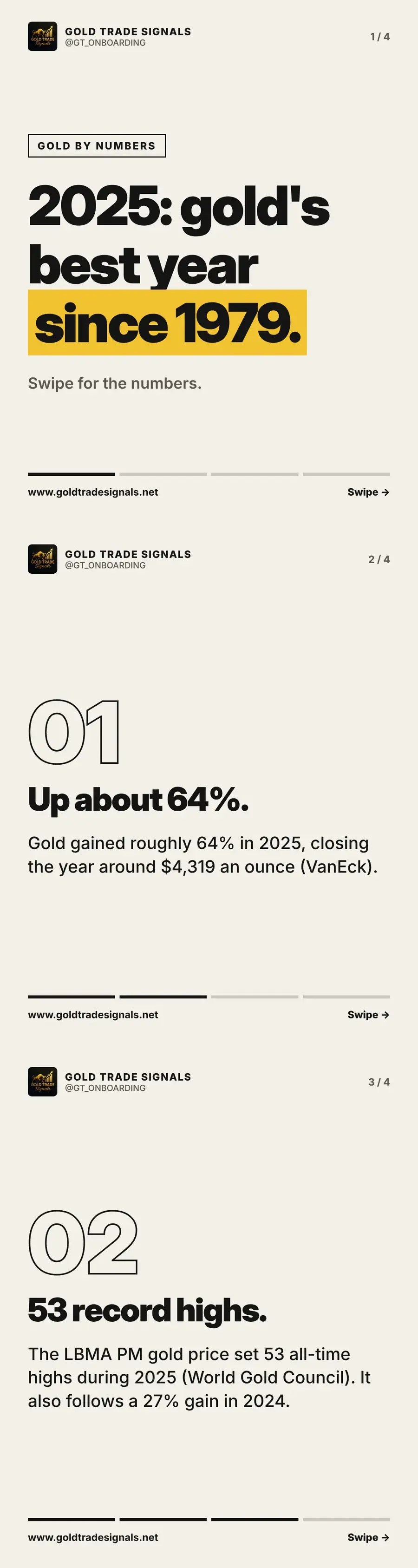
Gold in 2025: best year since 1979 with 53 record highs
Gold gained roughly 64% in 2025, closing around $4,319 an ounce, and set 53 all-time highs along the way. The numbers behind gold's best year since 1979.
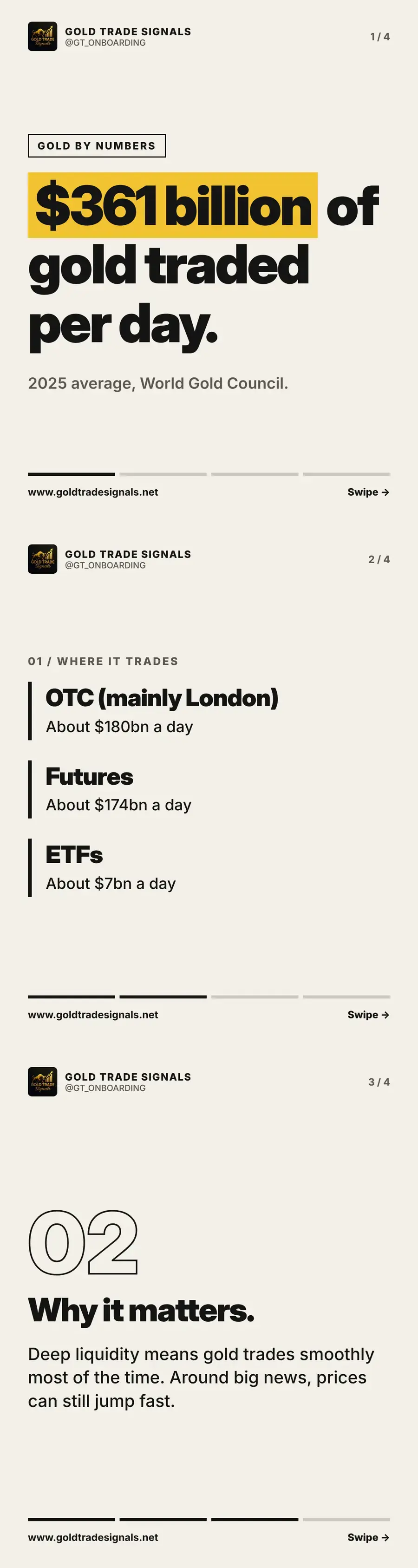
How much gold trades every day: around $361 billion
Around $361 billion of gold changes hands every day, split across OTC trading in London, futures and ETFs. Where it trades and why liquidity matters.