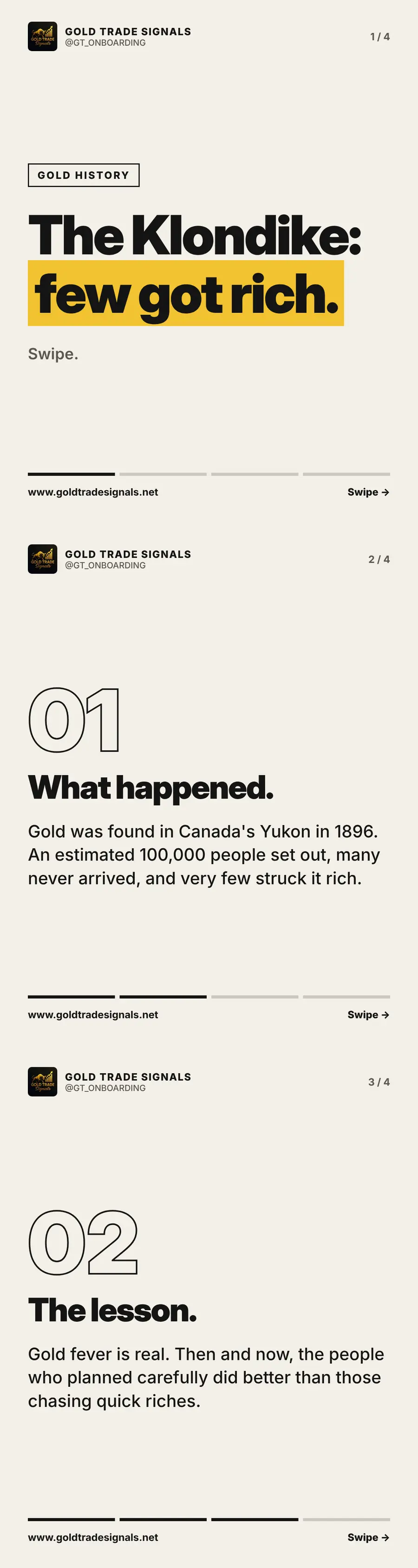
In August 1896 gold was discovered in a creek in Canada's Yukon territory. Within a year, news had spread across North America and an estimated 100,000 people set off for the Klondike. Many never arrived. Very few struck it rich. More than a century later, the story still has something to teach anyone who trades gold.
What happened in the Klondike
The route to the goldfields was brutal. Prospectors had to cross mountain passes on foot, often in winter, carrying around a tonne of supplies that the Canadian authorities required for survival. Some turned back, some died on the trail, and those who made it to Dawson City found the best claims had already been staked.
By the time most stampeders arrived in 1898, the easy gold was gone. Many spent everything they had on the journey and went home poorer than they started. The people who reliably made money were often those selling supplies, transport and services to the prospectors, not the prospectors themselves.
Gold fever, then and now
Gold fever is real. The same emotion that sent people over frozen passes shows up today as oversized positions, chasing a candle that has already moved, or adding to a losing trade because the price surely has to turn. The feeling that everyone else is getting rich is a powerful and expensive one.
The Klondike rewarded preparation. Those who planned their supplies, understood the terrain and set realistic expectations did better than those who ran at the first headline. The same holds on a gold chart: a plan with an entry, a stop-loss and a take-profit beats excitement every time.
The lesson for gold traders
Treat every rush of excitement as a signal to slow down, not speed up. Decide your risk before you enter, keep lot sizes small, and let the market come to your level rather than chasing it. If you would like to learn that approach with other people doing the same, our free community and live training are here for you.
Key takeaways
- Around 100,000 people set out for the Klondike; few got rich.
- The prepared did better than those chasing quick riches.
- Excitement is a signal to slow down and check your plan.
Common questions
When was the Klondike Gold Rush?
Gold was discovered in the Yukon in 1896, and the main rush ran from 1897 to 1899 as tens of thousands of people travelled to the Klondike region of Canada.
Did people get rich in the Klondike Gold Rush?
A small number did, mostly those who arrived first or already held good claims. Most of the estimated 100,000 who set out either never arrived or came home with little to show for it.
Trade ideas with the levels already worked out
Join the free community and receive XAU/USD trade ideas with entry, stop-loss and take-profit, live training on Tuesdays and Thursdays, and support whenever you are stuck.
Join free on TelegramOpen the calculatorsRisk warning: This article is educational content, not personal investment advice. Gold is a leveraged, volatile instrument and you can lose some or all of your capital. Gold Trade Signals is not FCA regulated. Read the full risk warning.
More from Gold by Numbers
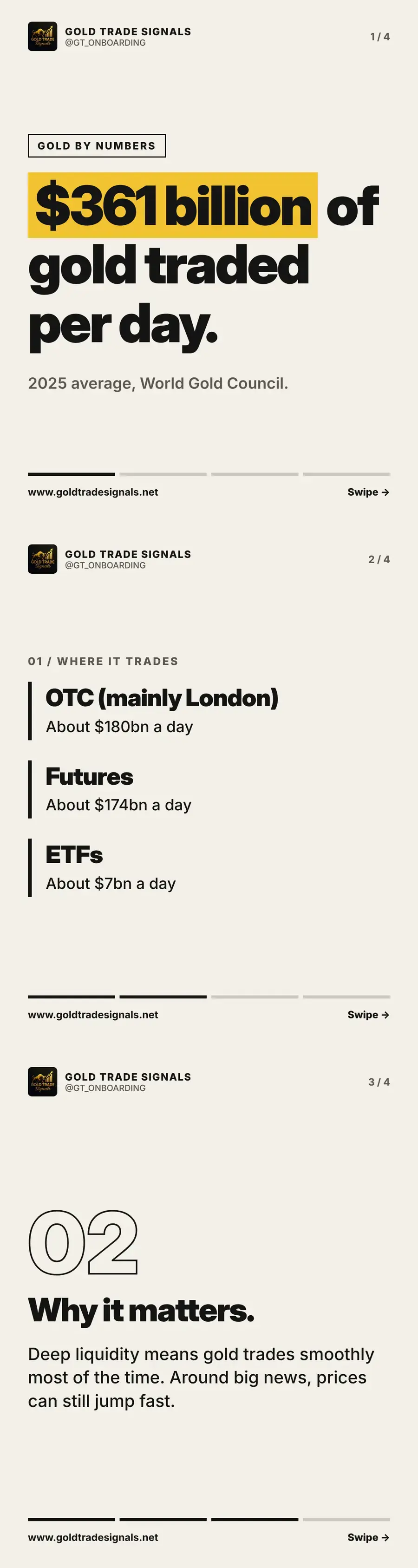
How much gold trades every day: around $361 billion
Around $361 billion of gold changes hands every day, split across OTC trading in London, futures and ETFs. Where it trades and why liquidity matters.
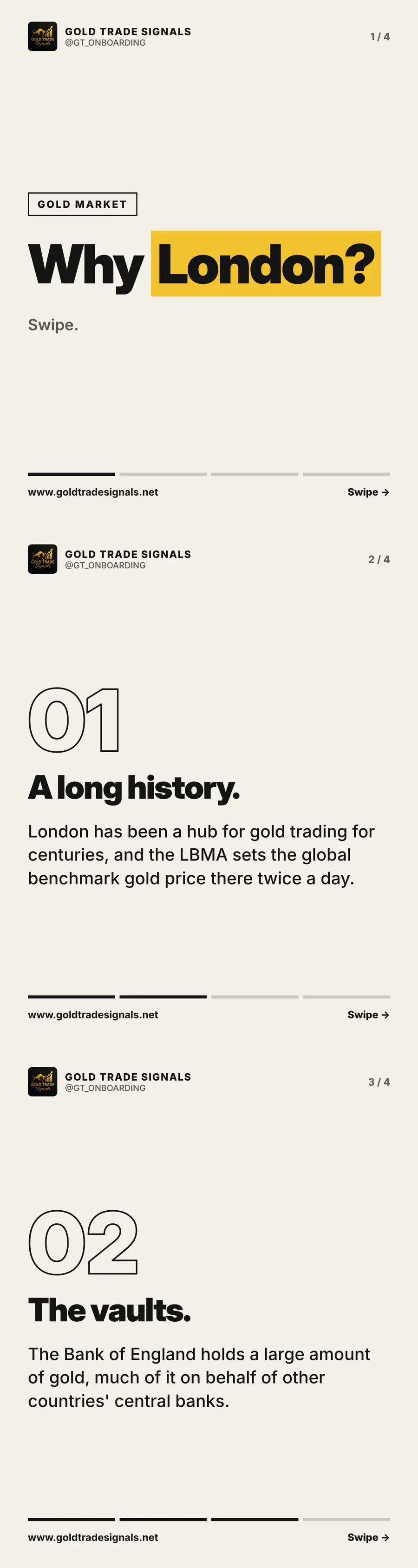
Why London is the centre of the global gold market
London has been a gold hub for centuries. Learn how the LBMA price benchmark works, what the Bank of England keeps in its vaults, and why it matters.
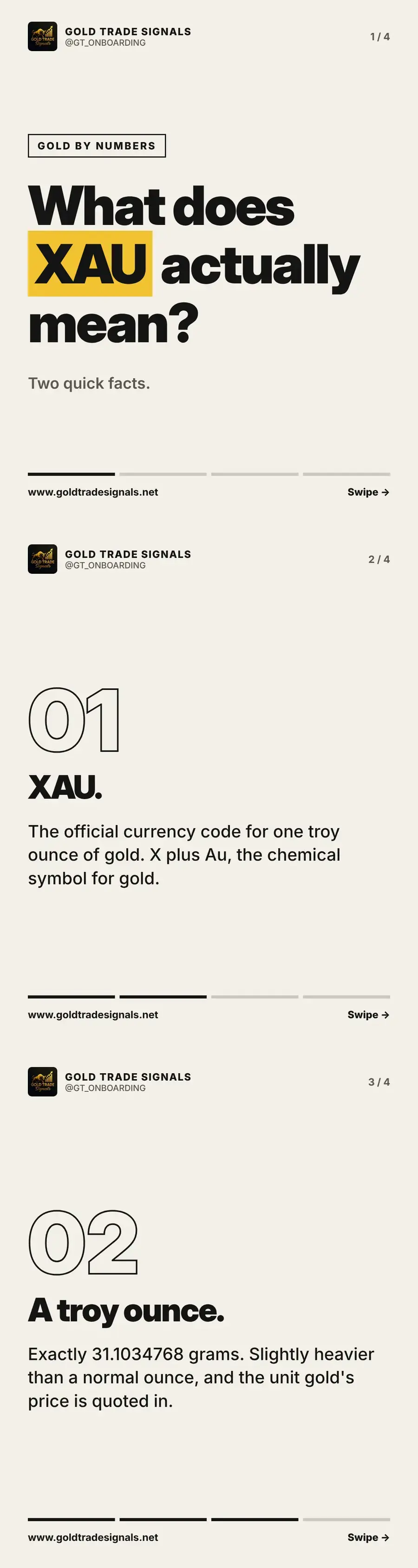
What XAU means and what a troy ounce actually is
XAU is the currency code for one troy ounce of gold, and a troy ounce is exactly 31.1034768 grams. Two facts every gold trader should know, explained.