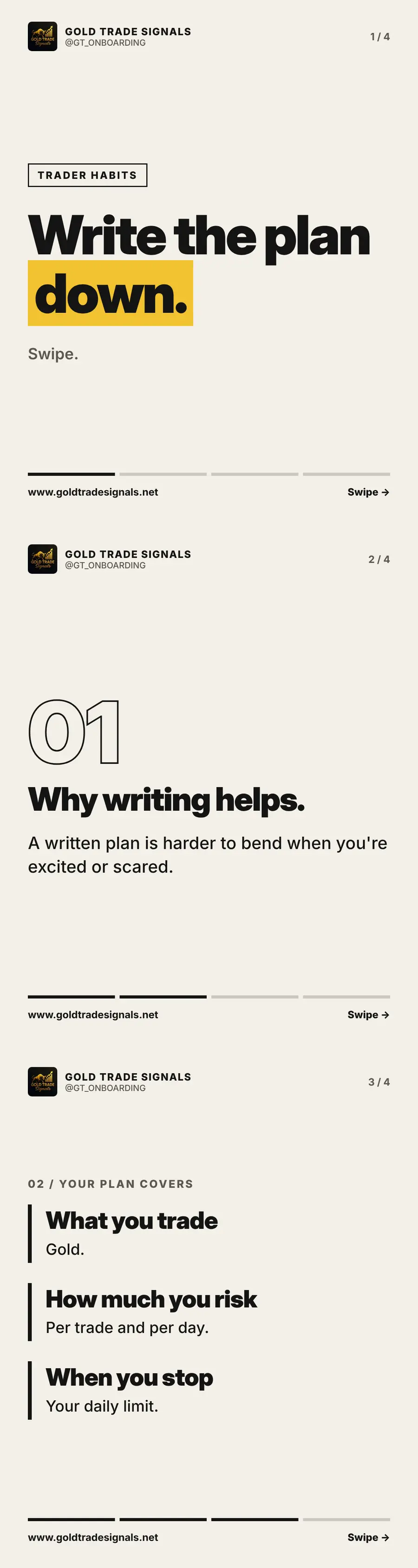
Ask a group of experienced traders what separates them from their earlier selves and a surprising number say the same thing: they wrote their plan down. A plan that only lives in your head bends with your mood. A written one does not. Here is why it works and what to include.
Why writing it down helps
When you are excited after a win or scared after a loss, your judgement shifts. In that state, a plan you remember loosely is easy to rewrite on the spot: a slightly bigger lot, one more trade, a stop moved a little wider. A plan written in black and white is much harder to bend, because you can see exactly what you agreed with yourself.
Writing also forces clarity. Vague ideas like 'be careful with risk' turn into specific numbers when you have to type them out. At the end of a week you can compare what you did with what you wrote, which is the fastest way to spot the habit that is costing you money.
What your plan should cover
Keep it short. Three lines are enough to start. First, what you trade: for most of our members, that is gold, and only gold, until the basics are second nature. Focusing on one market means you learn its rhythm, its news times and its typical moves far faster than if you jump between instruments.
Second, how much you risk, both per trade and per day. Many traders use a small fixed percentage of the account per trade. Third, when you stop: your daily loss limit, written as a number, so the decision is already made before a bad day arrives. We help new members write this plan in the live training on Tuesday and Thursday.
Key takeaways
- A written plan is harder to bend when you feel excited or scared.
- Cover three things: what you trade, how much you risk, when you stop.
- Review what you did against what you wrote each week.
Common questions
What should a trading plan include?
At minimum: what you trade, how much you risk per trade and per day, and the point at which you stop for the day. Keep it short enough to follow every time.
Why do traders need a written trading plan?
A plan in your head changes with your mood. A written plan is fixed, so you can see when emotion is pushing you to bend it and check your behaviour against it later.
Trade ideas with the levels already worked out
Join the free community and receive XAU/USD trade ideas with entry, stop-loss and take-profit, live training on Tuesdays and Thursdays, and support whenever you are stuck.
Join free on TelegramOpen the calculatorsRisk warning: This article is educational content, not personal investment advice. Gold is a leveraged, volatile instrument and you can lose some or all of your capital. Gold Trade Signals is not FCA regulated. Read the full risk warning.
More from Trader Stories and Habits
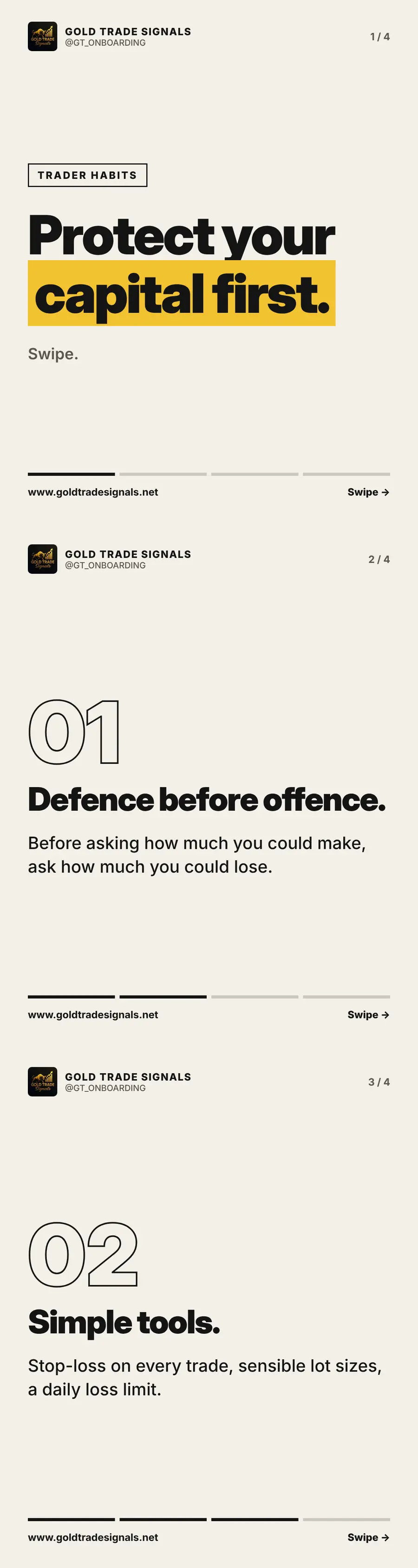
Why successful traders protect their capital first
You cannot trade tomorrow with an account you lost today. Learn the defence-first habit and the three simple tools that keep gold traders in the game.
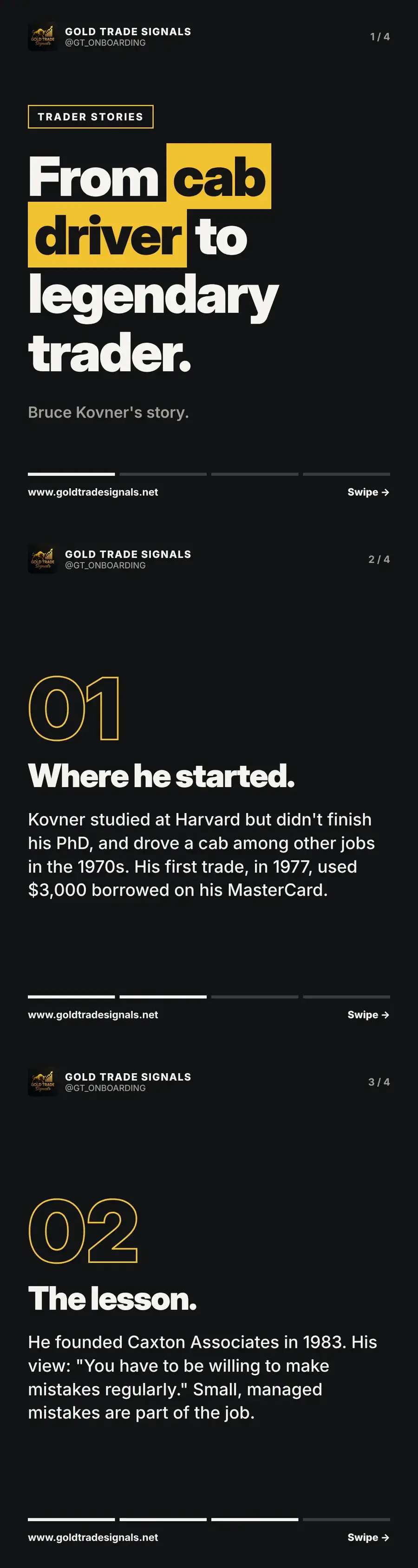
Bruce Kovner: from cab driver to legendary trader
Bruce Kovner drove a cab, made his first trade in 1977 with $3,000 borrowed on a credit card, and founded Caxton Associates. His lesson for gold traders.
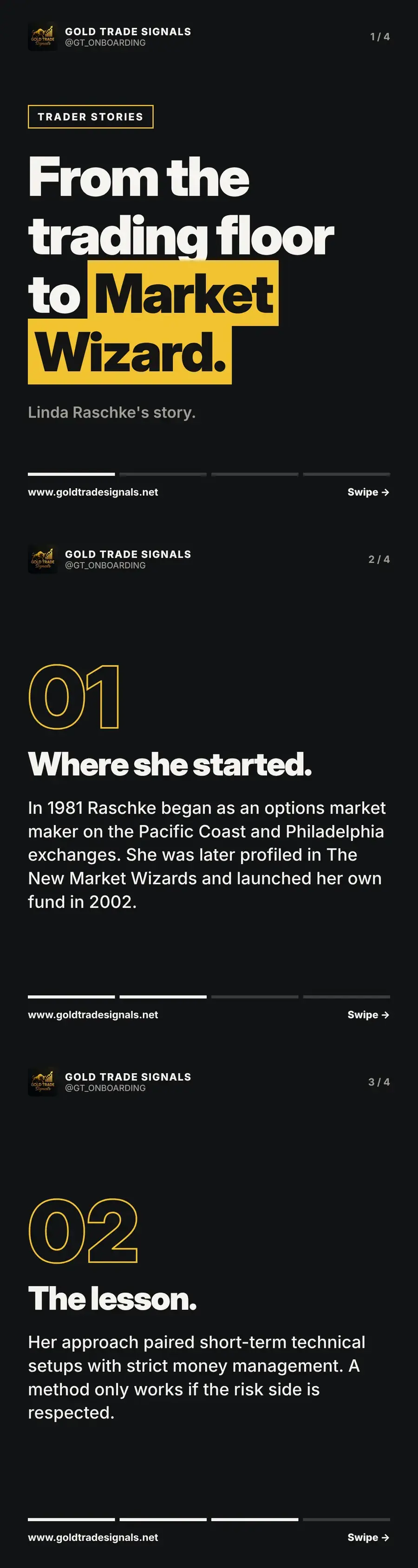
Linda Raschke: from the trading floor to Market Wizard
Linda Raschke began as an options market maker in 1981 and was profiled in The New Market Wizards. Her lesson: a method only works if risk is respected.