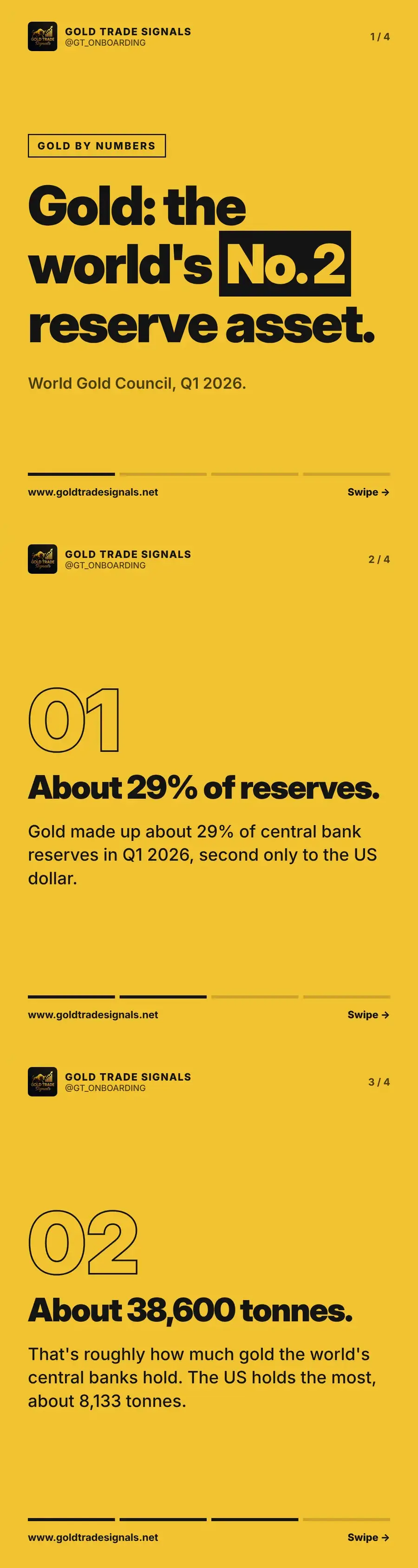
Gold is the second-largest reserve asset in the world, behind only the US dollar. That single fact explains a lot about why gold behaves the way it does. In this article we set out the World Gold Council figures for Q1 2026, who holds the most and why it matters to anyone trading XAUUSD.
About 29% of reserves
According to the World Gold Council, gold made up about 29% of central bank reserves in the first quarter of 2026. Only the US dollar accounted for a larger share. That puts gold ahead of every other currency as a store of national wealth, which is a remarkable position for an asset that pays no interest.
Central banks hold gold for the same reasons individuals do: it is not tied to any single government's promise, it has been treated as money for thousands of years and it tends to hold value when confidence in other assets wobbles. When the world's largest institutions behave that way, it shapes how the price moves.
About 38,600 tonnes
The world's central banks hold roughly 38,600 tonnes of gold between them. The United States holds the most, at about 8,133 tonnes. These holdings change slowly, but when central banks are net buyers over a sustained period, that steady demand sits underneath the market and influences how gold reacts to everything else.
For a trader the lesson is about context. Gold is not a speculative token that could vanish; it is the second-largest reserve asset on the planet, held by the most conservative institutions in the world. The day-to-day price still moves on rates, the dollar and the news, and every trade still needs a stop-loss, but you are trading the world's oldest money.
Key takeaways
- Gold was about 29% of central bank reserves in Q1 2026, behind only USD.
- Central banks hold roughly 38,600 tonnes; the US holds about 8,133 tonnes.
- Steady official demand shapes how gold reacts to rates, the dollar and news.
Common questions
What is the second-largest reserve asset in the world?
Gold. World Gold Council figures for Q1 2026 put gold at about 29% of central bank reserves, behind only the US dollar.
Which country holds the most gold?
The United States, with about 8,133 tonnes. Central banks worldwide hold roughly 38,600 tonnes in total.
Trade ideas with the levels already worked out
Join the free community and receive XAU/USD trade ideas with entry, stop-loss and take-profit, live training on Tuesdays and Thursdays, and support whenever you are stuck.
Join free on TelegramOpen the calculatorsRisk warning: This article is educational content, not personal investment advice. Gold is a leveraged, volatile instrument and you can lose some or all of your capital. Gold Trade Signals is not FCA regulated. Read the full risk warning.
More from Gold by Numbers
Gold volatility in 2026: top 5% of readings since 1971
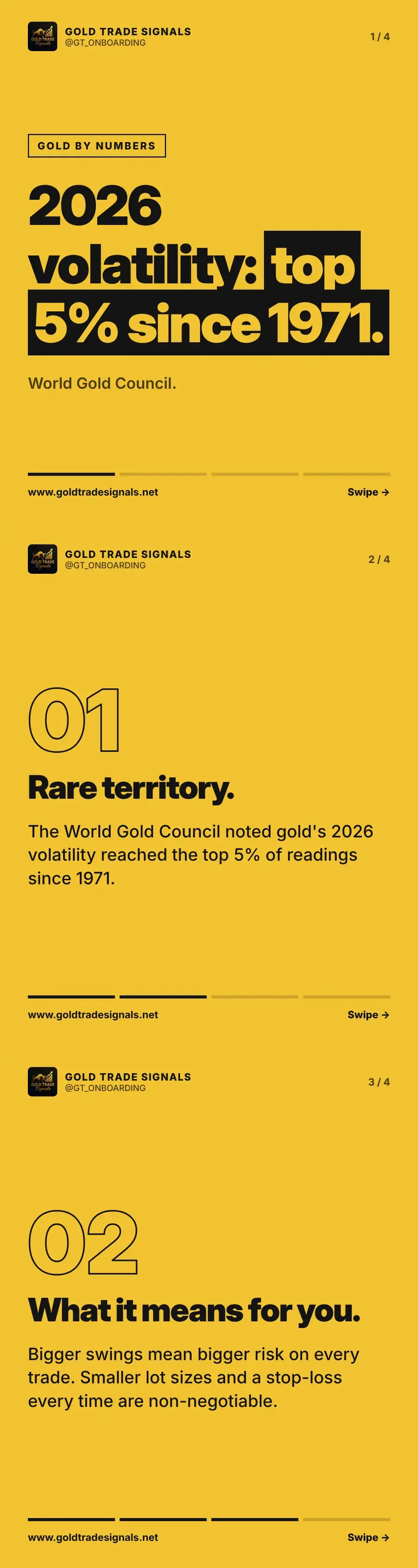
The World Gold Council noted gold volatility in 2026 reached the top 5% of readings since 1971. What bigger swings mean for lot sizes and stop-losses.
Gold price history: from $35 an ounce in 1971 to today
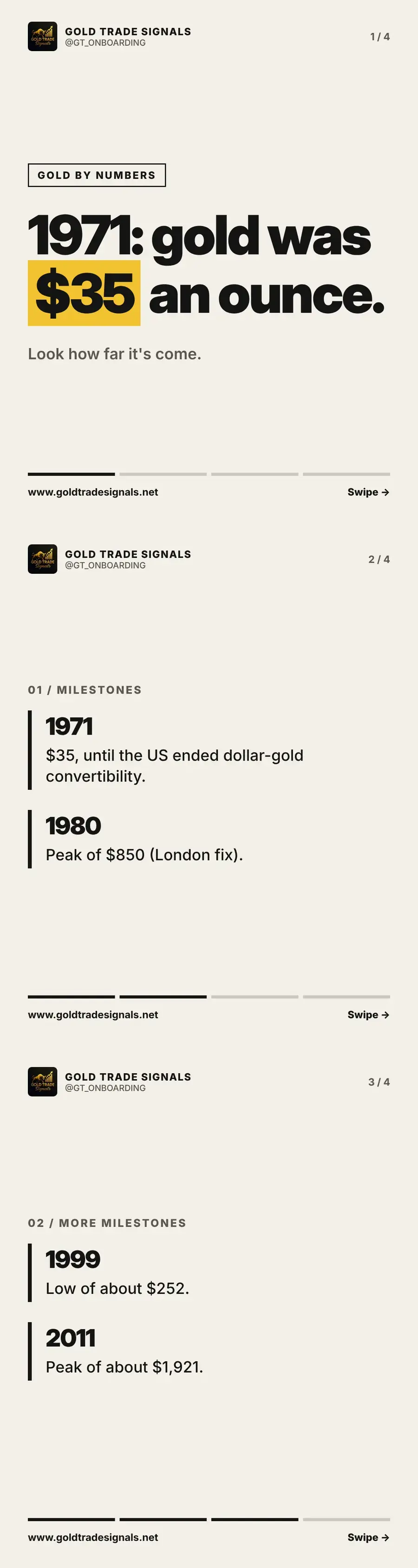
In 1971 gold was officially $35 an ounce. Follow the milestones since: the 1980 peak of $850, the 1999 low near $252 and the 2011 peak of about $1,921.
Gold in 2025: best year since 1979 with 53 record highs
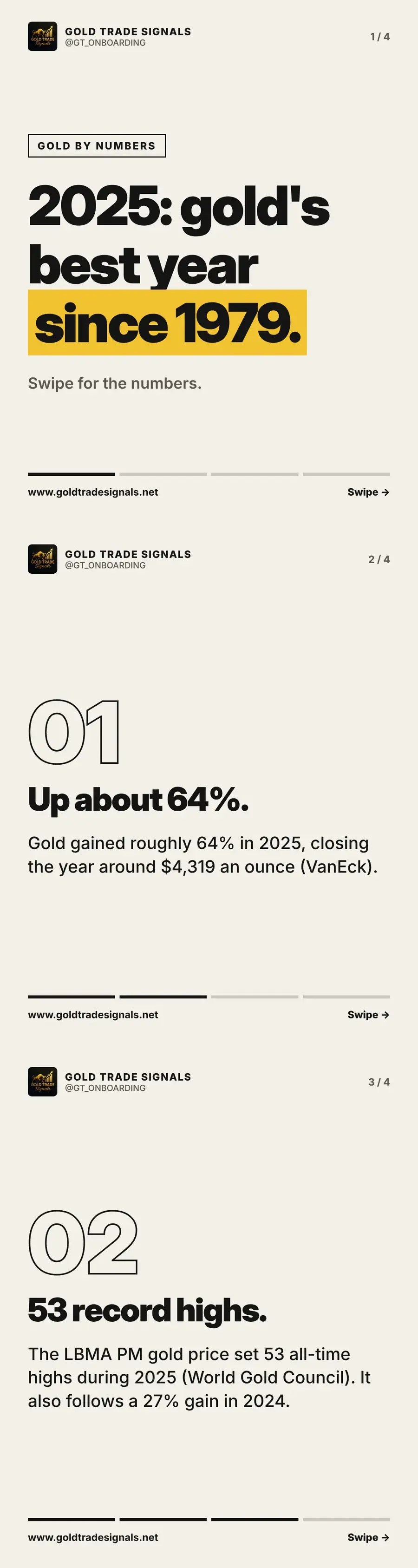
Gold gained roughly 64% in 2025, closing around $4,319 an ounce, and set 53 all-time highs along the way. The numbers behind gold's best year since 1979.