
Isaac Newton worked out the laws of gravity and ran the Royal Mint. If anyone should have been immune to a market bubble, it was him. Yet in 1720 he is widely reported to have lost a large sum in the South Sea Company. The story is three hundred years old and still describes most trading mistakes.
What happened
The South Sea Company was a British trading company whose shares became the focus of a speculative frenzy in 1720. Over a few months the share price rose many times over, driven less by the company's business than by the crowd's conviction that it could only go up. Then it collapsed, wiping out fortunes across London.
Newton, by widely reported accounts, bought shares early and sold for a healthy profit. He then watched the price keep climbing without him, bought back in near the top, and lost a sum often put at around £20,000, an enormous amount at the time. He had been right once and still lost, because the second decision was driven by fear of missing out.
The lesson for gold traders
Intelligence does not protect you from FOMO. Rules do. Newton's problem was not analysis; it was that he had no rule stopping him from chasing a move he had already banked. Gold produces the same temptation regularly: a sharp rally, a group of people celebrating, and a strong urge to jump in late with a larger size than planned.
A written plan handles this for you. It says what you trade, when you enter, how much you risk and when you stop, and it does not care how exciting the chart looks. Every trade idea we post has a defined entry, so there is never a need to chase. Trade with rules, not FOMO, and the bubbles will pass you by.
Key takeaways
- South Sea shares soared in 1720 and then collapsed.
- Newton is reported to have lost heavily after buying back near the top.
- Rules protect you from FOMO when intelligence does not.
Common questions
How much did Isaac Newton lose in the South Sea Bubble?
Accounts vary, but he is widely reported to have lost around £20,000 after selling early for a profit and then buying back in near the peak in 1720.
What was the South Sea Bubble?
A speculative mania in 1720 in which shares of Britain's South Sea Company rose many times over in a few months and then collapsed, ruining many investors.
Trade ideas with the levels already worked out
Join the free community and receive XAU/USD trade ideas with entry, stop-loss and take-profit, live training on Tuesdays and Thursdays, and support whenever you are stuck.
Join free on TelegramOpen the calculatorsRisk warning: This article is educational content, not personal investment advice. Gold is a leveraged, volatile instrument and you can lose some or all of your capital. Gold Trade Signals is not FCA regulated. Read the full risk warning.
More from Market History

Tulip mania in the 1630s and what it teaches gold traders
In the 1630s rare tulip bulbs in the Dutch Republic reportedly sold for more than a house, then prices collapsed in 1637. Learn the story and the lesson.
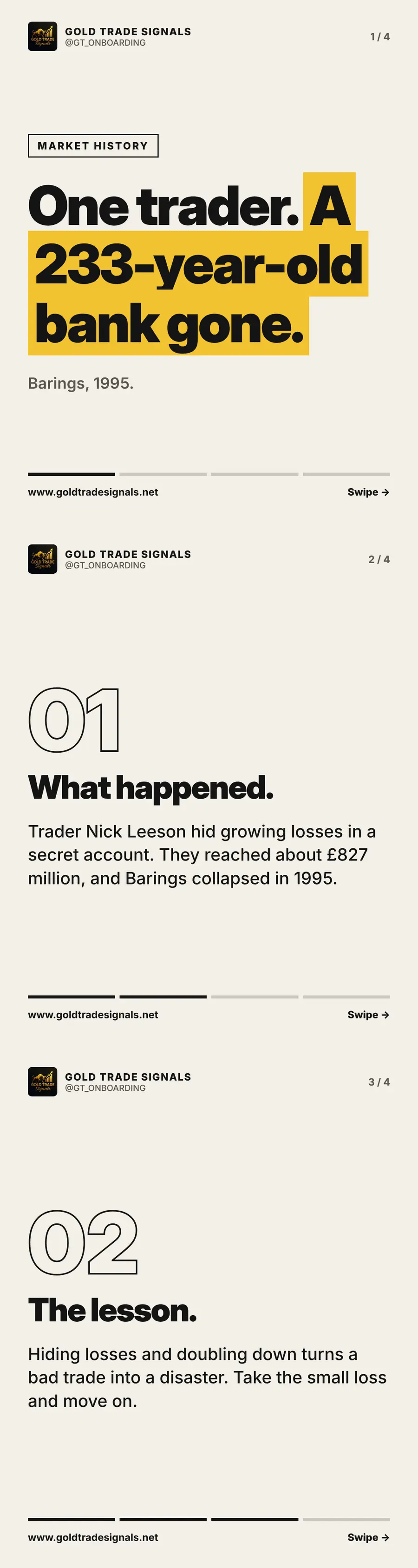
Barings Bank 1995: how one trader's hidden losses sank a bank
In 1995 Nick Leeson hid losses of around £827 million and brought down Barings, a 233-year-old bank. Learn what happened and the lesson for gold traders.
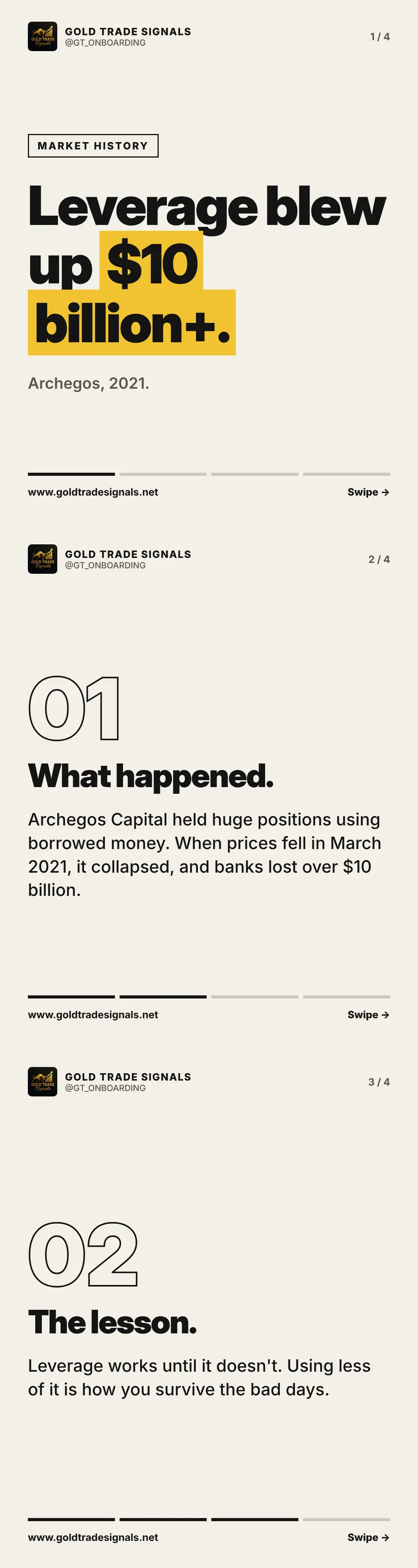
Archegos 2021: how extreme leverage blew up a family office
In March 2021 Archegos Capital collapsed after prices fell on its heavily leveraged positions, costing banks over $10 billion. The lesson for gold traders.