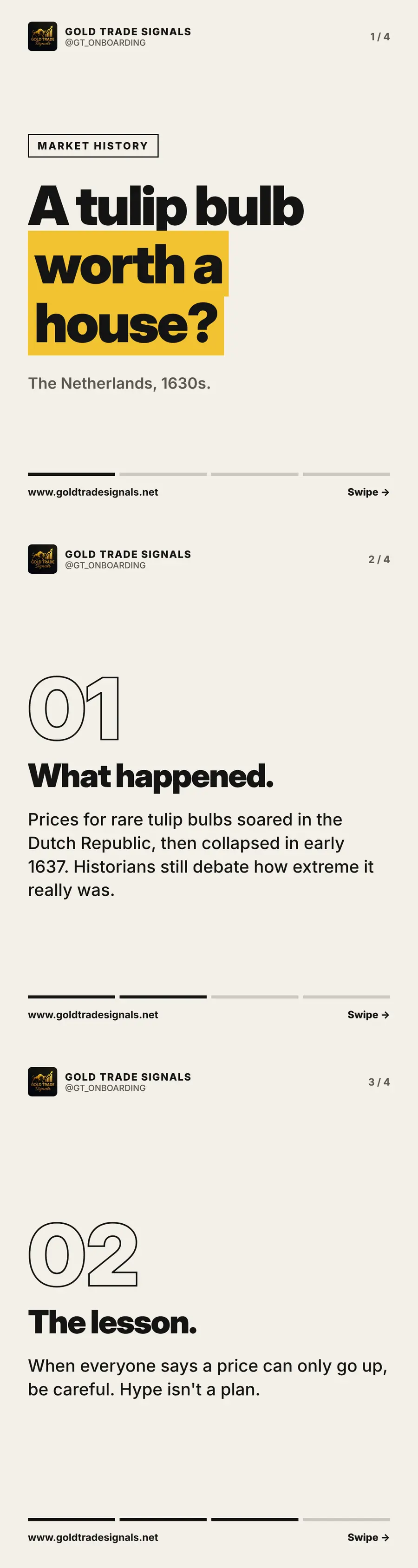
It is the oldest bubble story in the book. In the Dutch Republic of the 1630s, prices for rare tulip bulbs climbed to levels that still sound absurd, with single bulbs reportedly changing hands for more than a house. Then, in early 1637, the market collapsed. The details are debated, but the lesson is not.
What happened in the Netherlands
Tulips arrived in Europe from the Ottoman Empire in the 1500s and became a status symbol among the wealthy Dutch. Bulbs that produced rare, streaked flowers were especially prized. As demand grew, people began buying bulbs not to plant them but to sell them on at a higher price, often through contracts for bulbs still in the ground.
Prices for the rarest varieties rose dramatically through 1636, and by the winter trading had spread well beyond serious collectors. Then in February 1637 buyers stopped appearing at auctions, prices fell sharply, and many contracts were never honoured. Historians still debate how widespread the mania really was and how much economic damage it caused.
Why the pattern keeps repeating
Strip away the flowers and the mechanics are familiar. An asset starts rising, early buyers make money, their stories spread, and new buyers arrive who care only that the price went up yesterday. At some point the only reason to buy is the expectation of selling to someone else at a higher price. When those buyers stop coming, there is nothing underneath.
Gold is a real asset with thousands of years of history, so it is not a tulip bulb. But gold traders are still human, and the same crowd psychology shows up in sharp rallies, in social media hype and in the urge to buy because everybody else is.
The lesson for gold traders
When everyone says a price can only go up, be careful. That sentence has preceded most of the worst losses in market history. Hype is not a plan. An entry, a stop-loss and a take-profit are a plan, and they work whether the crowd is right or wrong. That is the approach we teach in every live session.
Key takeaways
- Rare tulip bulb prices soared in the 1630s, then collapsed in 1637.
- Bubbles form when people buy only because prices went up.
- When everyone says it can only go up, be careful.
Common questions
What was tulip mania?
Tulip mania was a period in the 1630s Dutch Republic when prices for rare tulip bulbs rose to extraordinary levels before collapsing in early 1637. It is often cited as the first recorded speculative bubble.
What can traders learn from tulip mania?
Be cautious when an asset is rising purely on hype and everyone expects it to keep going. Trade with a defined plan and stop-loss rather than following the crowd.
Trade ideas with the levels already worked out
Join the free community and receive XAU/USD trade ideas with entry, stop-loss and take-profit, live training on Tuesdays and Thursdays, and support whenever you are stuck.
Join free on TelegramOpen the calculatorsRisk warning: This article is educational content, not personal investment advice. Gold is a leveraged, volatile instrument and you can lose some or all of your capital. Gold Trade Signals is not FCA regulated. Read the full risk warning.
More from Market History
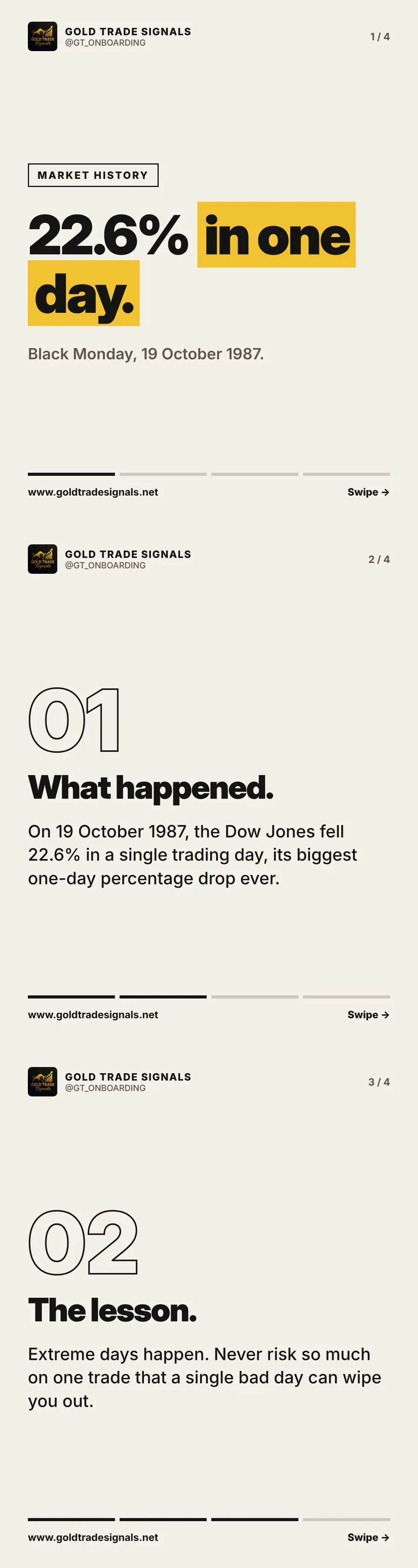
Black Monday 1987: the day the Dow fell 22.6% in one session
On 19 October 1987 the Dow Jones fell 22.6% in a single day. Learn what happened on Black Monday and the lesson it holds for anyone trading gold today.

Lehman Brothers 2008: when a giant bank collapsed
On 15 September 2008 Lehman Brothers filed the largest bankruptcy in US history. What happened and why gold traders plan for volatility before it arrives.

Isaac Newton and the South Sea Bubble of 1720
Even Isaac Newton lost money in a market bubble. Learn what happened with the South Sea Company in 1720 and why intelligence is no protection against FOMO.