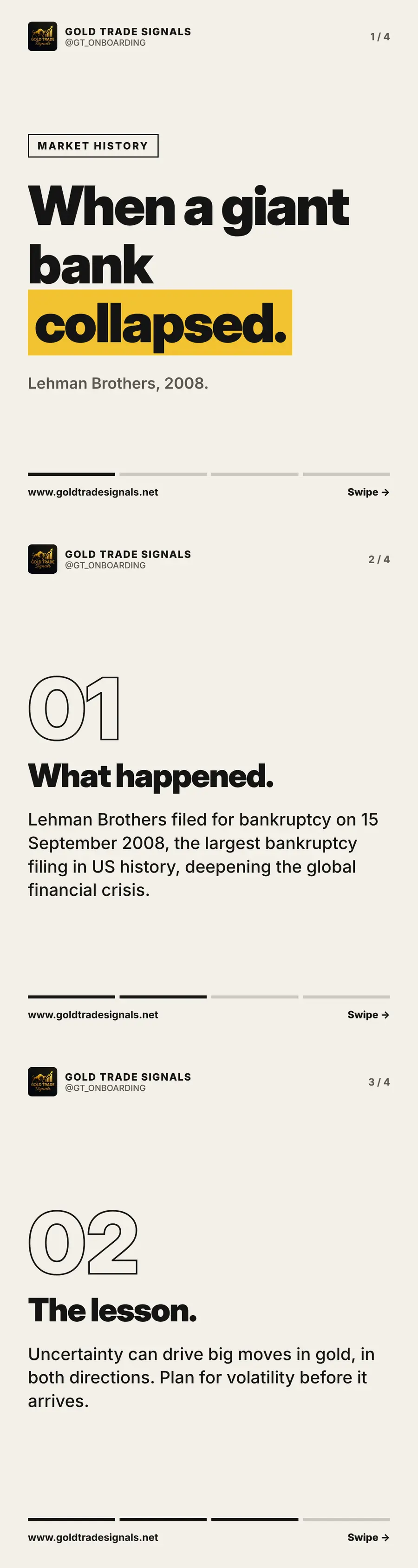
On 15 September 2008, Lehman Brothers, one of the largest investment banks in the world, filed for bankruptcy. It remains the biggest bankruptcy filing in US history and it turned a credit crunch into a global financial crisis. Gold traders remember it for a different reason: what the metal did next surprised many.
What happened
Lehman had built up enormous exposure to US mortgage-related securities. As house prices fell and those securities lost value, the bank's losses mounted and confidence drained away. Over a single weekend in September 2008, attempts to find a buyer or arrange a rescue failed, and on the Monday morning the firm filed for bankruptcy.
The shock spread immediately. Banks stopped trusting each other, credit markets froze, stock markets fell sharply around the world, and governments stepped in with huge rescue packages for other institutions. The crisis that followed shaped interest rates, central bank policy and the gold price for the next decade.
The lesson for gold traders
Many people assume gold simply rises in a crisis. In the weeks after Lehman it did the opposite for a while, falling as investors sold anything they could to raise cash. Only later, as central banks cut rates and expanded their balance sheets, did gold begin the long rally that took it to record highs in 2011.
The lesson is that uncertainty drives big moves in gold in both directions, and the direction is not always the obvious one. Plan for volatility before it arrives: keep lot sizes modest, use a stop-loss on every trade, and avoid assuming any outcome is certain. That is how we approach every idea we post.
Key takeaways
- Lehman filed for bankruptcy on 15 September 2008, the largest in US history.
- Gold fell at first in the panic, then rallied strongly over years.
- Plan for volatility in both directions before it arrives.
Common questions
What happened to gold when Lehman Brothers collapsed?
Gold initially fell in the weeks after the collapse as investors sold assets to raise cash. It then rose strongly over the following years as central banks cut rates and expanded money supply.
Why did Lehman Brothers go bankrupt?
Heavy exposure to US mortgage-related securities that lost value as house prices fell, combined with a loss of market confidence and no buyer or government rescue.
Trade ideas with the levels already worked out
Join the free community and receive XAU/USD trade ideas with entry, stop-loss and take-profit, live training on Tuesdays and Thursdays, and support whenever you are stuck.
Join free on TelegramOpen the calculatorsRisk warning: This article is educational content, not personal investment advice. Gold is a leveraged, volatile instrument and you can lose some or all of your capital. Gold Trade Signals is not FCA regulated. Read the full risk warning.
More from Market History
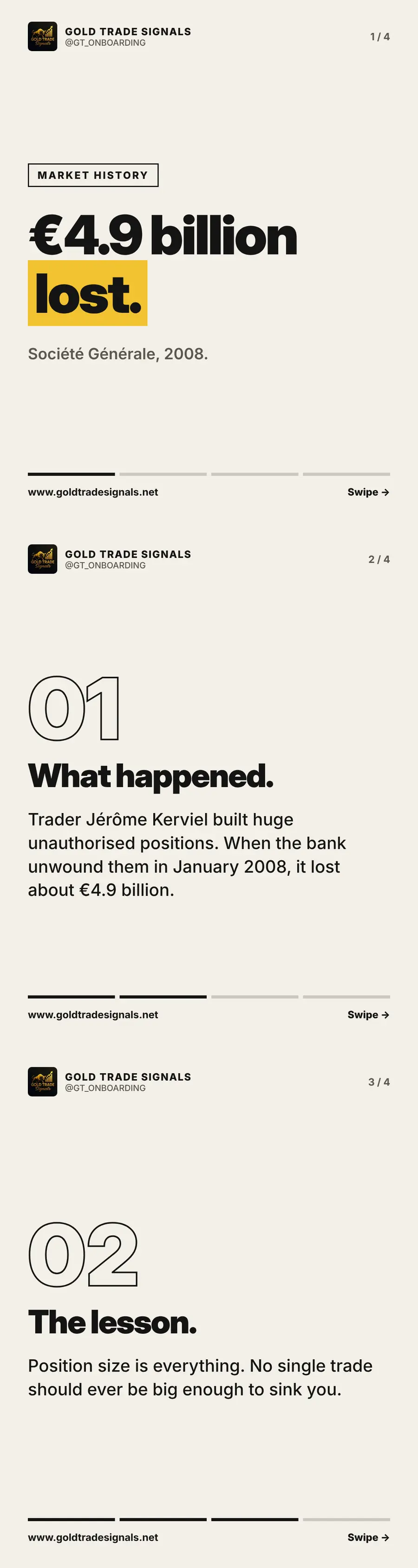
Kerviel and the €4.9 billion Société Générale loss, 2008
In January 2008 Société Générale lost about €4.9 billion unwinding a rogue trader's hidden positions. What happened and the lesson on position size.
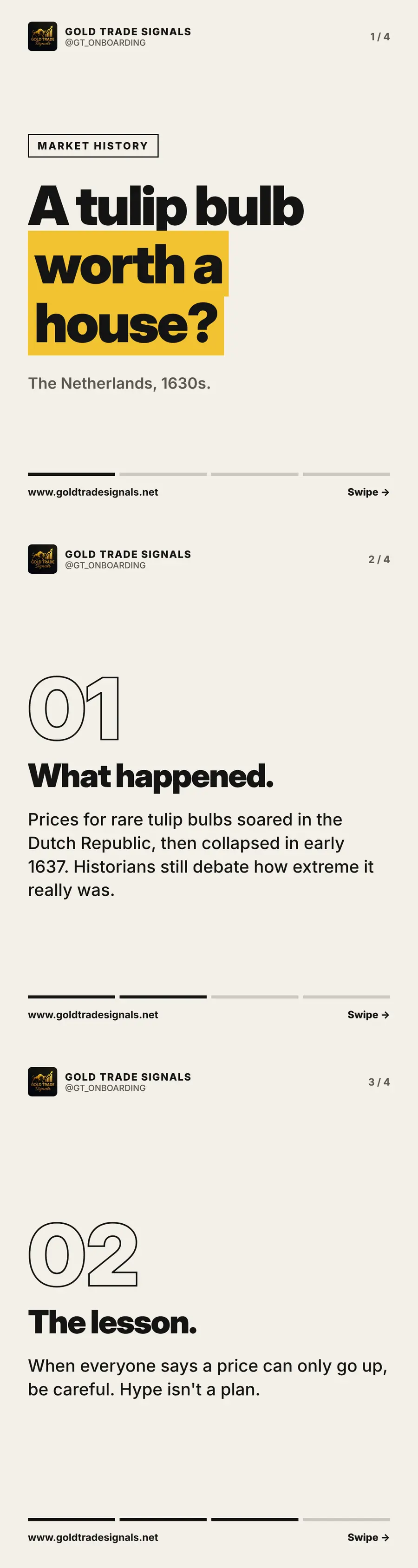
Tulip mania in the 1630s and what it teaches gold traders
In the 1630s rare tulip bulbs in the Dutch Republic reportedly sold for more than a house, then prices collapsed in 1637. Learn the story and the lesson.
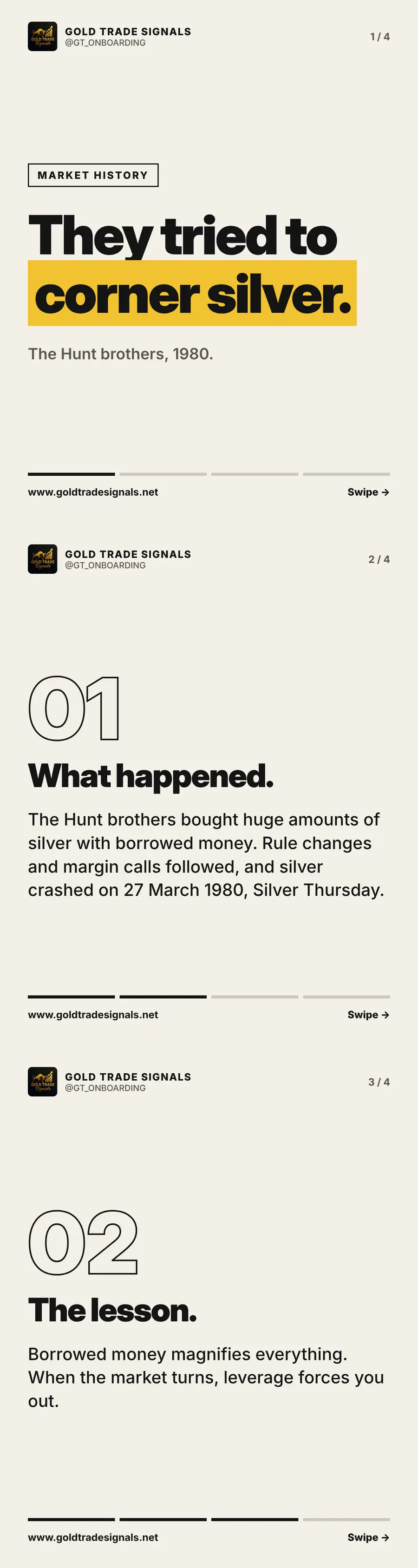
The Hunt brothers and Silver Thursday, 1980
Two billionaire brothers tried to corner the silver market with borrowed money. What happened on Silver Thursday in 1980 and what it teaches gold traders.