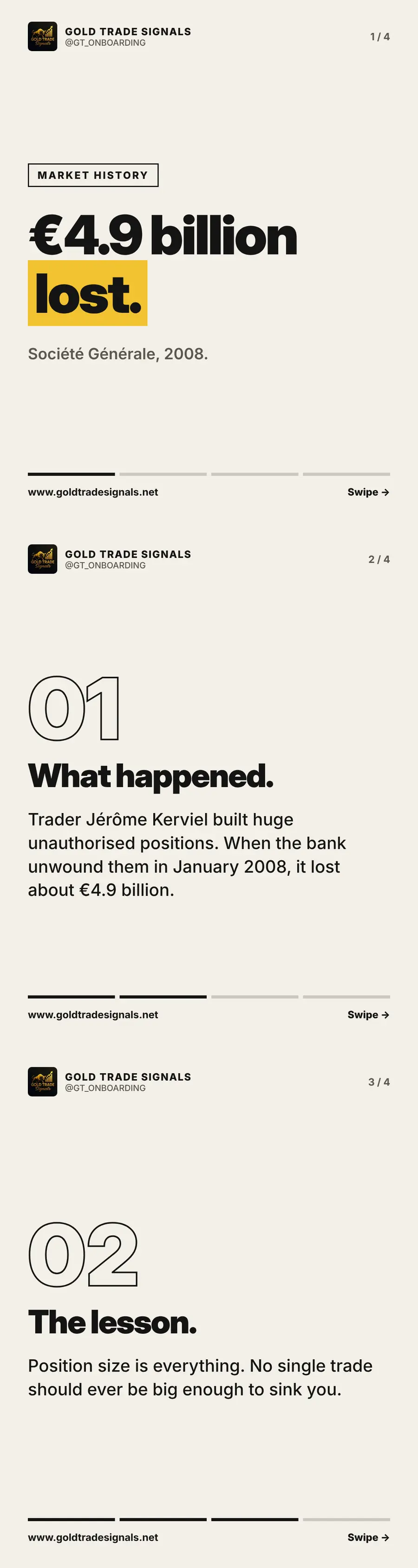
In January 2008, one of France's largest banks announced a loss of about €4.9 billion from the trades of a single employee. Jérôme Kerviel, a junior trader at Société Générale, had built enormous unauthorised positions and hidden them for months. The story is a lesson in what happens when size runs out of control.
What happened
Kerviel worked on a desk that was supposed to take small, hedged positions on European stock index futures. Instead, he built directional bets that grew to tens of billions of euros, far beyond the bank's own capital, and used his knowledge of the back office systems to disguise them with fictitious offsetting trades.
When the positions were discovered in January 2008, the bank decided to close them immediately. Unwinding such a large position over a few days, during a market that was already falling, turned a paper problem into a realised loss of around €4.9 billion. Kerviel was later convicted, and the case prompted banks worldwide to tighten their controls on trading limits.
The lesson for a gold trader
Position size is everything. Kerviel's trades were not necessarily bad ideas on their own. The problem was that each one was big enough to sink the institution if it went wrong. Once a position is that large, the market decides your fate, not your analysis. The exit was forced, at the worst time, because there was no other option.
The same principle scales down to a retail gold account. No single trade should ever be big enough to sink you. If one loss at your stop-loss would take a serious bite from the account, the position is too large, however confident you feel. Fixed lot sizes and a stop-loss on every idea are how we keep that rule in place, and position sizing is one of the first things we teach new members.
Key takeaways
- Kerviel hid huge unauthorised positions at Société Générale.
- Unwinding them in January 2008 cost about €4.9 billion.
- No single trade should be big enough to sink you.
Common questions
How much did Jérôme Kerviel lose Société Générale?
The bank reported a loss of about €4.9 billion in January 2008 after closing out his unauthorised positions.
What is the lesson of the Kerviel case for traders?
Position size matters more than being right. A trade large enough to destroy the account removes your control over when and how you exit.
Trade ideas with the levels already worked out
Join the free community and receive XAU/USD trade ideas with entry, stop-loss and take-profit, live training on Tuesdays and Thursdays, and support whenever you are stuck.
Join free on TelegramOpen the calculatorsRisk warning: This article is educational content, not personal investment advice. Gold is a leveraged, volatile instrument and you can lose some or all of your capital. Gold Trade Signals is not FCA regulated. Read the full risk warning.
More from Market History
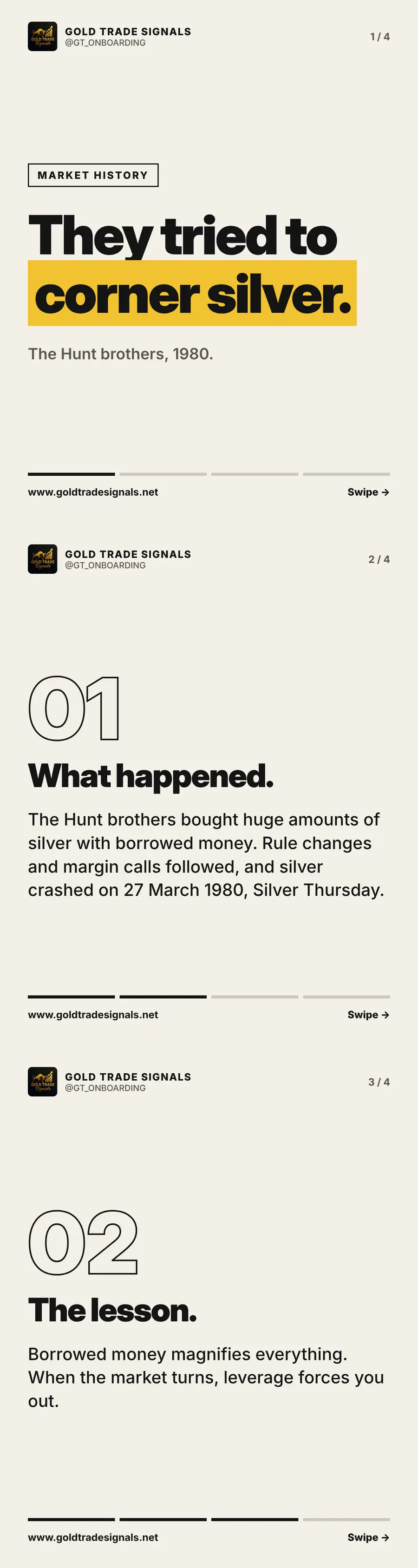
The Hunt brothers and Silver Thursday, 1980
Two billionaire brothers tried to corner the silver market with borrowed money. What happened on Silver Thursday in 1980 and what it teaches gold traders.
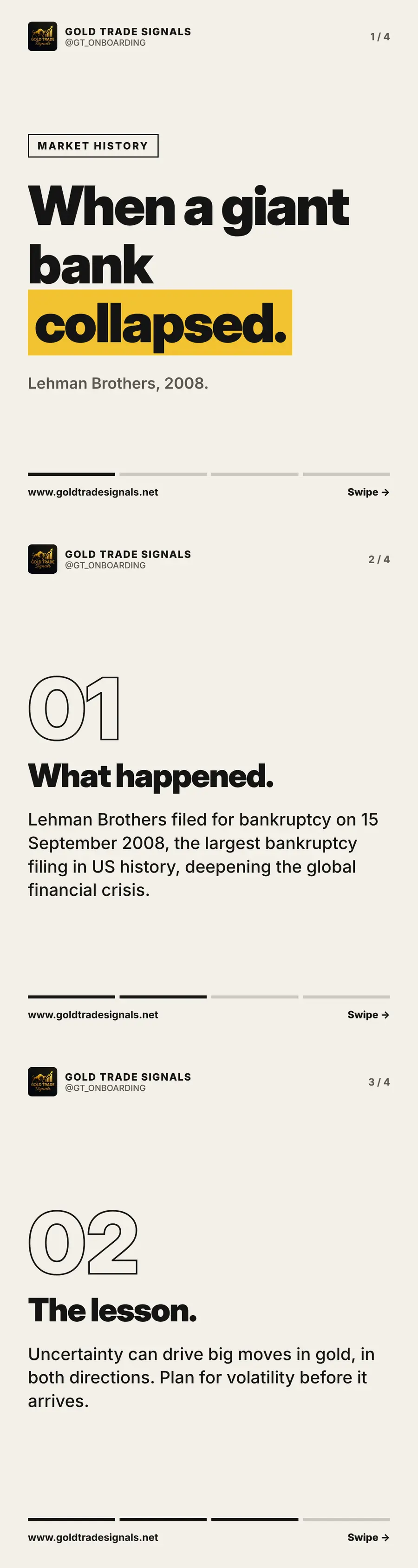
Lehman Brothers 2008: when a giant bank collapsed
On 15 September 2008 Lehman Brothers filed the largest bankruptcy in US history. What happened and why gold traders plan for volatility before it arrives.
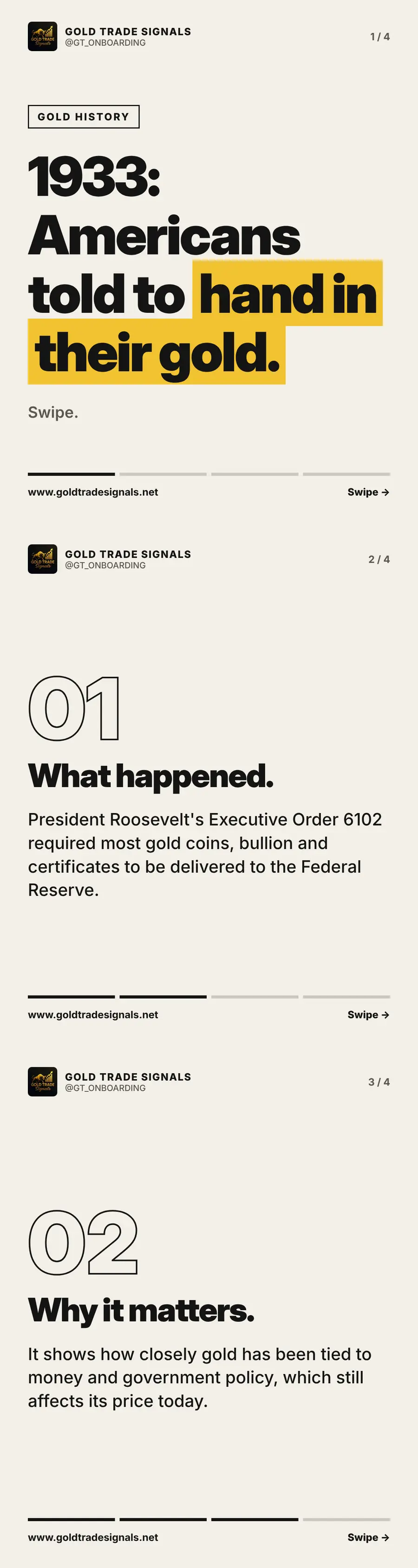
Executive Order 6102: when Americans had to hand in gold
In 1933 President Roosevelt ordered most privately held gold coins, bullion and certificates handed to the Federal Reserve. Why it still matters today.