
In the late 1970s, Nelson Bunker Hunt and William Herbert Hunt, sons of a Texas oil billionaire, set out to buy as much silver as they could. For a while it worked and the price soared. Then the rules changed, the loans were called and the whole position collapsed on a single day.
What happened
The Hunt brothers accumulated enormous amounts of physical silver and silver futures through the 1970s, much of it bought with borrowed money. As they bought, the price climbed, which made their holdings look more valuable and allowed them to borrow more. By early 1980 silver had risen to around 50 dollars an ounce, many times its level a few years earlier.
Exchanges and regulators then changed the rules, raising margin requirements and restricting new buying. The price began to fall, and falling prices meant margin calls on the borrowed money. On 27 March 1980, known as Silver Thursday, the brothers could not meet a huge margin call and silver crashed. The price lost roughly half its value in a short period and the Hunts' fortune went with it.
The lesson for a gold trader
Borrowed money magnifies everything. On the way up, leverage made the Hunts look like geniuses. On the way down, it took the decision out of their hands: when the market turned, margin calls forced them out at the worst possible moment. They did not choose to sell, they were made to.
Retail gold traders use leverage too, and the same mechanics apply at any size. If a position is so large that a normal pullback triggers a margin call, you are no longer trading, you are hoping. Safe position sizing means a move against you is a planned loss at your stop-loss, not an account event. That is the first thing we teach new members.
Key takeaways
- The Hunts bought huge silver positions with borrowed money.
- Rule changes and margin calls forced the sale on 27 March 1980.
- Leverage removes your choice when the market turns against you.
Common questions
What was Silver Thursday?
It was 27 March 1980, the day the Hunt brothers failed to meet a large margin call and the silver price crashed.
Did the Hunt brothers corner the silver market?
They came close to controlling a large share of the available silver, but rule changes and falling prices broke the position before they could complete it.
Trade ideas with the levels already worked out
Join the free community and receive XAU/USD trade ideas with entry, stop-loss and take-profit, live training on Tuesdays and Thursdays, and support whenever you are stuck.
Join free on TelegramOpen the calculatorsRisk warning: This article is educational content, not personal investment advice. Gold is a leveraged, volatile instrument and you can lose some or all of your capital. Gold Trade Signals is not FCA regulated. Read the full risk warning.
More from Market History

The 2010 Flash Crash: nearly 1,000 points in minutes
On 6 May 2010 the Dow fell nearly 1,000 points in minutes and then bounced back. Learn what happened in the Flash Crash and why sensible sizing matters.

Tulip mania in the 1630s and what it teaches gold traders
In the 1630s rare tulip bulbs in the Dutch Republic reportedly sold for more than a house, then prices collapsed in 1637. Learn the story and the lesson.
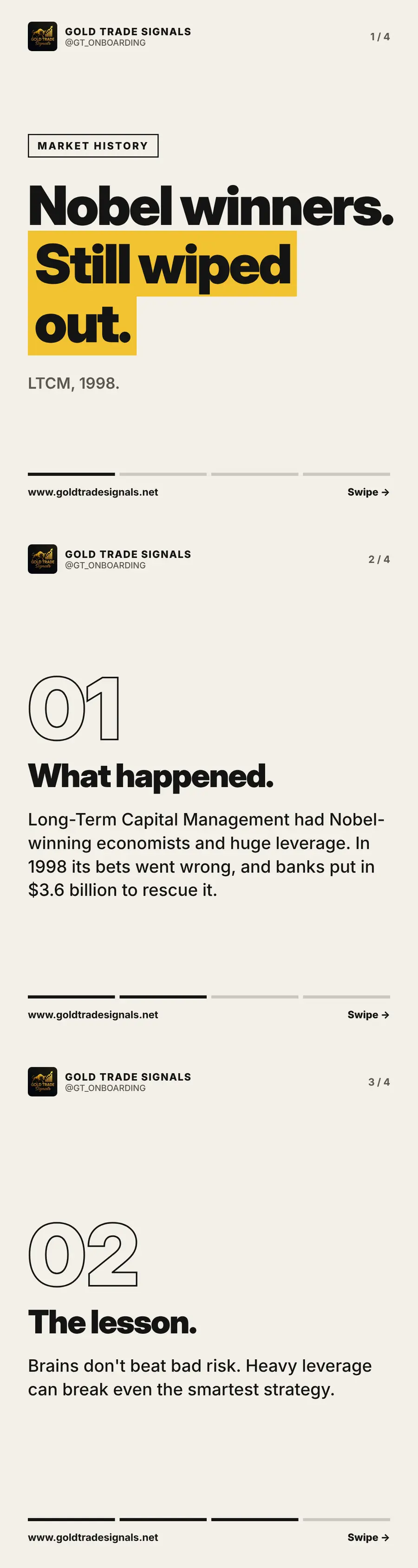
LTCM 1998: when Nobel winners met too much leverage
Long-Term Capital Management had Nobel-winning economists and huge leverage. In 1998 it needed a $3.6 billion rescue. Here is the lesson for gold traders.