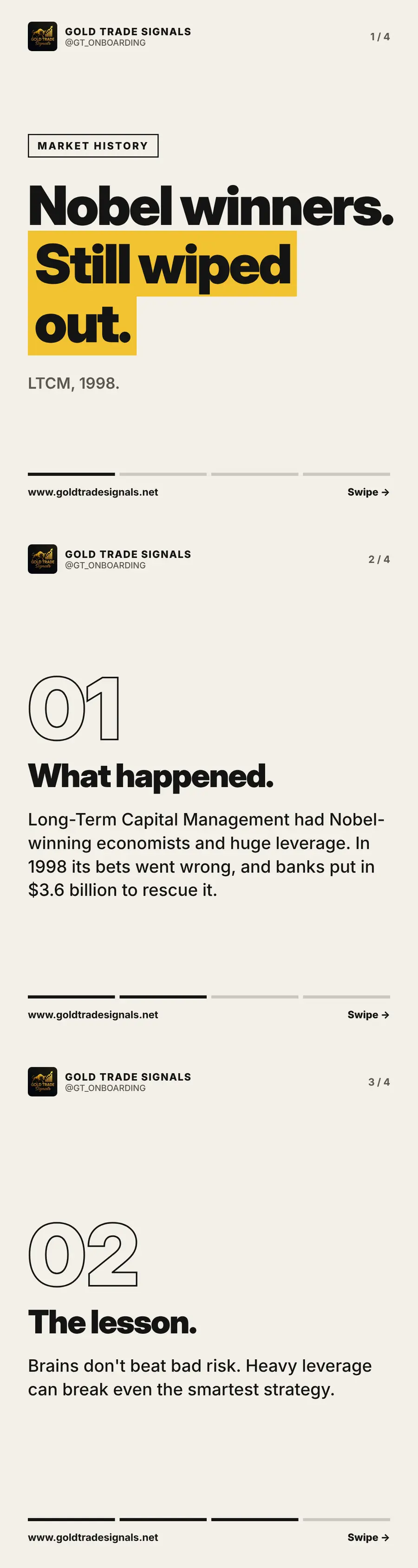
If brains alone could beat the market, Long-Term Capital Management should have been unbeatable. Its partners included two economists who had just won the Nobel Prize. Yet in 1998 the fund came close to taking several big banks down with it. The reason was leverage, and the lesson applies to every gold trader.
What happened
Long-Term Capital Management, usually shortened to LTCM, was a hedge fund that made highly leveraged bets on small price differences between related bonds and other instruments. For a few years it was very profitable. To make those tiny differences pay, it borrowed heavily, controlling positions worth many times its own capital.
In 1998, after Russia defaulted on its debt, markets moved in ways the fund's models had treated as almost impossible. Positions that were supposed to be unrelated all lost money at once, and the borrowed money turned those losses into a crisis. In September 1998 a group of major banks, coordinated by the Federal Reserve, put in around $3.6 billion to rescue it and unwind the positions.
The lesson for gold traders
Brains do not beat bad risk. LTCM's strategy was built by some of the smartest people in finance, and heavy leverage still broke it. A retail gold account is far smaller, but the mechanics are identical: the more you borrow relative to your capital, the smaller the move needed to wipe you out.
Treat leverage as a tool you use sparingly, not a way to get rich faster. Keep lot sizes small relative to your account, use a stop-loss on every trade, and assume that so-called impossible moves will happen eventually. We cover sensible leverage in our live training on Tuesday and Thursday.
Key takeaways
- LTCM had Nobel-winning partners and still needed a $3.6 billion rescue.
- Heavy leverage turns an unusual market move into a fatal one.
- Keep lot sizes small and use a stop-loss on every gold trade.
Common questions
What caused the collapse of LTCM in 1998?
Extreme leverage combined with market moves, following Russia's 1998 debt default, that its models had treated as near impossible. Losses on borrowed money wiped out its capital within months.
Why is LTCM relevant to retail traders today?
It shows that intelligence and a good strategy do not survive excessive leverage. The same principle applies to a small gold account: borrow less and you survive the unexpected.
Trade ideas with the levels already worked out
Join the free community and receive XAU/USD trade ideas with entry, stop-loss and take-profit, live training on Tuesdays and Thursdays, and support whenever you are stuck.
Join free on TelegramOpen the calculatorsRisk warning: This article is educational content, not personal investment advice. Gold is a leveraged, volatile instrument and you can lose some or all of your capital. Gold Trade Signals is not FCA regulated. Read the full risk warning.
More from Market History
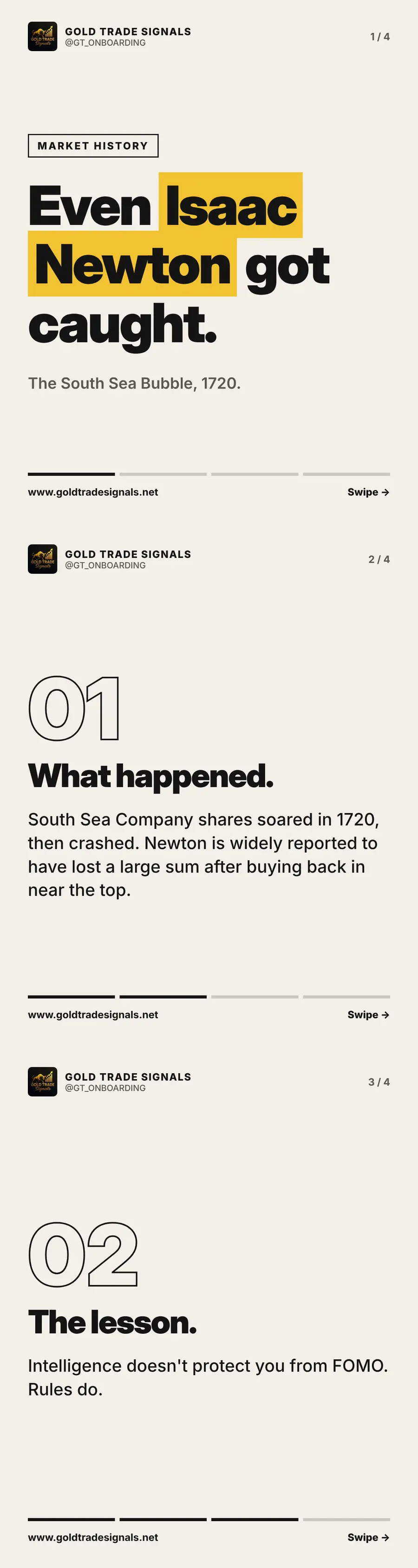
Isaac Newton and the South Sea Bubble of 1720
Even Isaac Newton lost money in a market bubble. Learn what happened with the South Sea Company in 1720 and why intelligence is no protection against FOMO.
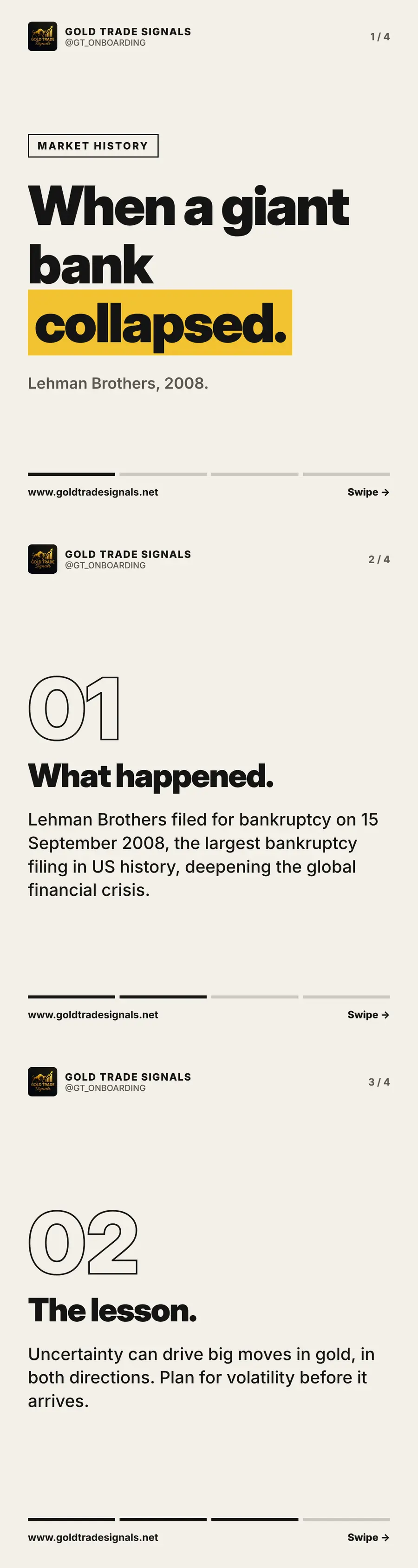
Lehman Brothers 2008: when a giant bank collapsed
On 15 September 2008 Lehman Brothers filed the largest bankruptcy in US history. What happened and why gold traders plan for volatility before it arrives.
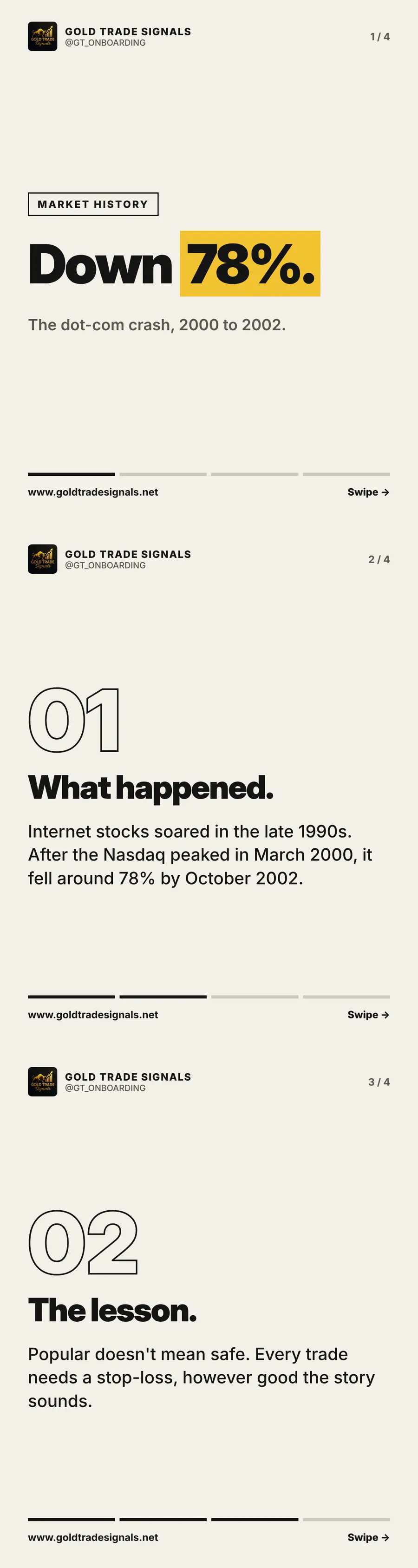
The dot-com crash: how the Nasdaq fell around 78% by 2002
After the Nasdaq peaked in March 2000 it fell around 78% by October 2002. Learn what happened in the dot-com crash and the lesson it holds for gold traders.