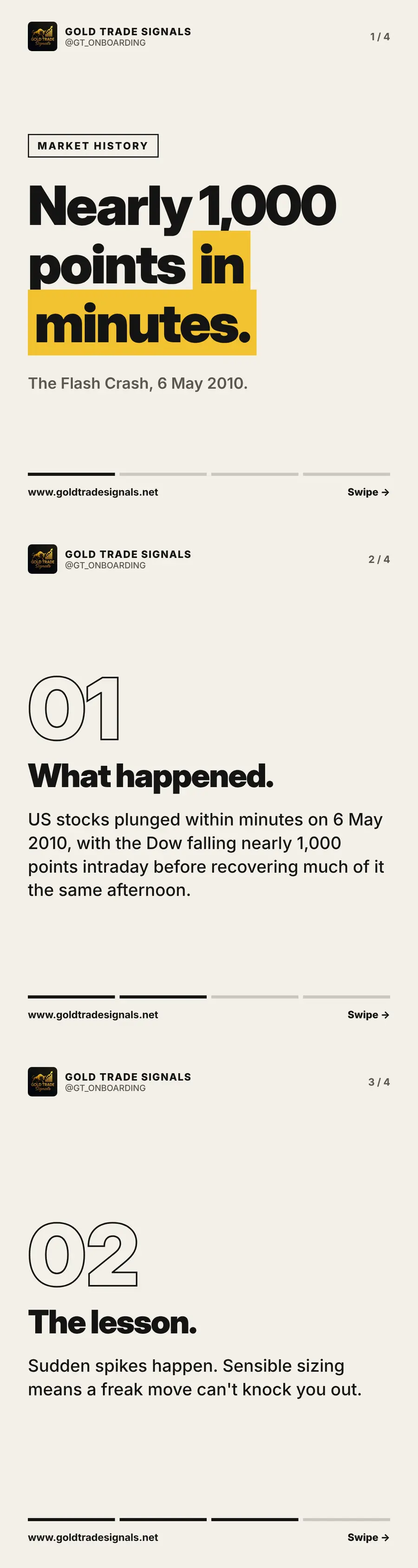
On the afternoon of 6 May 2010, US stock markets did something nobody watching had seen before. The Dow Jones index dropped nearly 1,000 points in a matter of minutes, then recovered most of the fall almost as quickly. It became known as the Flash Crash, and it still shapes how traders think about sudden moves.
What happened
Markets were already nervous that day because of the European debt crisis. In the middle of the afternoon, selling accelerated sharply. Within minutes the Dow was down nearly 1,000 points intraday, its largest point drop within a single day at that time. Some well-known shares briefly traded at absurd prices, a few for as little as a cent.
Then it reversed. By the close, much of the fall had been recovered, and many of the strangest trades were later cancelled. Investigations pointed to a large automated sell order in futures combined with high-frequency trading systems withdrawing from the market, which left very little buying to absorb the selling. The event prompted new circuit breaker rules in the years that followed.
The lesson for a gold trader
Sudden spikes happen. Not often, but they do, and gold is not immune: thin liquidity around news or in quiet hours can produce sharp moves that reverse just as fast. You will not see them coming, and neither will anyone else. The only thing within your control is how much a freak move can hurt you.
Sensible sizing means a move far beyond anything you expected still leaves the account intact. If a position is sized so that a normal stop-loss is a small loss, an unusual slip past that stop is an annoying loss rather than a fatal one. That is the whole point of trading smaller than you think you need to, and it is how we size every trade idea we share.
Key takeaways
- The Dow fell nearly 1,000 points intraday on 6 May 2010.
- Much of the move was recovered the same afternoon.
- Size trades so that a freak move cannot knock you out.
Common questions
What caused the 2010 Flash Crash?
Investigations pointed to a large automated sell order in futures combined with high-frequency traders pulling out, leaving almost no buyers for a few minutes.
Can a flash crash happen in gold?
Sharp, fast moves can happen in any market, especially in thin conditions. Sensible position sizing is the practical protection.
Trade ideas with the levels already worked out
Join the free community and receive XAU/USD trade ideas with entry, stop-loss and take-profit, live training on Tuesdays and Thursdays, and support whenever you are stuck.
Join free on TelegramOpen the calculatorsRisk warning: This article is educational content, not personal investment advice. Gold is a leveraged, volatile instrument and you can lose some or all of your capital. Gold Trade Signals is not FCA regulated. Read the full risk warning.
More from Market History
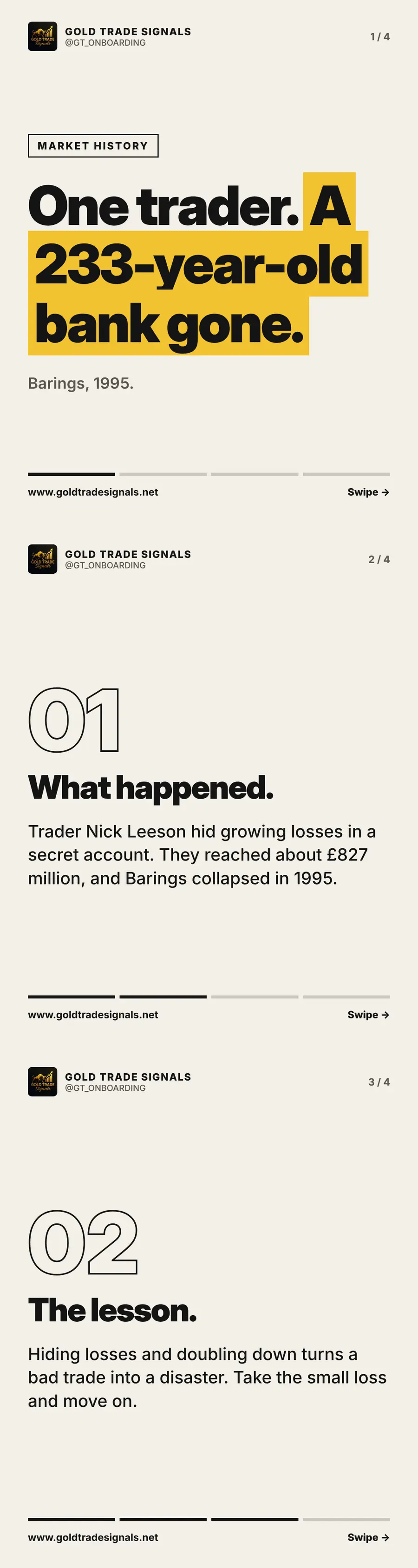
Barings Bank 1995: how one trader's hidden losses sank a bank
In 1995 Nick Leeson hid losses of around £827 million and brought down Barings, a 233-year-old bank. Learn what happened and the lesson for gold traders.
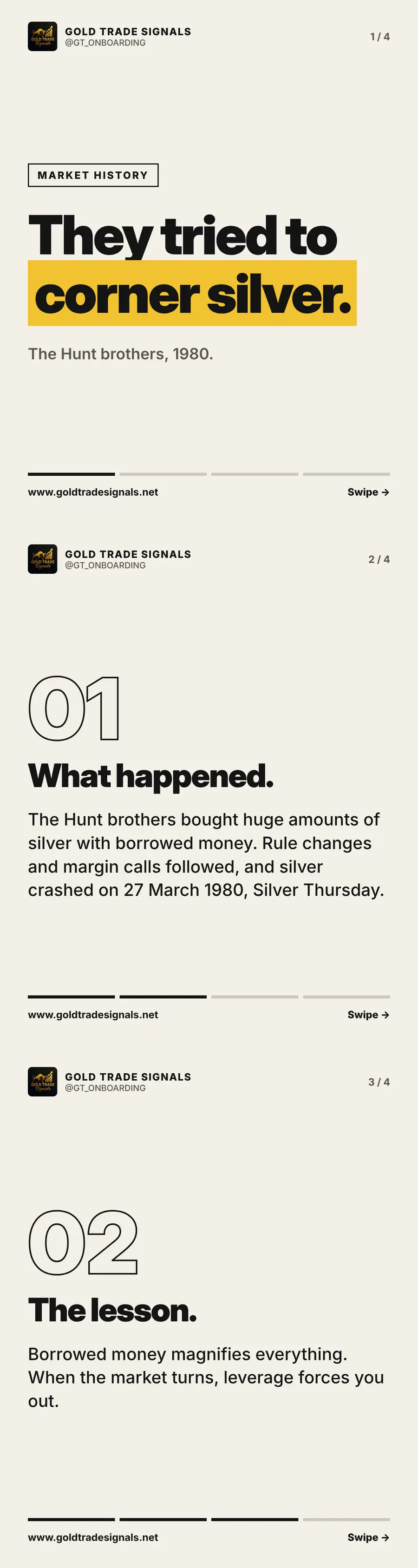
The Hunt brothers and Silver Thursday, 1980
Two billionaire brothers tried to corner the silver market with borrowed money. What happened on Silver Thursday in 1980 and what it teaches gold traders.

Isaac Newton and the South Sea Bubble of 1720
Even Isaac Newton lost money in a market bubble. Learn what happened with the South Sea Company in 1720 and why intelligence is no protection against FOMO.