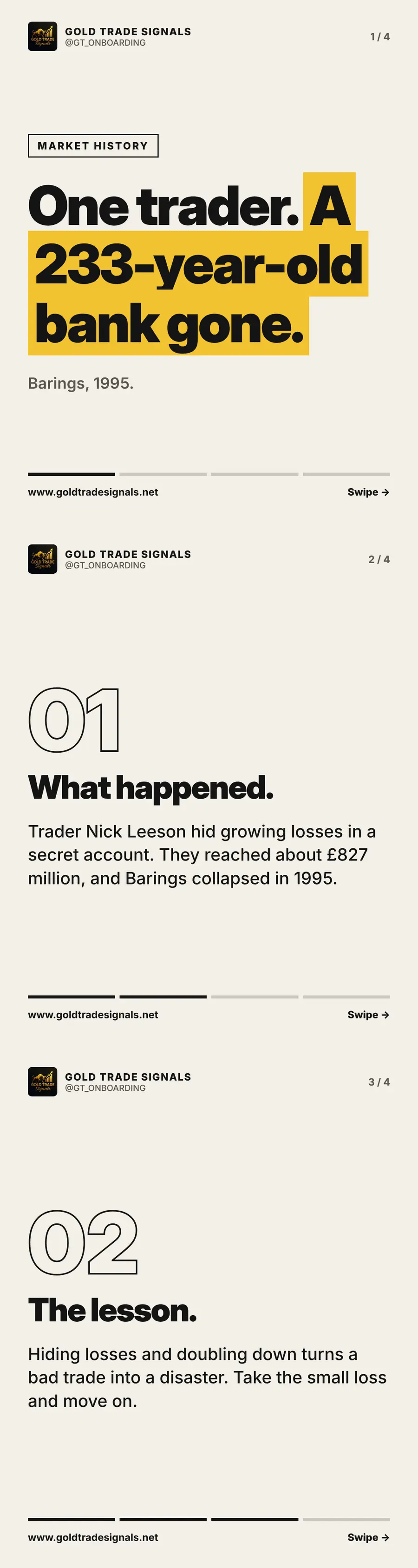
Barings was one of the oldest merchant banks in Britain, founded in 1762. In February 1995 it collapsed, brought down not by a market crash but by one trader who could not accept a loss. The story is a warning that every gold trader should keep close.
What happened at Barings
Nick Leeson was running the bank's trading operation in Singapore, dealing mostly in futures on the Japanese stock market. When trades went wrong, instead of reporting the losses he moved them into a secret error account where head office could not see them. On paper he looked like a star performer.
To recover the hidden losses he kept trading bigger, betting that the market would turn his way. It did not. After the Kobe earthquake in January 1995 the Japanese market fell sharply and the losses ballooned to around £827 million, more than the bank's entire capital. Barings collapsed and was sold for a nominal sum.
The pattern that destroys accounts
Strip away the scale and the behaviour is familiar to anyone who has traded. A loss feels like a mistake, so it gets hidden, ignored or left open in the hope it comes back. Then the position gets increased to make the money back faster. Each step feels reasonable in the moment, and each step raises the stakes.
In a retail account there is no secret ledger, but the same thing happens when a trader removes a stop-loss, averages into a losing trade or doubles the lot size after a bad day. The loss that should have been small becomes the one that empties the account.
The lesson for gold traders
Take the small loss and move on. A stop-loss that gets hit is the system working, not failing. Every trade idea we share has an entry, a stop-loss and a take-profit for exactly this reason: the maximum loss is decided before the trade, and it is never negotiated afterwards. If you want help building that discipline, our free community and live training are open to you.
Key takeaways
- Hidden losses and doubling down turned one bad trade into a disaster.
- A stop-loss hit is the system working, not a failure.
- Decide your maximum loss before the trade and never renegotiate it.
Common questions
Why did Barings Bank collapse in 1995?
Trader Nick Leeson hid growing losses in a secret account and kept increasing his positions. The losses reached around £827 million, more than the bank's capital, and Barings collapsed.
What can traders learn from Nick Leeson?
Never hide, ignore or double down on a losing trade. Accept the small loss your stop-loss defines, and keep position sizes sensible so no single trade can do serious damage.
Trade ideas with the levels already worked out
Join the free community and receive XAU/USD trade ideas with entry, stop-loss and take-profit, live training on Tuesdays and Thursdays, and support whenever you are stuck.
Join free on TelegramOpen the calculatorsRisk warning: This article is educational content, not personal investment advice. Gold is a leveraged, volatile instrument and you can lose some or all of your capital. Gold Trade Signals is not FCA regulated. Read the full risk warning.
More from Market History
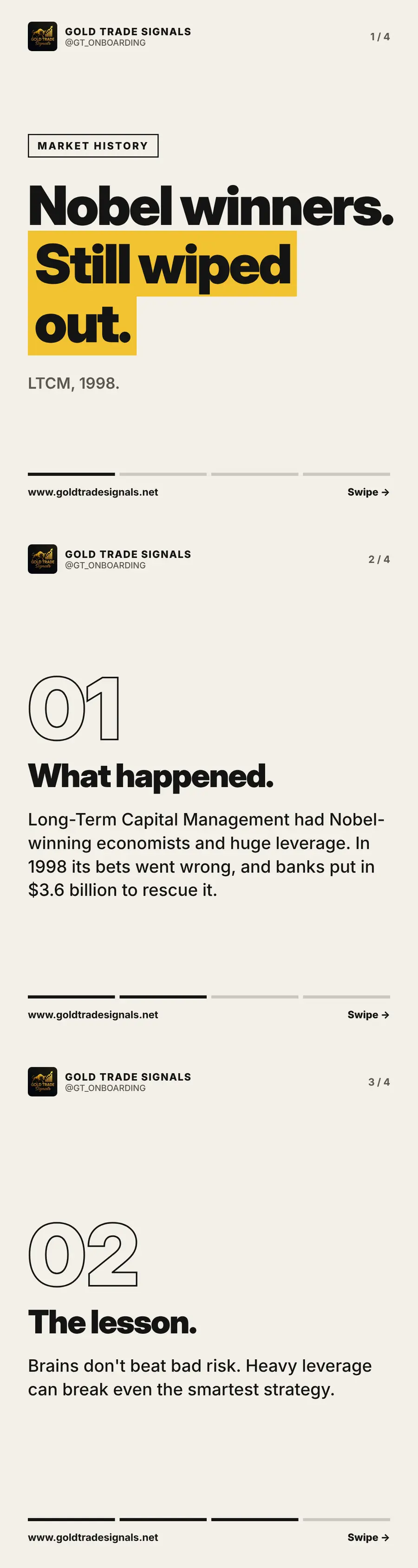
LTCM 1998: when Nobel winners met too much leverage
Long-Term Capital Management had Nobel-winning economists and huge leverage. In 1998 it needed a $3.6 billion rescue. Here is the lesson for gold traders.
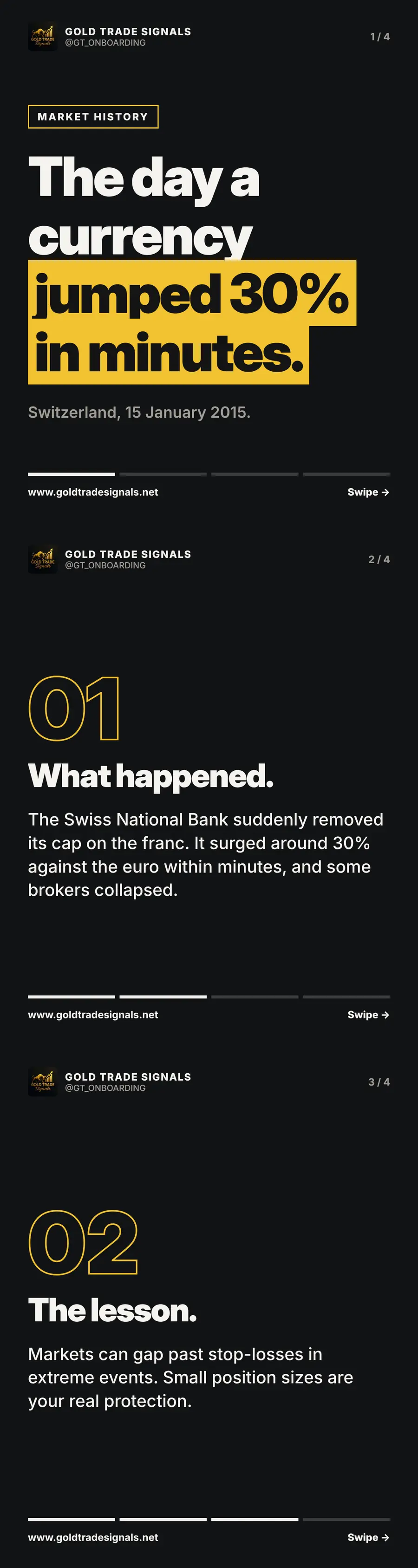
The Swiss franc shock of 2015 and what it teaches gold traders
On 15 January 2015 the Swiss franc jumped around 30% in minutes and brokers collapsed. Learn what happened and why position size is your real protection.
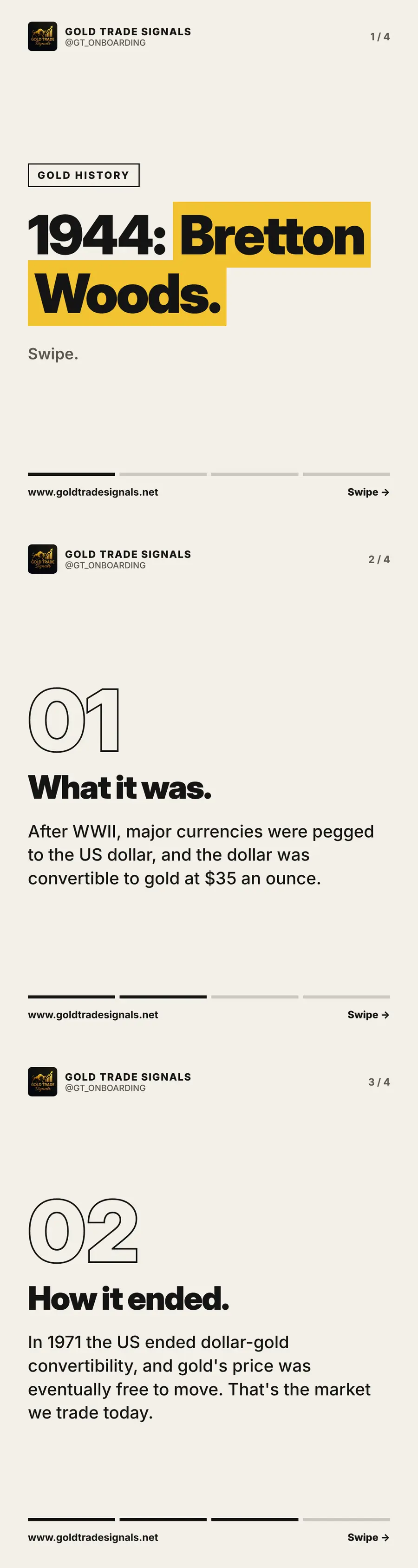
Bretton Woods 1944: when the world's money was tied to gold
In 1944 Bretton Woods pegged major currencies to the dollar and the dollar to gold at $35 an ounce. How it worked, how it ended and why it matters today.