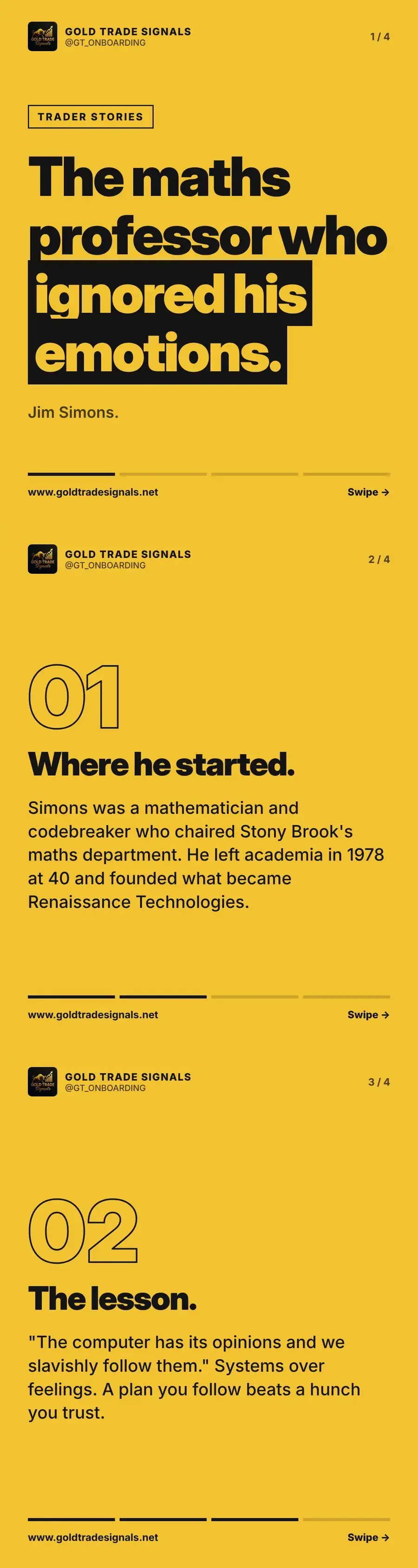
Jim Simons did not come to markets as a trader. He came as a mathematician who decided emotions had no place in the decision. This article covers where he started, the principle he became known for, and the one lesson every gold trader can use: a plan you follow beats a hunch you trust.
Where he started
Simons was a mathematician and codebreaker who chaired the maths department at Stony Brook. He left academia in 1978, at the age of 40, and founded what became Renaissance Technologies. Rather than relying on gut feel or market gossip, he built a firm around mathematical models that decided what to buy and sell, removing human emotion from the trade as far as possible.
The lesson
His own words sum it up: "The computer has its opinions and we slavishly follow them." Systems over feelings. A plan you follow beats a hunch you trust, because the plan was made calmly in advance while the hunch arrives in the heat of the moment. Simons is not affiliated with Gold Trade Signals, but the principle behind his approach is one we build into every trade idea.
What it means for a gold trader
You do not need a research team to apply this. Your system can be three rules: a stop-loss decided before the entry, the same lot size every time and no trading without a proper setup. Then follow them slavishly, in Simons's word, especially when a feeling tells you to override them. Trade with a plan, not a feeling, and let the rules take the strain.
Key takeaways
- Simons left academia at 40 and founded Renaissance Technologies
- He let systems, not emotions, make the trading decisions
- A plan you follow beats a hunch you trust
Common questions
Who is Jim Simons?
A mathematician and codebreaker who chaired Stony Brook's maths department, left academia in 1978 and founded what became Renaissance Technologies.
What can beginner traders learn from Jim Simons?
That systems beat feelings. A set of rules followed consistently, including a stop-loss on every trade, protects you from decisions made in the heat of the moment.
Trade ideas with the levels already worked out
Join the free community and receive XAU/USD trade ideas with entry, stop-loss and take-profit, live training on Tuesdays and Thursdays, and support whenever you are stuck.
Join free on TelegramOpen the calculatorsThe traders featured are not affiliated with, and do not endorse, Gold Trade Signals. Their results are exceptional, not typical.
Risk warning: This article is educational content, not personal investment advice. Gold is a leveraged, volatile instrument and you can lose some or all of your capital. Gold Trade Signals is not FCA regulated. Read the full risk warning.
More from Trader Stories and Habits
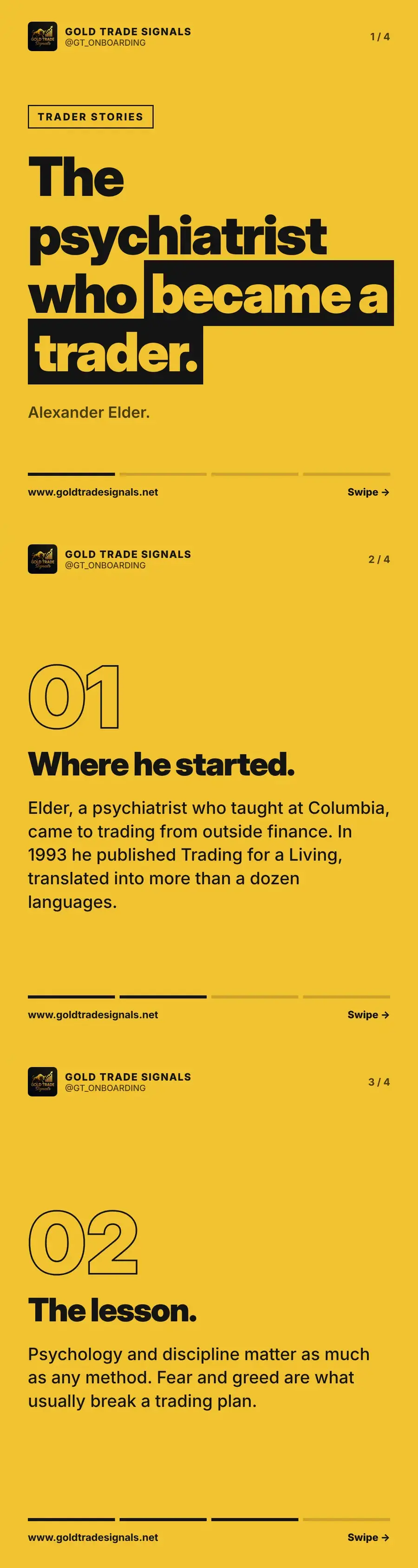
Alexander Elder: the psychiatrist who became a trader
Alexander Elder came to trading from psychiatry and wrote Trading for a Living in 1993. His lesson: psychology and discipline matter as much as any method.
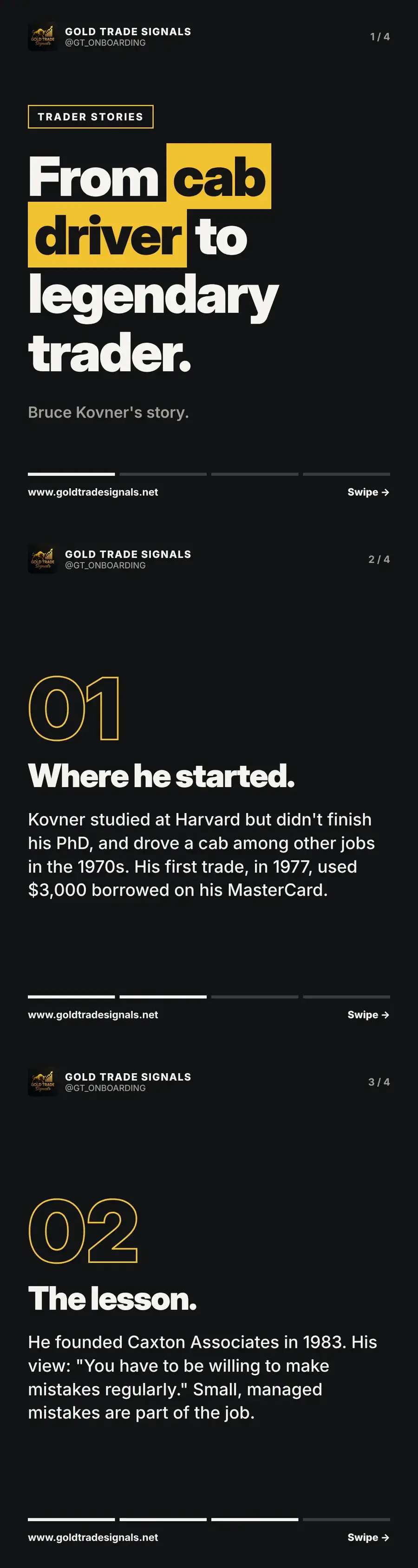
Bruce Kovner: from cab driver to legendary trader
Bruce Kovner drove a cab, made his first trade in 1977 with $3,000 borrowed on a credit card, and founded Caxton Associates. His lesson for gold traders.
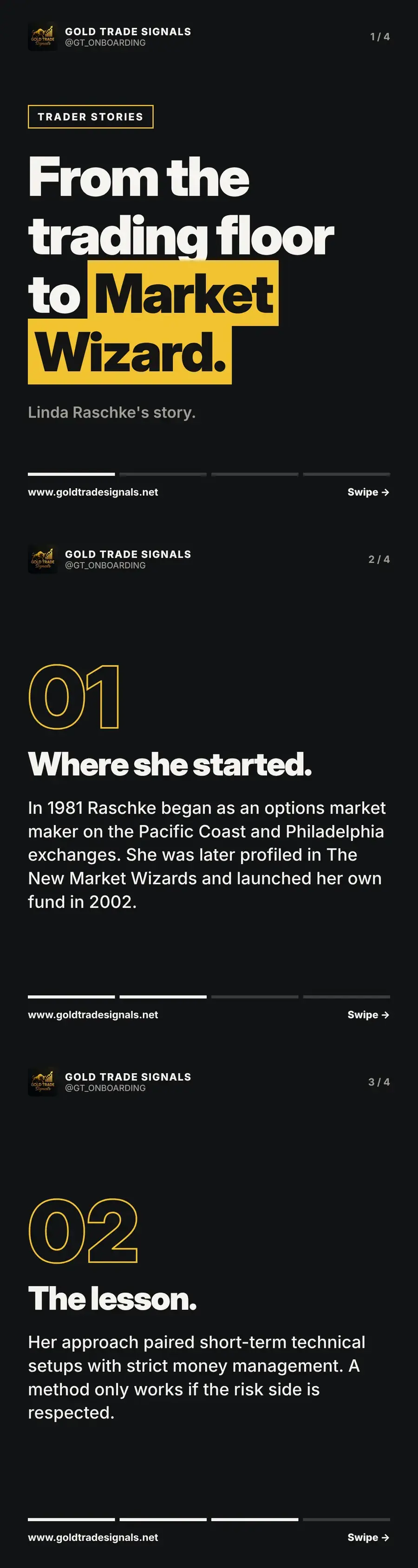
Linda Raschke: from the trading floor to Market Wizard
Linda Raschke began as an options market maker in 1981 and was profiled in The New Market Wizards. Her lesson: a method only works if risk is respected.