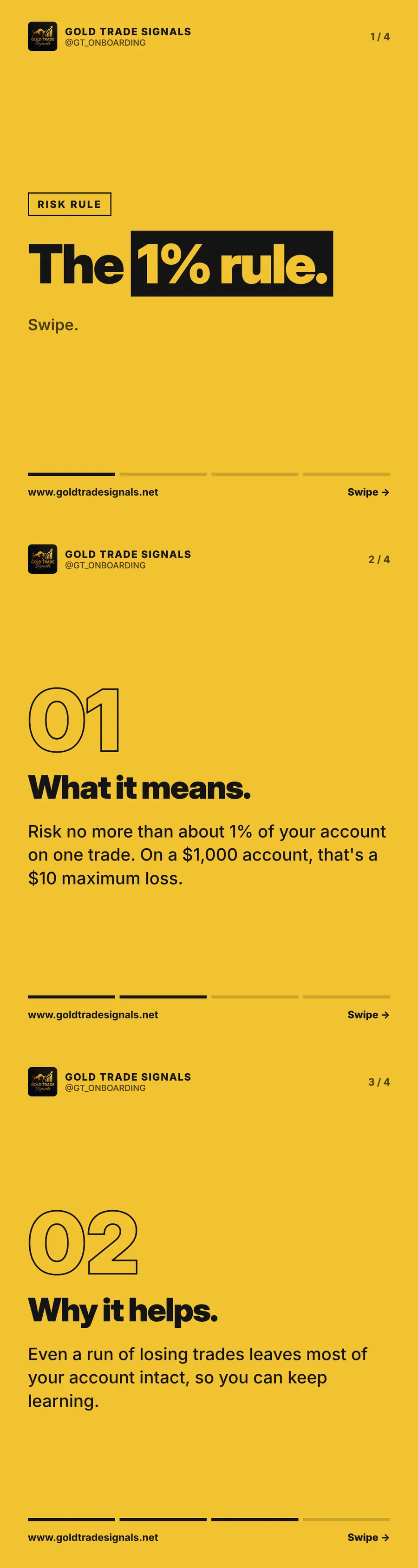
Ask experienced traders how they stayed in the game and most will mention some version of the 1% rule. It is one of the simplest risk guidelines there is: never risk more than about 1% of your account on a single trade. Here is what that means in practice and why it matters so much for beginners.
What the 1% rule means
The rule says you should risk no more than about 1% of your account balance on any one trade. Risk here means the amount you would lose if the trade hits your stop-loss, not the size of the position. On a $1,000 account, that is a maximum loss of $10 per trade. On a $5,000 account, it is $50.
To apply it, you work backwards from the stop-loss. Decide where your stop goes based on the chart, measure the distance from entry to stop in pips, then choose a lot size so that distance equals roughly 1% of your account. Every trade idea we share includes an entry, stop-loss and take-profit, so you always have the numbers you need to do this calculation.
Why it helps
Losing trades are a normal part of trading. The question is how much damage each one does. If you risk 1% per trade, a run of ten losses in a row costs you around 10% of your account. That hurts, but you are still trading and still learning. If you risk 10% per trade, the same run leaves you with almost nothing.
The 1% rule also takes emotion out of position sizing. You are not guessing how confident you feel, you are following a fixed number. Some traders use 0.5% while they learn, others go up to 2% once consistent. The exact figure matters less than having one and sticking to it. If you want help working out your own risk per trade, our team can walk you through it.
Key takeaways
- Risk no more than about 1% of your account on one trade.
- On a $1,000 account, that means a $10 maximum loss.
- Small losses keep you in the game long enough to learn.
Common questions
What is the 1% rule in trading?
It is a guideline that says you should not risk more than about 1% of your account balance on any single trade, measured by the loss at your stop-loss.
How do I calculate 1% risk on a gold trade?
Take 1% of your balance, measure the distance from entry to stop-loss in pips, then choose a lot size where that distance equals your 1% figure.
Trade ideas with the levels already worked out
Join the free community and receive XAU/USD trade ideas with entry, stop-loss and take-profit, live training on Tuesdays and Thursdays, and support whenever you are stuck.
Join free on TelegramOpen the calculatorsRisk warning: This article is educational content, not personal investment advice. Gold is a leveraged, volatile instrument and you can lose some or all of your capital. Gold Trade Signals is not FCA regulated. Read the full risk warning.
More from Trading Basics
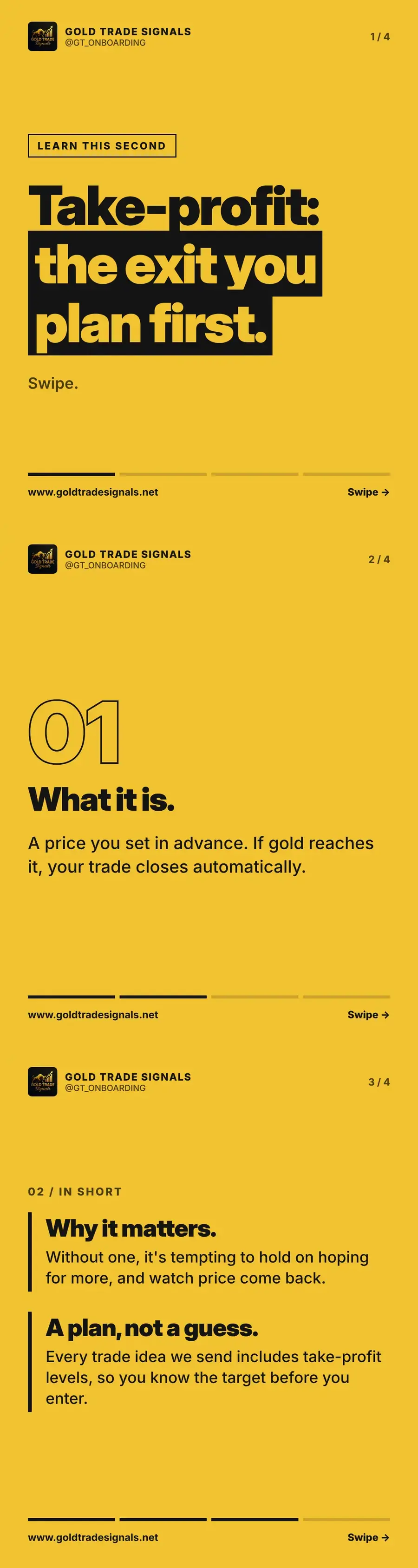
Take-profit explained: the exit you plan before the trade starts
A take-profit is a price set in advance that closes your gold trade at your target. We explain what it is and why planning the exit first helps.
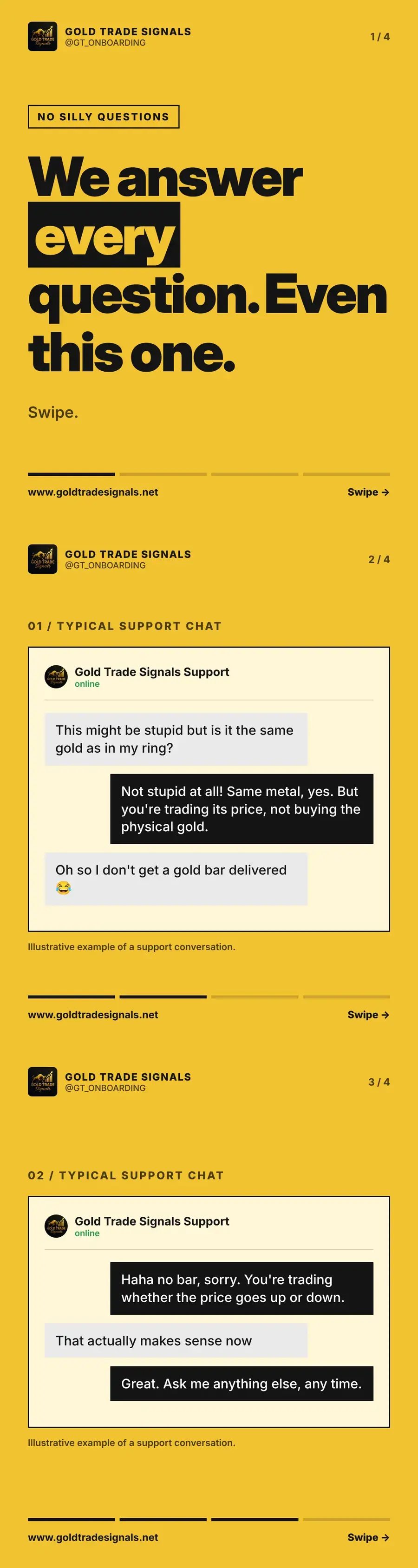
No question is too small: what our support chat is really like
Is the gold you trade the same as the gold in your ring? We answer every question, even that one. Here is what support should feel like for a new trader.
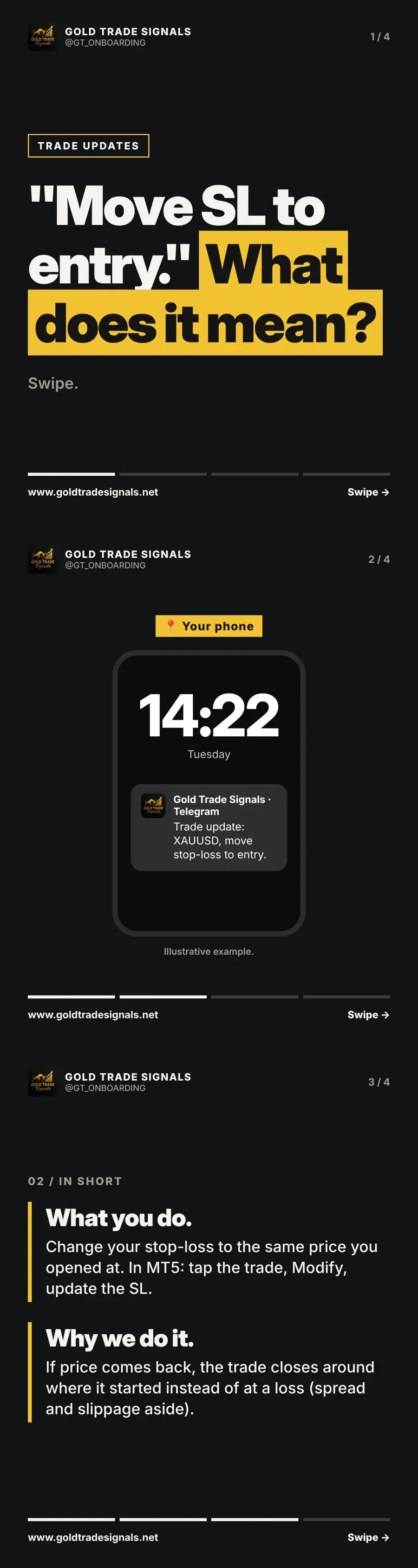
Move stop-loss to entry: what the trade update means
One of the most common trade updates is move stop-loss to entry. We explain what it means, how to do it in MT5 and why it protects an open gold trade.