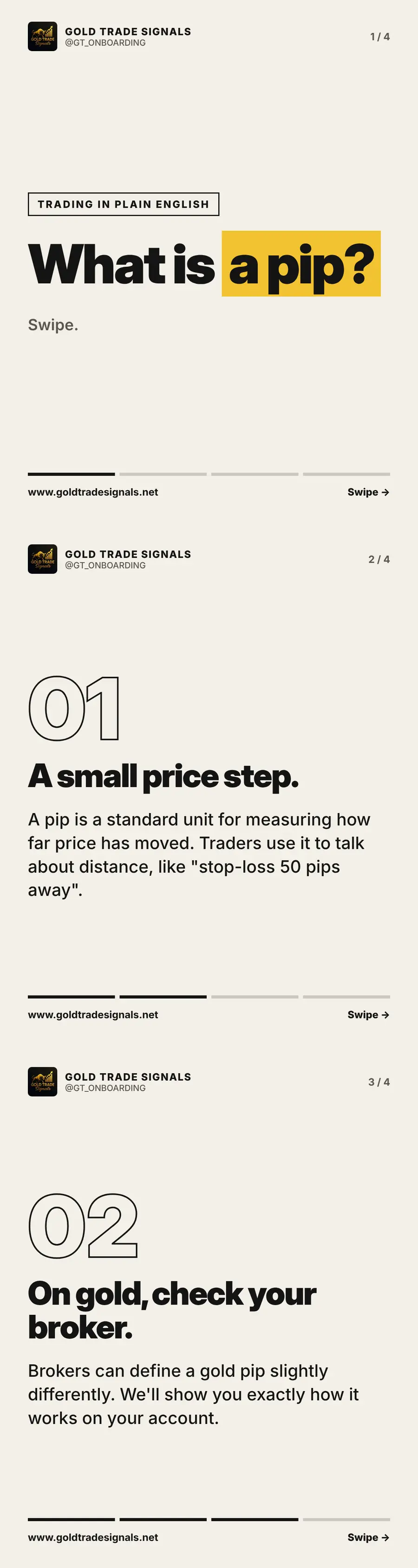
Pip is one of the first words you will hear in any trading conversation. Traders use it to describe how far price has moved, how far away a stop-loss sits, and how much a trade made or lost. Here is what it means and how it applies to gold.
A pip is a small step in price
A pip is a standard unit for measuring how far price has moved. Instead of quoting the exact price every time, traders talk in pips: "my stop-loss is 50 pips away" or "gold moved 200 pips this morning". It is simply a shared language for distance on the chart, in the same way that a runner talks in metres rather than describing every stride.
The reason this matters is that pips connect directly to risk. Once you know how many pips sit between your entry and your stop-loss, and how much each pip is worth at your lot size, you know exactly how much money is on the line before you open the trade. That is the whole point of thinking in pips: it turns a vague feeling into a number.
On gold, check how your broker defines it
Gold is quoted in US dollars per ounce, usually to two decimal places, such as 2,350.45. Brokers do not all agree on which decimal counts as a pip. Some treat a move of 0.10 as one pip, others use 0.01, and some talk in points instead. The same price move can therefore be described as 10 pips on one platform and 100 on another.
Before you place a trade, open your broker's contract specification for XAUUSD and look at how the pip and the pip value are defined. Then size your trade from that, not from a figure you read elsewhere. When new members join our free community we walk through this on their own account, so the numbers on screen match the plan.
Key takeaways
- A pip is a standard unit for measuring price movement.
- Pips connect your stop-loss distance to the money at risk.
- Gold pip definitions vary by broker, so check your contract specification.
Common questions
How much is one pip worth in gold?
It depends on your broker's definition and your lot size. Check the XAUUSD contract specification on your platform, then multiply the pip size by your position size.
Is a pip the same as a point on gold?
Not always. Many brokers call the smallest price step a point and a larger step a pip, so always confirm which one your platform uses.
Trade ideas with the levels already worked out
Join the free community and receive XAU/USD trade ideas with entry, stop-loss and take-profit, live training on Tuesdays and Thursdays, and support whenever you are stuck.
Join free on TelegramOpen the calculatorsRisk warning: This article is educational content, not personal investment advice. Gold is a leveraged, volatile instrument and you can lose some or all of your capital. Gold Trade Signals is not FCA regulated. Read the full risk warning.
More from Trading Basics
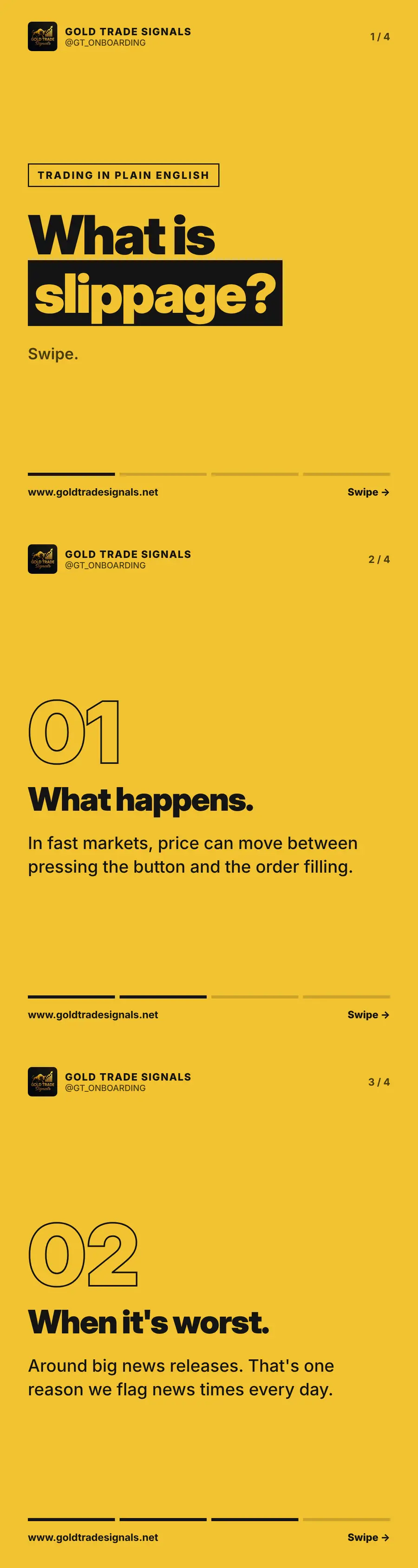
What is slippage? Why your trade filled at a different price
Slippage is the gap between the price you clicked and the price you got. Learn why it happens, when it is worst, and how gold traders plan around it.

Why your MT5 trade history is a free trading teacher
Your MetaTrader 5 history records every trade you have made. Learn what to look for in a weekly review and how patterns in your own trading jump out.
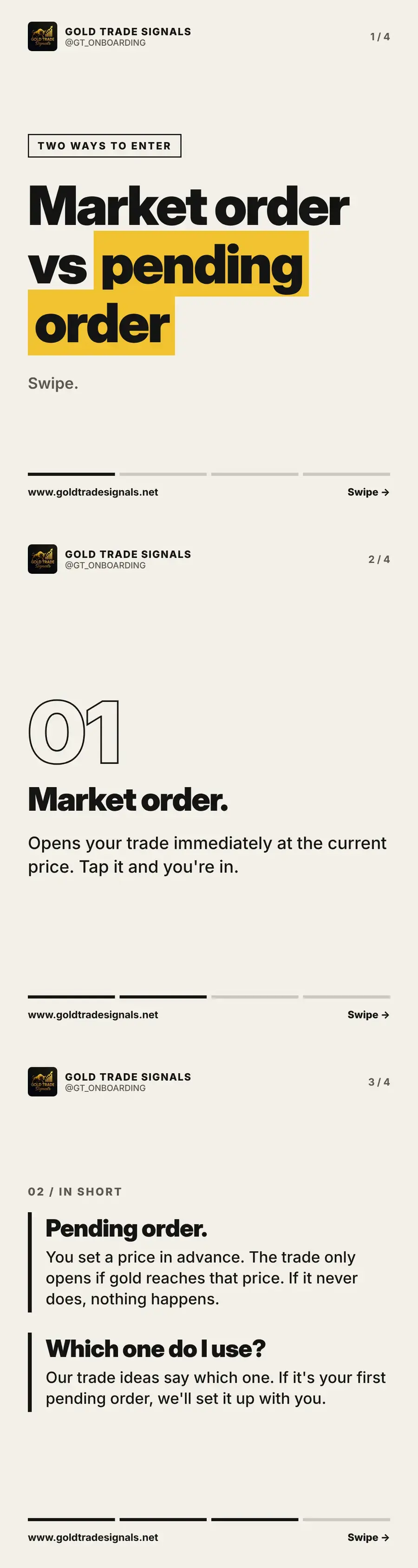
Market order vs pending order: two ways to enter a trade
A market order opens your trade now at the current price. A pending order waits for a price you set. Learn the difference and which one our ideas use.