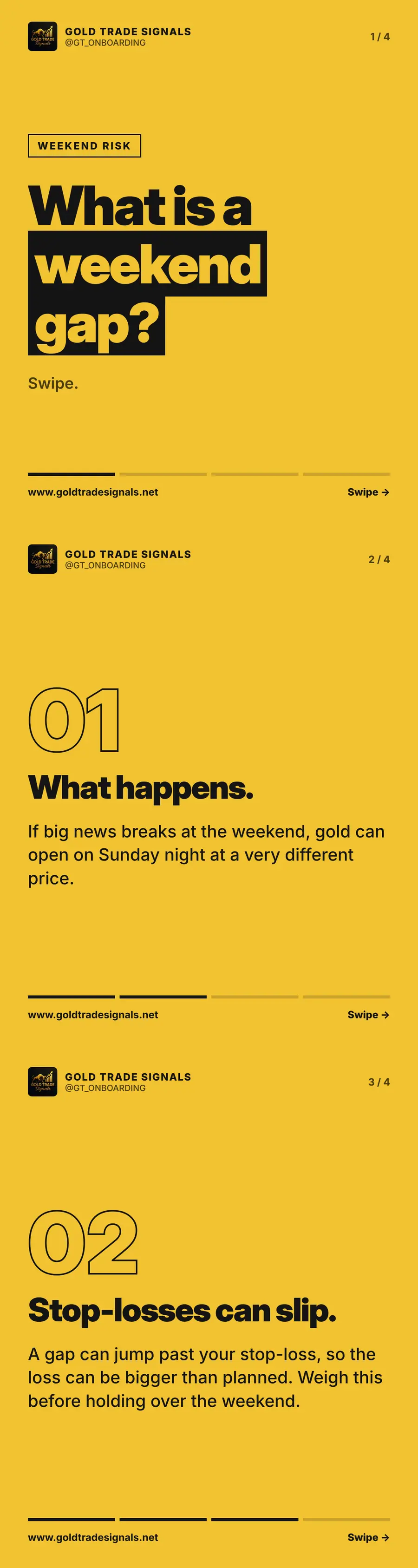
Gold stops trading on Friday evening and starts again on Sunday evening. In between, the world keeps turning. If something important happens over those two days, the first price on Sunday night can be a long way from Friday's close. That jump is called a weekend gap, and every gold trader should understand it.
What happens
During the week, price moves tick by tick and your platform updates constantly. Over the weekend there are no ticks. When the market reopens, the first trades reflect everything that happened since Friday: political news, economic announcements, a crisis somewhere. If sentiment has shifted, the opening price simply appears at the new level, leaving an empty space on the chart.
Most weekends the gap is small or nonexistent. Occasionally it is large, and those occasions tend to coincide with exactly the kind of news that makes people want to hold gold or dump it. You cannot predict which weekend will be the one, which is why the risk needs to be weighed every Friday rather than only after a shock.
Stop-losses can slip
A stop-loss is an instruction to close your trade at a given price. It can only be filled at a price that actually trades. If gold gaps past your stop-loss over the weekend, the first available price is on the other side of it, and your trade is closed there. The loss can be noticeably bigger than you planned.
This does not make stop-losses pointless, far from it. It means weekend exposure is a decision to make deliberately. Ask whether the position size is one you would be comfortable with if the gap went against you, and consider closing or reducing before Friday's close if not. We flag notable weekend risk in the community when the calendar calls for it.
Key takeaways
- A weekend gap is the jump between Friday's close and Sunday's open.
- Big weekend news can open gold far from where it closed.
- Stop-losses fill at the next available price, so losses can exceed the plan.
Common questions
Why did gold open at a different price on Sunday?
Because news during the weekend shifted sentiment while the market was closed, so the first price on Sunday reflected the new view.
Does a stop-loss protect me from a weekend gap?
Only partly. It closes the trade at the first available price after the gap, which can be worse than the level you set.
Trade ideas with the levels already worked out
Join the free community and receive XAU/USD trade ideas with entry, stop-loss and take-profit, live training on Tuesdays and Thursdays, and support whenever you are stuck.
Join free on TelegramOpen the calculatorsRisk warning: This article is educational content, not personal investment advice. Gold is a leveraged, volatile instrument and you can lose some or all of your capital. Gold Trade Signals is not FCA regulated. Read the full risk warning.
More from Gold by Numbers
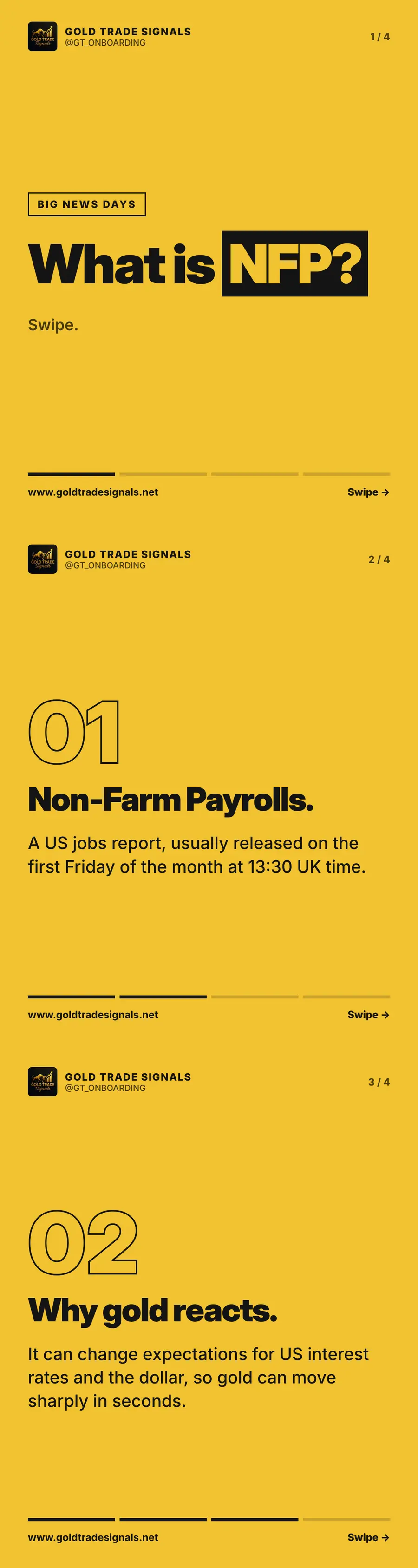
What is NFP? The US jobs report that moves gold fast
Non-Farm Payrolls is the monthly US jobs report, usually released on the first Friday at 13:30 UK time. Learn what it measures and why gold can move sharply.
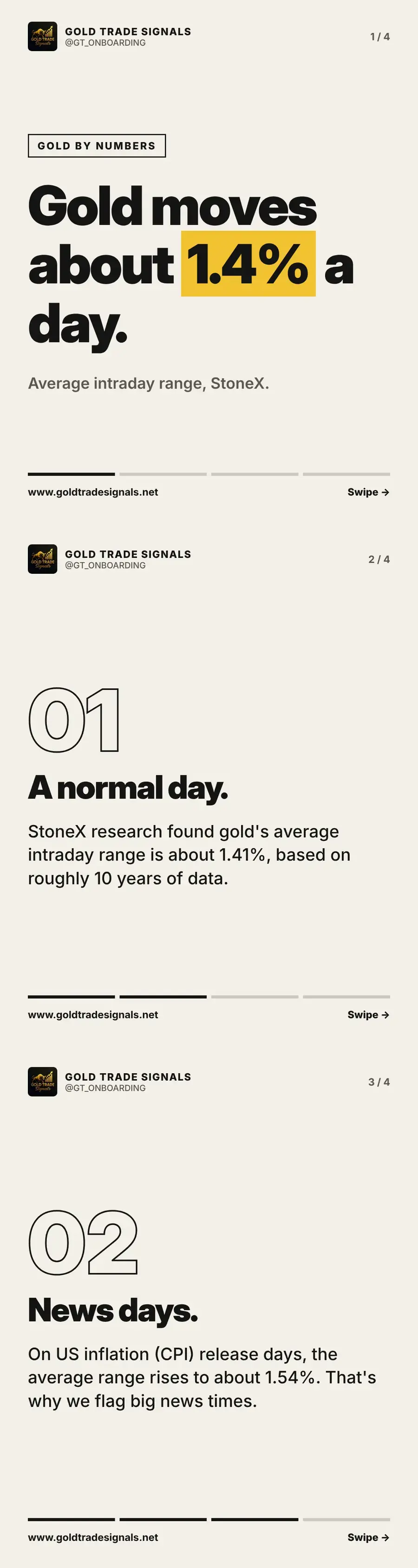
How much does gold move in a day? About 1.4% on average
StoneX research puts gold's average intraday range at about 1.41%, rising to about 1.54% on US inflation days. We explain what that means for your risk.
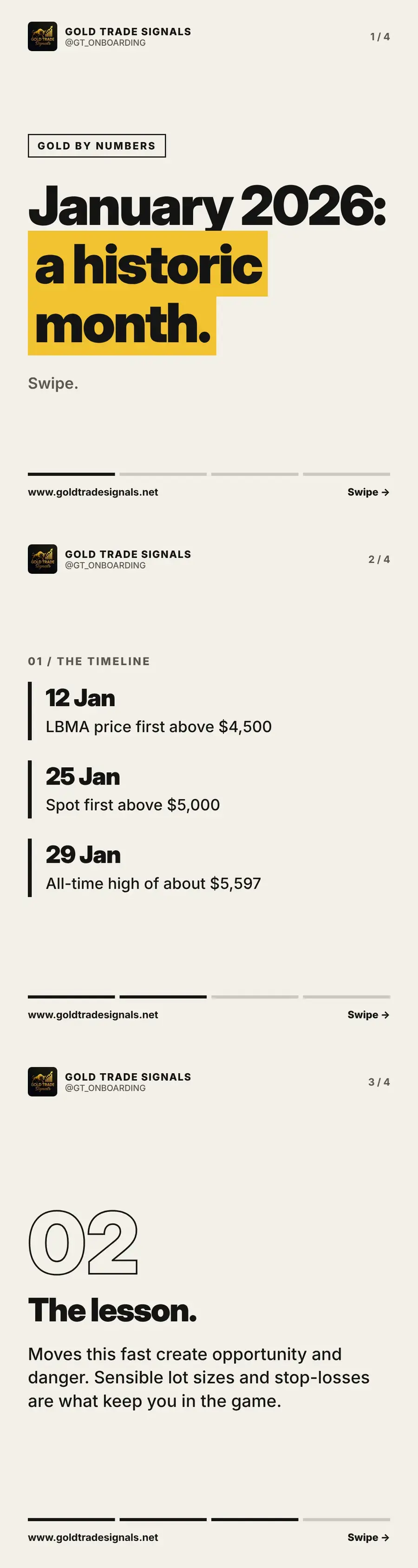
Gold's record January 2026: $4,500 to over $5,500 in two weeks
In January 2026 gold went from above $4,500 to a record of about $5,597 in about two weeks. We set out the timeline and the lesson for fast markets.