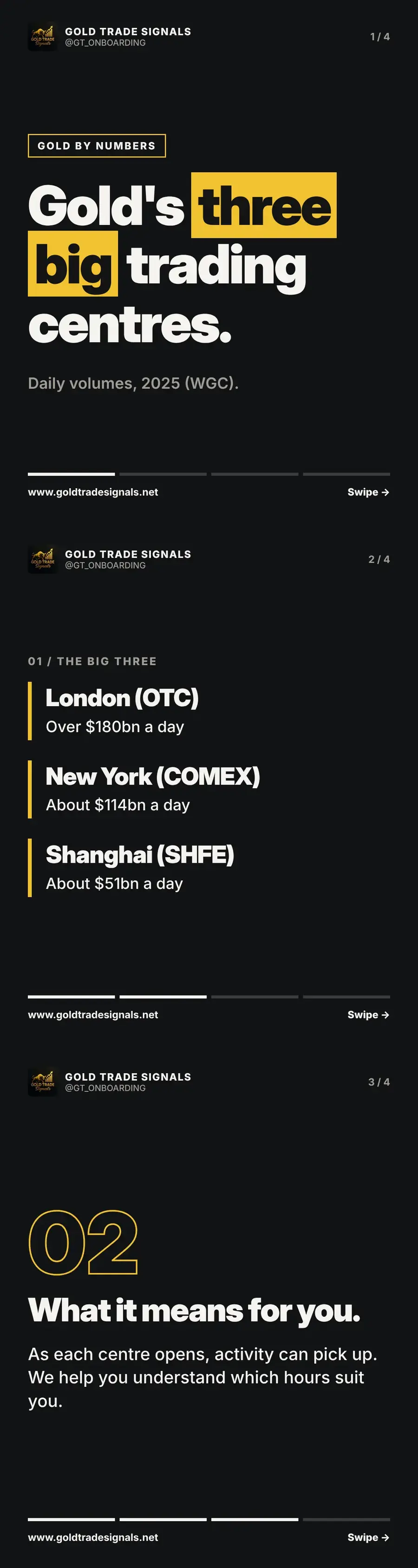
Where does the world's gold actually trade? Three centres dominate: London, New York and Shanghai. Daily volumes from the World Gold Council for 2025 show how they compare, and knowing when each one is active helps you work out which hours of the day suit your own trading.
The big three by daily volume
London, trading over the counter (OTC), handles over $180bn of gold a day, making it the largest centre by a clear margin. New York, through the COMEX futures exchange, trades about $114bn a day. Shanghai, through the Shanghai Futures Exchange (SHFE), trades about $51bn a day. These are 2025 daily volumes from the World Gold Council.
What it means for you
As each centre opens, activity in gold can pick up. Shanghai is active during the Asian morning, London through the European day, and New York from the US morning onwards, with the London and New York overlap often the busiest stretch. More activity can mean faster moves and clearer levels, but also sharper swings, so it suits some traders better than others.
Find your trading hours
You do not need to be awake for all three. Most members pick the session that fits their day, whether that is the London open before work or the New York session in the evening, and learn how gold tends to behave in those hours. We help you understand which hours suit you, and every trade idea we send includes an entry, a stop-loss and a take-profit whatever the session.
Key takeaways
- London (OTC) trades over $180bn of gold a day.
- New York (COMEX) about $114bn, Shanghai (SHFE) about $51bn a day.
- Activity picks up as each centre opens; pick hours that suit you.
Common questions
Where is most gold traded?
London, over the counter, with more than $180bn a day in 2025 according to the World Gold Council, followed by New York and Shanghai.
What are the best hours to trade gold?
Activity often picks up as London and New York open. The best hours are the ones you can trade calmly and consistently.
Trade ideas with the levels already worked out
Join the free community and receive XAU/USD trade ideas with entry, stop-loss and take-profit, live training on Tuesdays and Thursdays, and support whenever you are stuck.
Join free on TelegramOpen the calculatorsRisk warning: This article is educational content, not personal investment advice. Gold is a leveraged, volatile instrument and you can lose some or all of your capital. Gold Trade Signals is not FCA regulated. Read the full risk warning.
More from Gold by Numbers
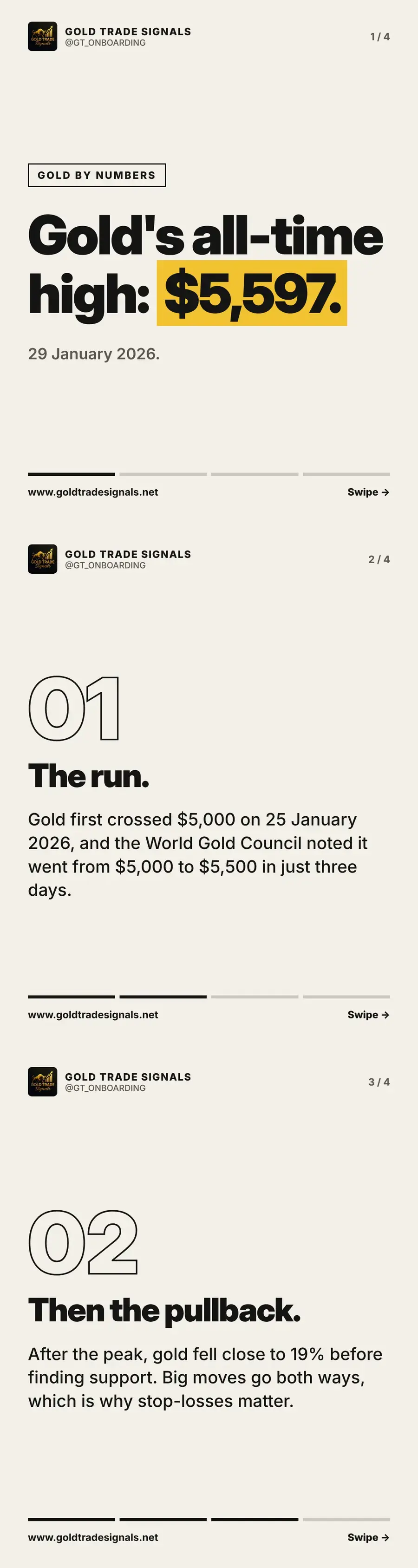
Gold's all-time high: about $5,597 an ounce on 29 January 2026
Gold hit a record of about $5,597 an ounce on 29 January 2026, days after first crossing $5,000. We look at the run, the pullback and the lesson for you.
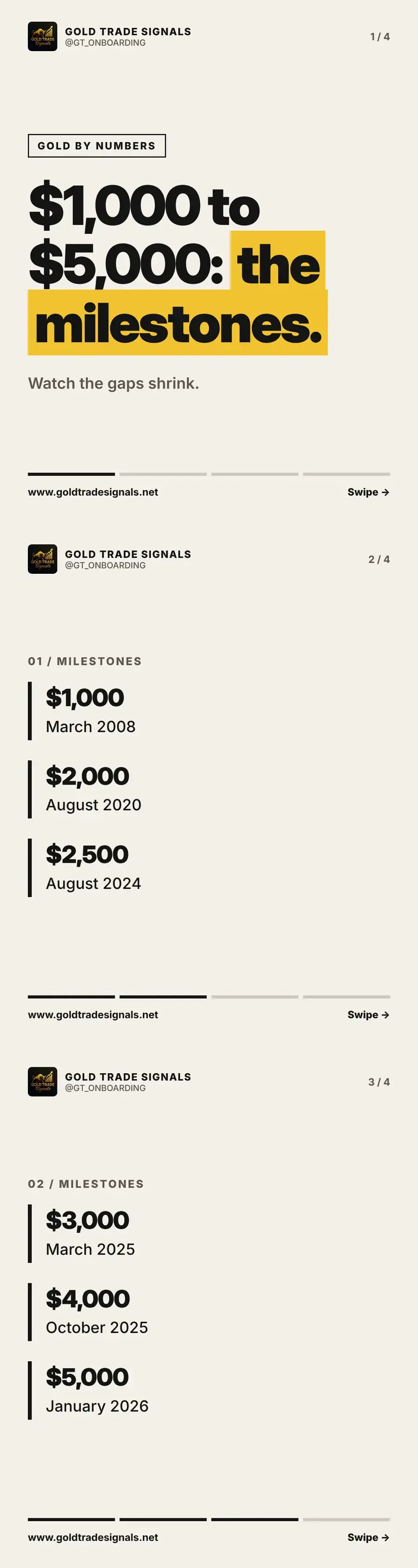
Gold price milestones: when gold crossed $1,000 to $5,000
From $1,000 in March 2008 to $5,000 in January 2026: the dates gold crossed each round-number milestone, and why the gaps between them kept shrinking.
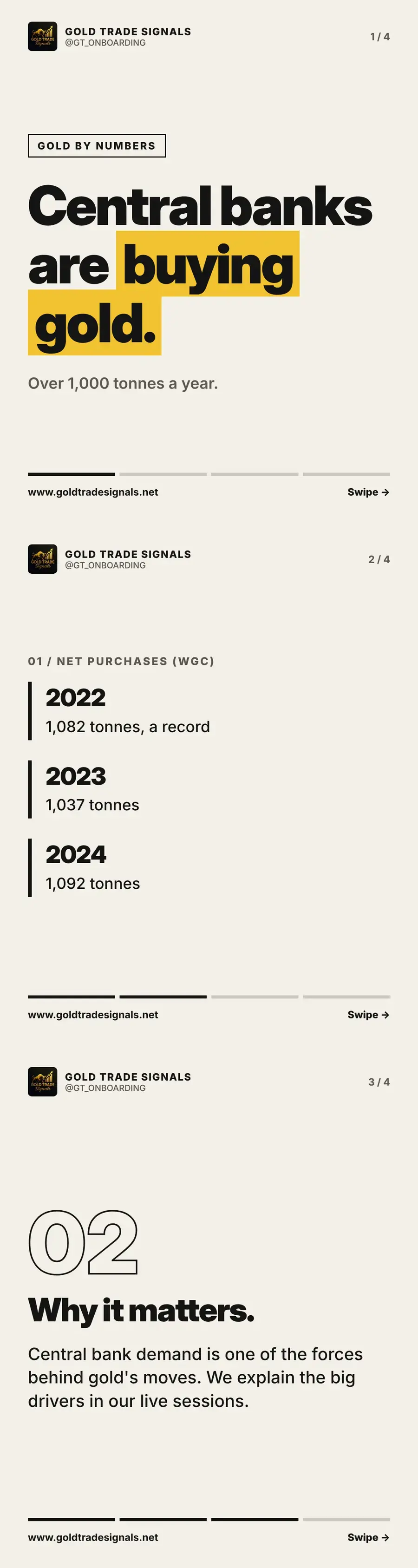
Central banks are buying gold: over 1,000 tonnes a year
Central banks bought over 1,000 tonnes of gold a year in 2022, 2023 and 2024, says the World Gold Council. We explain the figures and why they matter.