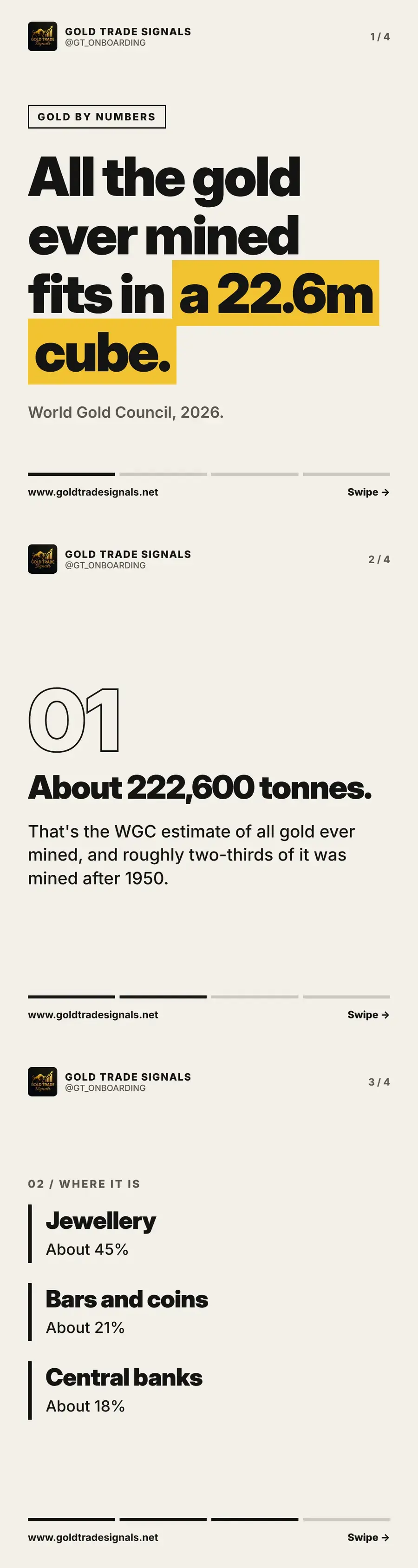
All the gold ever mined would fit in a cube about 22.6 metres wide. That is a surprisingly small object for a metal that moves markets. In this article we look at the World Gold Council's estimate of total gold ever mined, how recently most of it was dug up, and where it all sits today.
About 222,600 tonnes
The World Gold Council's 2026 estimate puts all the gold ever mined at about 222,600 tonnes. Roughly two-thirds of it was mined after 1950, which means most of the world's gold was extracted within a single human lifetime. Because gold does not corrode or decay, almost all of it still exists in some form, from ancient jewellery to freshly cast bars in a vault.
Where it is
The largest share, about 45%, is jewellery. Bars and coins held by private investors account for about 21%. Central banks hold about 18% in their official reserves. The remainder is spread across industrial uses, technology and other holdings. These proportions help explain gold's behaviour: it is partly a consumer good, partly a private investment and partly a reserve asset, all at once.
Why it matters for a trader
A limited, slowly growing supply held by very different kinds of owners is part of what gives gold its character as a market. Jewellery demand, investor flows and central bank buying each respond to different pressures, and together they shape the price you see on the XAUUSD chart. If you want to learn the gold market with us, understanding where the gold is turns out to be a useful place to start.
Key takeaways
- About 222,600 tonnes of gold have ever been mined (WGC, 2026)
- Roughly two-thirds of it was mined after 1950
- About 45% jewellery, 21% bars and coins, 18% central banks
Common questions
How much gold is there in the world?
The World Gold Council estimates about 222,600 tonnes have ever been mined, which would fit in a cube about 22.6 metres wide.
Who owns most of the world's gold?
Jewellery accounts for about 45%, private bars and coins about 21%, and central banks about 18%, according to the WGC.
Trade ideas with the levels already worked out
Join the free community and receive XAU/USD trade ideas with entry, stop-loss and take-profit, live training on Tuesdays and Thursdays, and support whenever you are stuck.
Join free on TelegramOpen the calculatorsRisk warning: This article is educational content, not personal investment advice. Gold is a leveraged, volatile instrument and you can lose some or all of your capital. Gold Trade Signals is not FCA regulated. Read the full risk warning.
More from Gold by Numbers
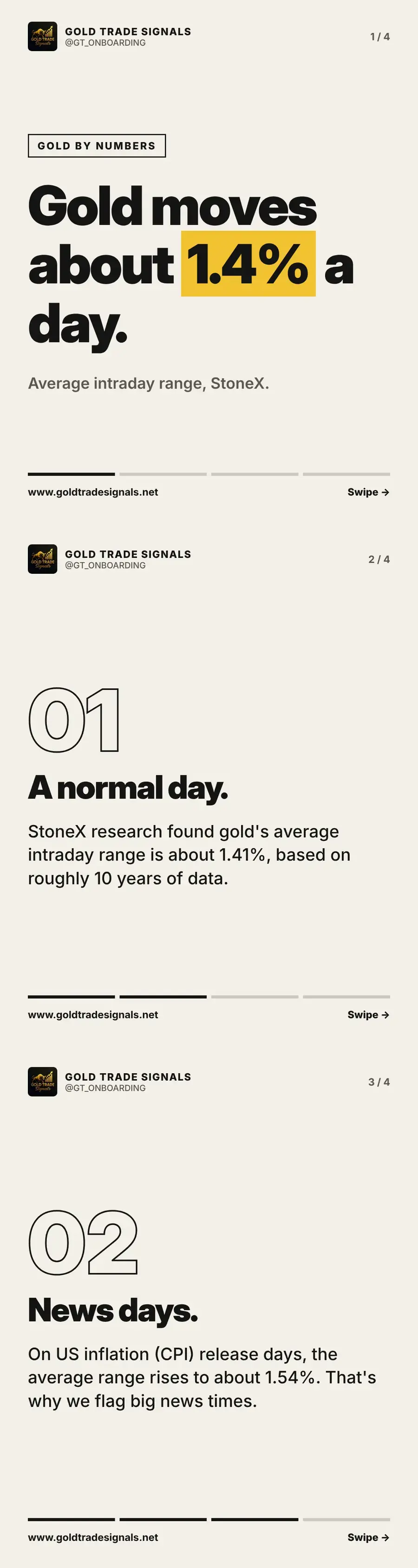
How much does gold move in a day? About 1.4% on average
StoneX research puts gold's average intraday range at about 1.41%, rising to about 1.54% on US inflation days. We explain what that means for your risk.
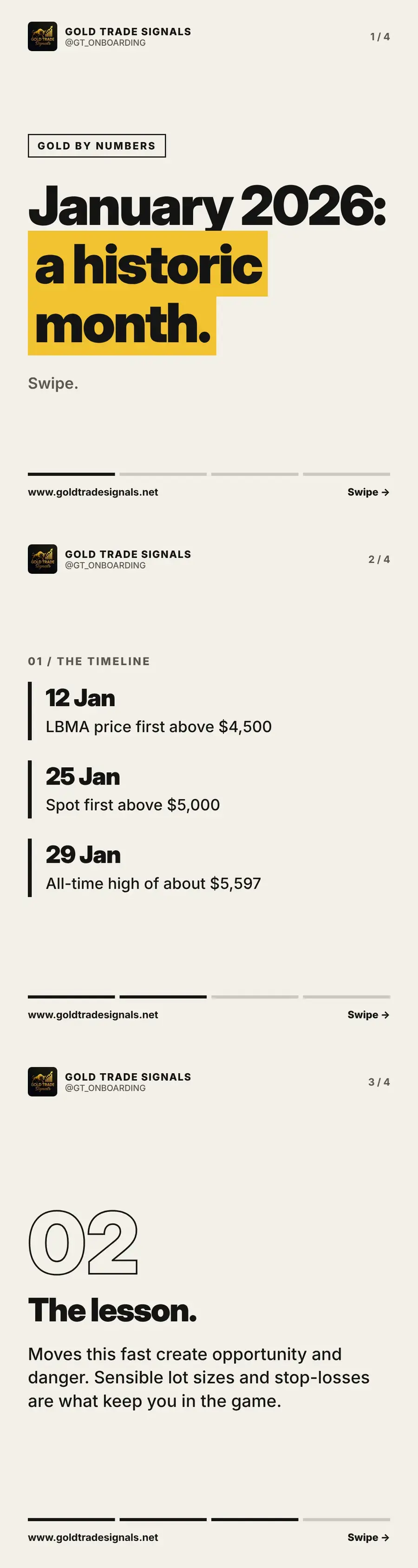
Gold's record January 2026: $4,500 to over $5,500 in two weeks
In January 2026 gold went from above $4,500 to a record of about $5,597 in about two weeks. We set out the timeline and the lesson for fast markets.
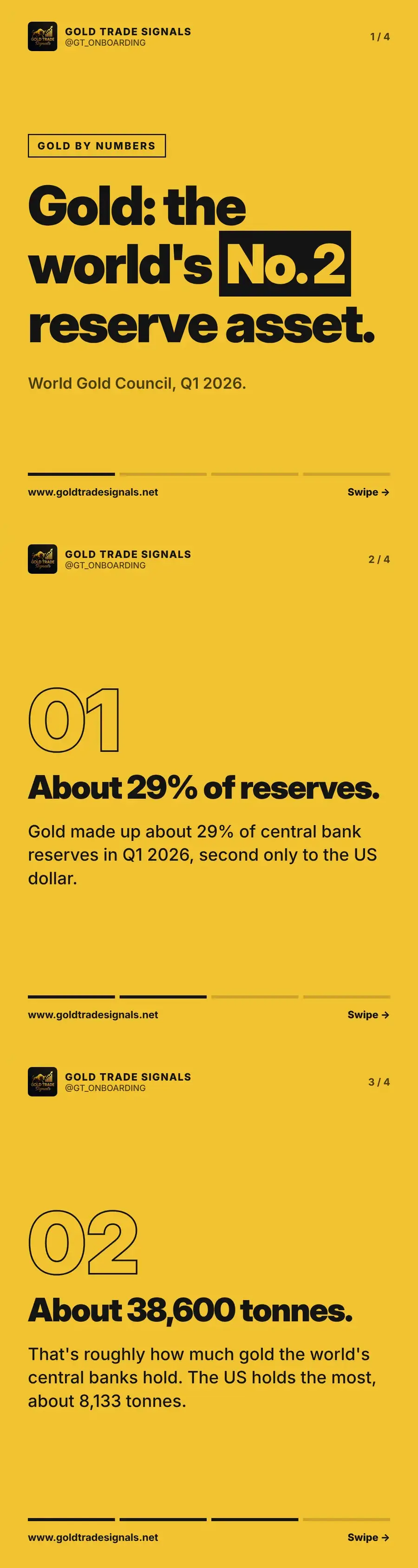
Gold is the world's second-largest reserve asset
Gold was about 29% of central bank reserves in Q1 2026, second only to the US dollar, with roughly 38,600 tonnes held worldwide. What it means for traders.