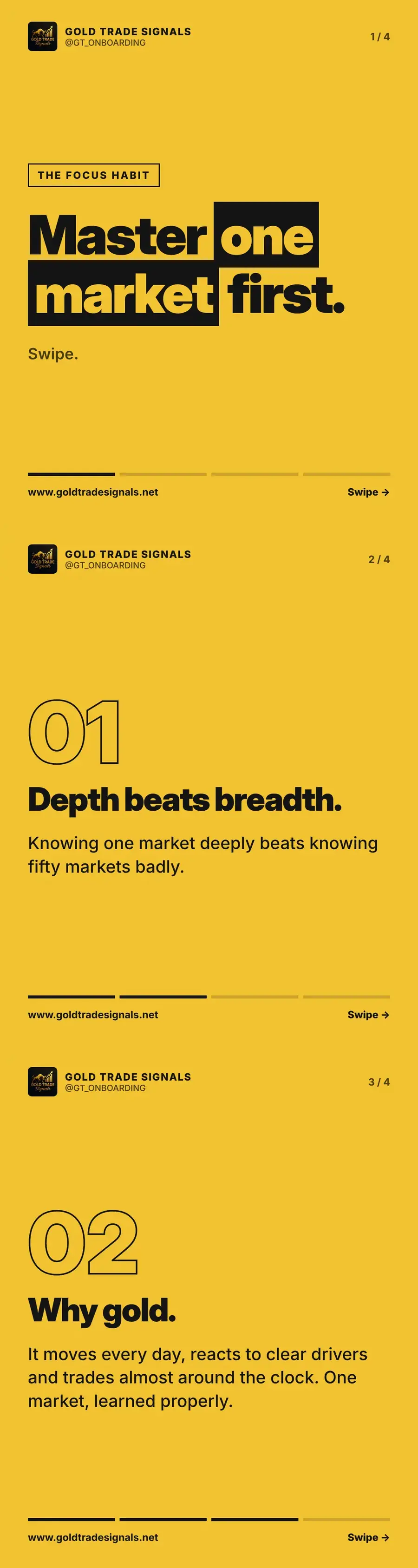
Successful traders tend to share a habit: they master one market before touching anything else. This article explains why depth beats breadth, why spreading yourself across fifty markets slows learning to a crawl, and why gold is the single market we have chosen to learn and teach properly.
Depth beats breadth
Knowing one market deeply beats knowing fifty markets badly. Each market has its own rhythm, its own news drivers and its own typical daily range. Learning those takes months of watching the same chart. Hop between markets and you never accumulate that knowledge; every day feels like day one. Focus is not a limitation, it is how expertise is built in trading as in anything else.
Why gold
Gold moves every day, so there is always something to learn from and usually a setup worth considering. It reacts to clear drivers, such as the US dollar, interest rate expectations and major news, which makes the cause of a move easier to understand. And it trades almost around the clock on weekdays, so it fits most schedules. One market, learned properly.
One market, learned properly
Every trade idea we send is on XAUUSD, and every live training session is about reading the gold chart. That repetition is deliberate. After a few weeks you begin to recognise how gold behaves around the London and New York opens and around news, and that recognition is the start of real skill. Master gold with us before you think about anything else.
Key takeaways
- Knowing one market deeply beats knowing fifty badly
- Gold moves daily, reacts to clear drivers and trades almost round the clock
- Repetition on one chart is how recognition and skill develop
Common questions
Should beginners trade multiple markets?
No. Mastering one market first builds real understanding. Spreading attention across many markets slows learning and multiplies mistakes.
Why is gold a good market for beginners?
It moves every day, reacts to clear drivers and trades almost around the clock on weekdays, so there is always something to learn and a session that fits your schedule.
Trade ideas with the levels already worked out
Join the free community and receive XAU/USD trade ideas with entry, stop-loss and take-profit, live training on Tuesdays and Thursdays, and support whenever you are stuck.
Join free on TelegramOpen the calculatorsThe traders featured are not affiliated with, and do not endorse, Gold Trade Signals. Their results are exceptional, not typical.
Risk warning: This article is educational content, not personal investment advice. Gold is a leveraged, volatile instrument and you can lose some or all of your capital. Gold Trade Signals is not FCA regulated. Read the full risk warning.
More from Trader Stories and Habits
Patience in trading: no setup means no trade
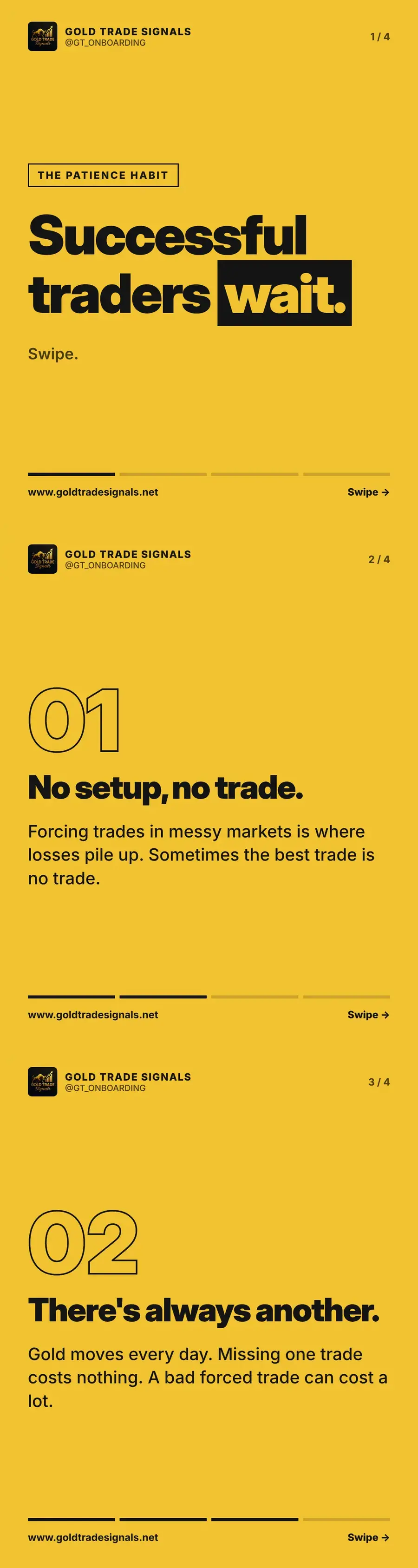
Successful traders wait for the right trade. Forcing trades in messy markets is where losses pile up, and gold moves every day, so there is always another.
Jim Simons: the maths professor who ignored his emotions
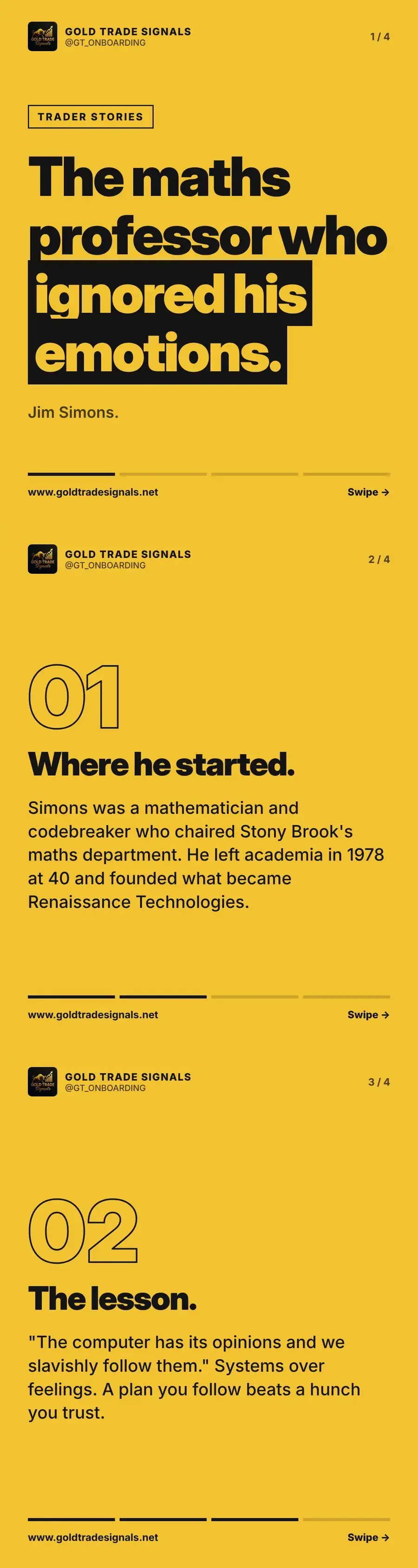
Jim Simons left academia at 40 to found Renaissance Technologies and let systems, not feelings, make the decisions. The lesson for gold traders is simple.
Alexander Elder: the psychiatrist who became a trader
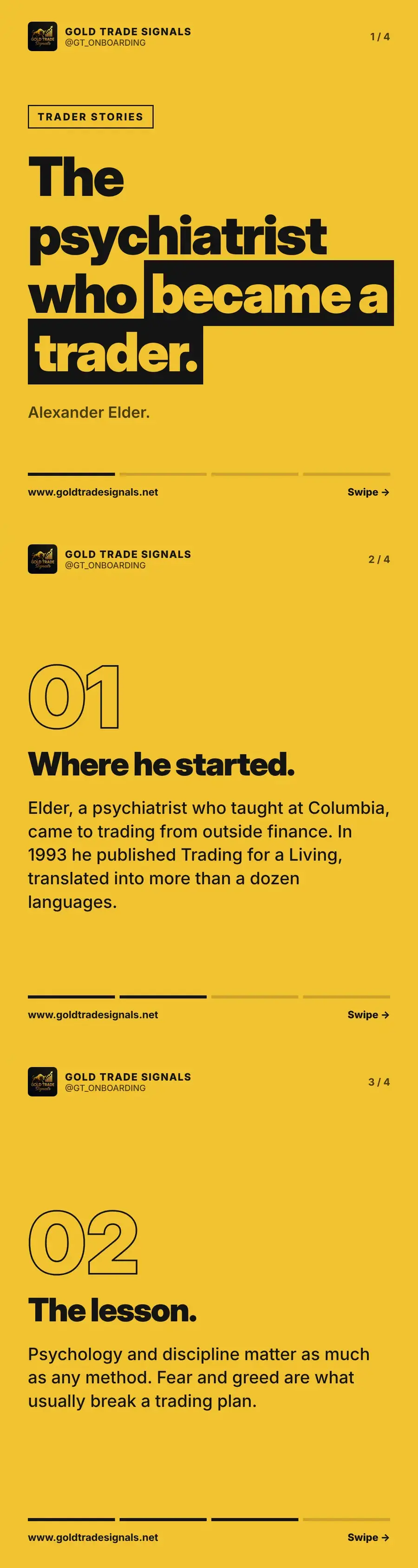
Alexander Elder came to trading from psychiatry and wrote Trading for a Living in 1993. His lesson: psychology and discipline matter as much as any method.