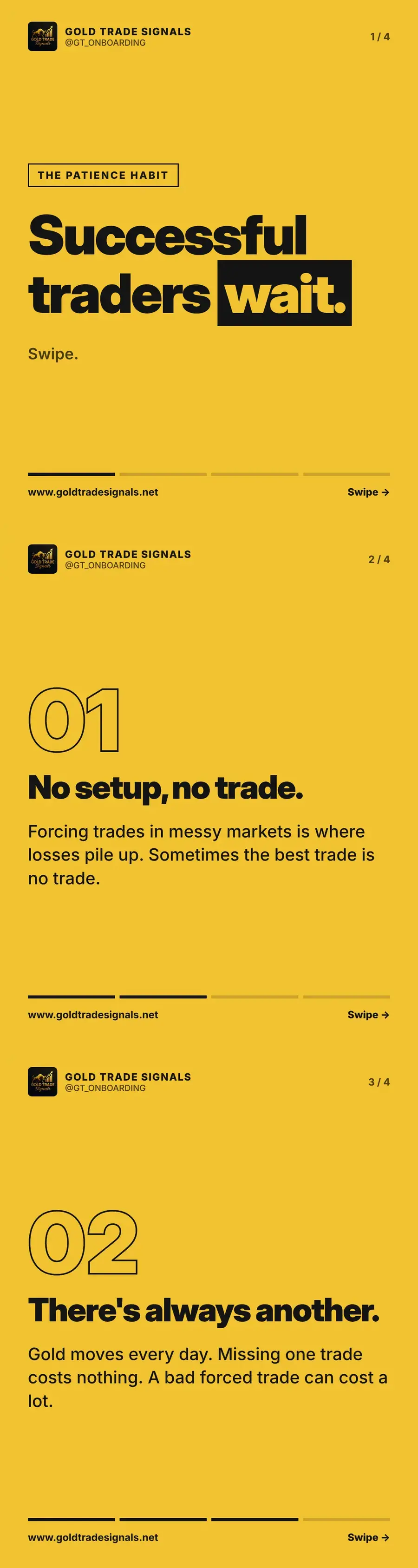
Successful traders are patient. They wait for the right trade, and when the market is messy they do nothing at all. This article explains why forcing trades is where losses pile up, why missing a move costs nothing and how to build the patience to say no setup, no trade.
No setup, no trade
Forcing trades in messy markets is where losses pile up. When price is choppy and nothing matches your rules, the urge to do something anyway is strong, especially after a quiet morning. Resist it. Sometimes the best trade is no trade. A rulebook that covers entry, exit and size is only useful if you are willing to sit out when none of the conditions are met.
There is always another
Gold moves every day. Missing one trade costs nothing: the account is the same size as it was, and another setup will arrive, often within hours. A bad forced trade, by contrast, can cost a lot, both in money and in the frustration that leads to revenge trading. The maths of patience is simple. The cost of waiting is zero. The cost of forcing is real.
Building the habit
Patience is easier with structure. Trade a fixed window each day rather than watching all of it, and set a rule that you only act on ideas meeting every condition. Our trade ideas help here, because each one is a complete plan with entry, stop-loss and take-profit, and when there is no proper setup, we send nothing. Trade with patience, and let the market come to you.
Key takeaways
- Forcing trades in messy markets is where losses pile up
- Missing a trade costs nothing: gold moves every day
- Only act when every condition of your rules is met
Common questions
Why is patience important in trading?
Because most losses come from forced trades taken out of boredom or frustration. Waiting for a proper setup keeps you out of the messy conditions where accounts get hurt.
What should you do when there is no trade setup?
Nothing. Close the chart, wait for the next proper setup and remember that gold moves every day, so another opportunity is never far away.
Trade ideas with the levels already worked out
Join the free community and receive XAU/USD trade ideas with entry, stop-loss and take-profit, live training on Tuesdays and Thursdays, and support whenever you are stuck.
Join free on TelegramOpen the calculatorsThe traders featured are not affiliated with, and do not endorse, Gold Trade Signals. Their results are exceptional, not typical.
Risk warning: This article is educational content, not personal investment advice. Gold is a leveraged, volatile instrument and you can lose some or all of your capital. Gold Trade Signals is not FCA regulated. Read the full risk warning.
More from Trader Stories and Habits
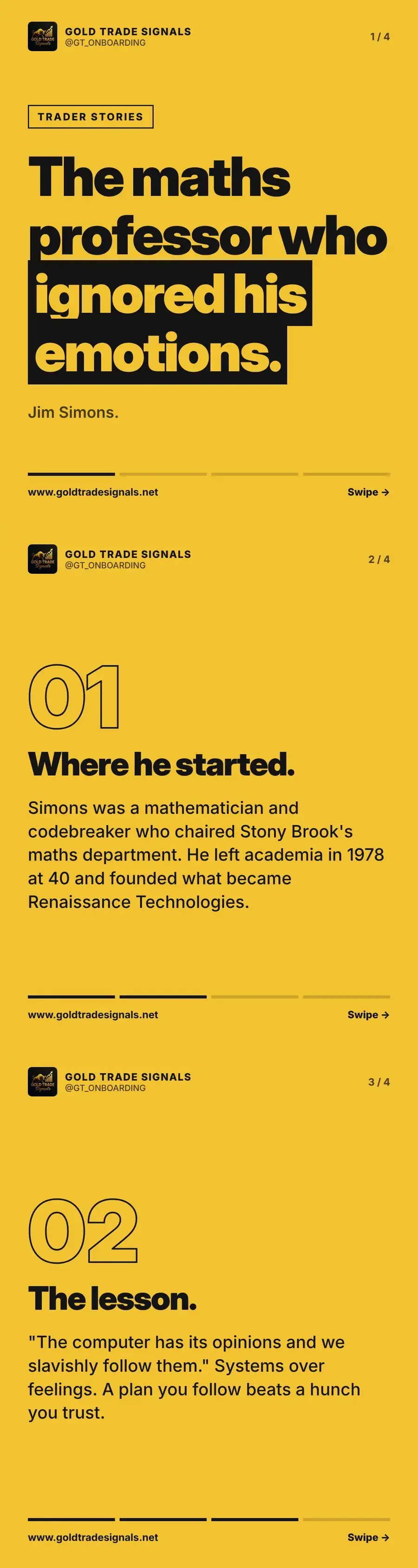
Jim Simons: the maths professor who ignored his emotions
Jim Simons left academia at 40 to found Renaissance Technologies and let systems, not feelings, make the decisions. The lesson for gold traders is simple.
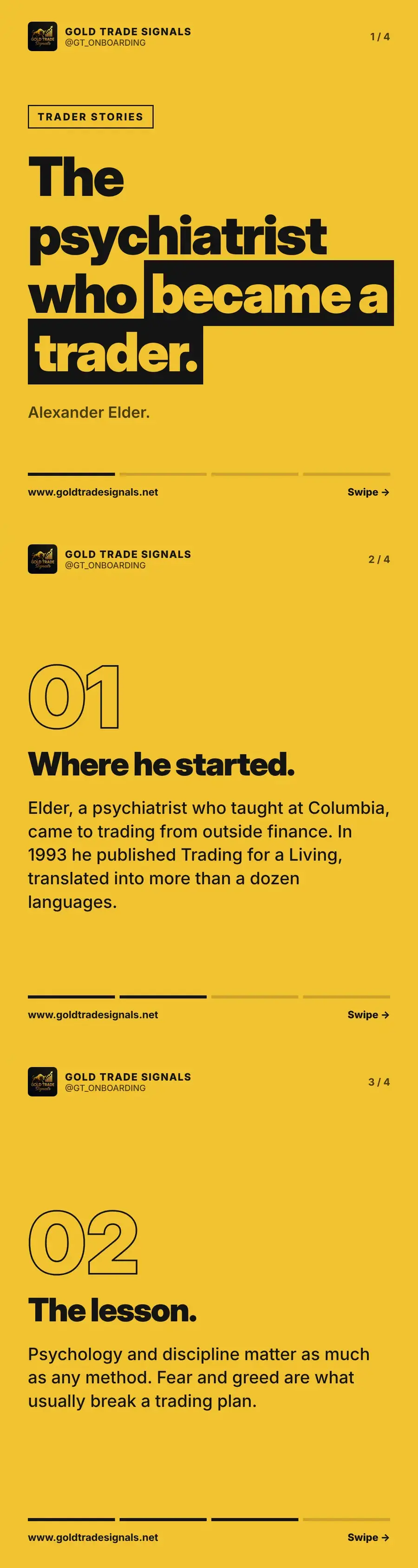
Alexander Elder: the psychiatrist who became a trader
Alexander Elder came to trading from psychiatry and wrote Trading for a Living in 1993. His lesson: psychology and discipline matter as much as any method.
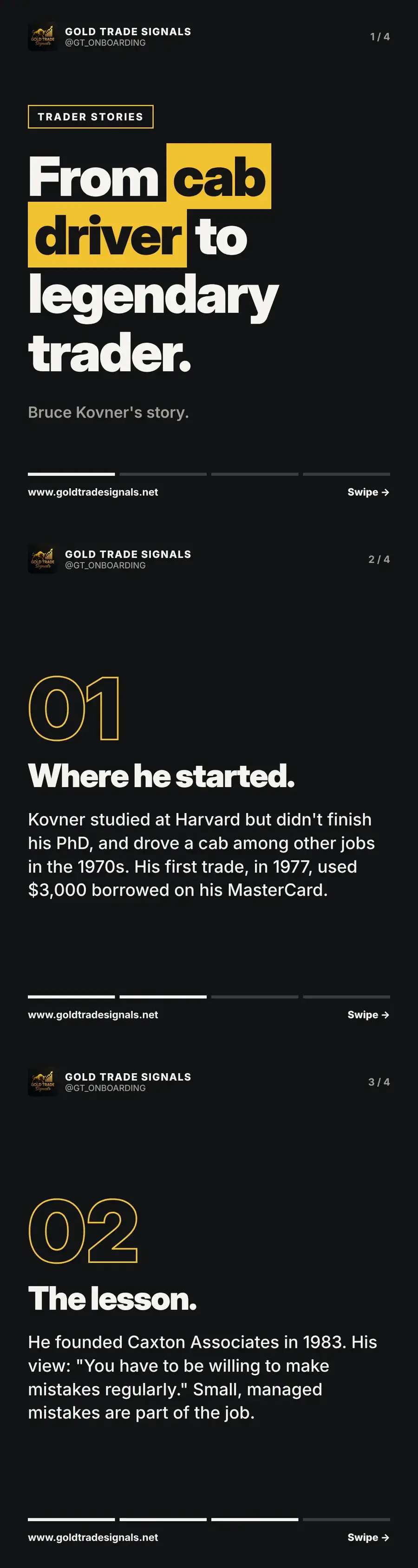
Bruce Kovner: from cab driver to legendary trader
Bruce Kovner drove a cab, made his first trade in 1977 with $3,000 borrowed on a credit card, and founded Caxton Associates. His lesson for gold traders.