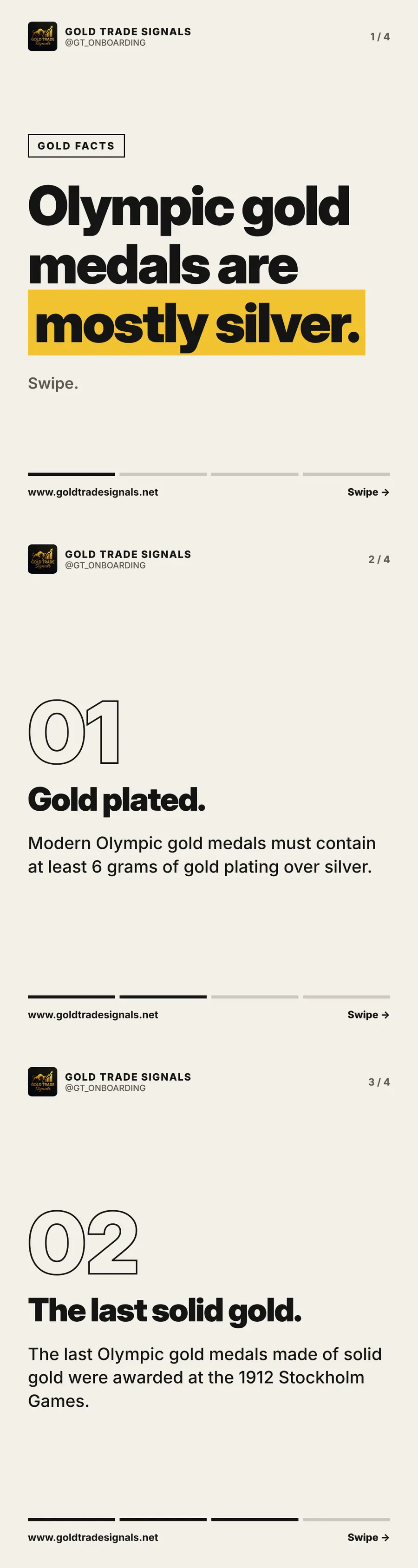
Stand on the top step of an Olympic podium and the medal around your neck is called gold. Weigh it, melt it, and you would find it is mostly silver. The last Olympic medals made of solid gold were handed out more than a century ago. Here is the story, and what it says about gold itself.
Gold plated, not solid gold
Under the International Olympic Committee's rules, a modern gold medal must be made of silver and plated with at least six grams of pure gold. Six grams is a thin layer. The rest of a medal weighing several hundred grams is silver, which is why its melt value is far lower than many people assume.
Host cities design their own medals within those rules, so size and weight vary from Games to Games, but the six-gram minimum has stayed. A solid gold medal of the same size would cost tens of thousands of dollars each at today's prices, and with hundreds awarded at each Games, the bill would be enormous.
The last solid gold medals
The last Olympic gold medals made entirely of gold were awarded at the 1912 Stockholm Games. Even then, they were small. After that, rising costs and the growing size of the Games made solid gold impractical, and the plated design became standard.
For a gold trader, the detail is a nice reminder of why the metal commands the price it does: it is scarce enough that even the Olympics cannot afford to give it away in bulk. That scarcity, alongside its role in money and policy, is part of what keeps XAU/USD moving. We share more gold facts like this in the community.
Key takeaways
- Modern gold medals are silver plated with at least six grams of gold.
- The last solid gold medals were awarded at Stockholm 1912.
- Gold's scarcity is part of why it holds its value.
Common questions
Are Olympic gold medals real gold?
Only partly. They are made of silver and plated with at least six grams of pure gold, so the gold content is a small fraction of the medal's weight.
When were the last solid gold Olympic medals awarded?
At the 1912 Stockholm Games. Since then, gold medals have been silver with a gold plating.
Trade ideas with the levels already worked out
Join the free community and receive XAU/USD trade ideas with entry, stop-loss and take-profit, live training on Tuesdays and Thursdays, and support whenever you are stuck.
Join free on TelegramOpen the calculatorsRisk warning: This article is educational content, not personal investment advice. Gold is a leveraged, volatile instrument and you can lose some or all of your capital. Gold Trade Signals is not FCA regulated. Read the full risk warning.
More from Gold by Numbers
The California Gold Rush of 1848: what really happened
Gold was found at Sutter's Mill in January 1848 and around 300,000 people headed to California. What happened, and how it compares with gold trading today.
Why London is the centre of the global gold market
London has been a gold hub for centuries. Learn how the LBMA price benchmark works, what the Bank of England keeps in its vaults, and why it matters.
The first gold coins: ancient Lydia and the birth of money
Discover where the first gold coins were struck, why ancient Lydia matters to gold's story, and how that history connects to trading XAU/USD today.